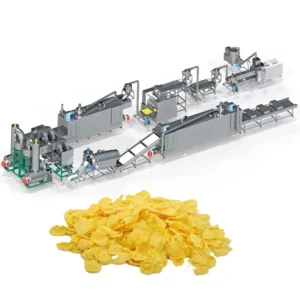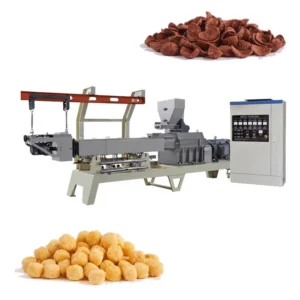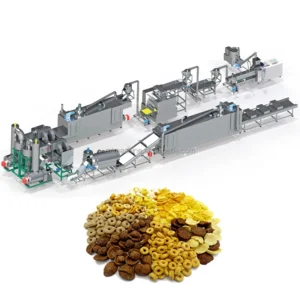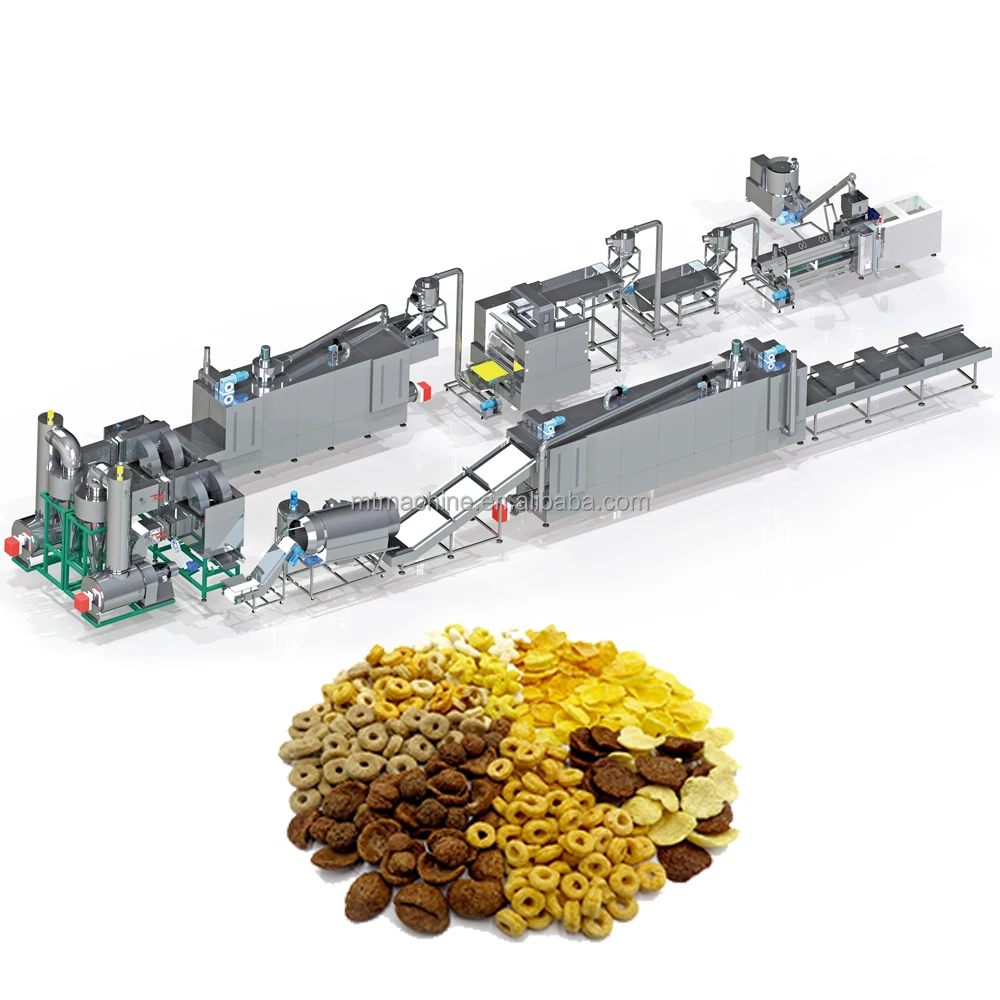
Screw Geometry First — Screw configuration and die design are specified to the buyer’s actual cereal raw material before the MT75 is built, preventing the texture failures generic catalogue defaults cause.
Technical Specifications
| Parameter | Value |
|---|---|
| Model | MT75 |
| Product Type | Twin Screw Corn Flake Extruder |
| Installed Power | 210 kW |
| Power Consumption | 150 kW |
| Output Capacity | 300–500 kg/h (basis not stated in source — confirm raw material, moisture, pellet size) |
| Overall Dimensions (L×W×H) | 45 × 1.5 × 3.5 m |
| Screw Type | Twin Screw |
| Control System | PLC, MCC |
| Barrel Heating | Electric (zoned) |
| Line Stations | Mixing → Extruding → Flaking → Drying → Hot Air Roasting → Sugar Coating → Cooling → Packing |
| Flaking Unit | Hydraulic double-roller, dual motors, PLC controlled, infrared temperature sensor |
| Dryer Heating Source | Gas / Electric |
| Hot Air Roasting Oven | Conciliation burner, dual circulating fans, cyclone dust removal |
| Coating System | Double tumble sugar melter, elevator, coating drum, spraying nozzle |
| Assembly State | Complete line |
| Voltage & Frequency | Customized per destination (basis not stated in source — confirm voltage / frequency / phase) |
| Language Options | (basis not stated in source — confirm HMI language) |
| Standards | CE, ISO certified |
Application Suitability
| Application | Material or Output |
|---|---|
| Natural corn flakes | Corn grits, corn flour |
| Sugar-coated corn flakes | Corn, rice, sugar syrup coating |
| Honey-coated breakfast flakes | Corn, rice, wheat, honey glaze |
| Variant cereal shapes | Ball, tube, stick, ring, fruit loop, star, wheel, flower, heart (via die change) |
| Multigrain flakes | Oat, barley, wheat, rice powders blended with corn |
Why "500 kg per Hour" Means Nothing Without the Raw Material
Capacity on a nameplate is only as honest as the formulation behind it.
I once spent two extra weeks in a buyer’s plant because the corn flakes extrusion technology twin screw line ran fine on standard corn grits during factory acceptance, but when the buyer switched to a high-fibre whole-grain recipe on day one, gelatinisation temperatures shifted, expansion collapsed, and the flakes came out hard and brittle. The screw configuration and die geometry had been set to a generic build [NEED_CITE: starch gelatinisation temperature variance across cereal formulations]. Throughput dropped, density went out of spec, and we had to reconfigure the entire screw profile and barrel temperature zones from scratch. Extrusion geometry must be matched to the actual raw material, not a catalogue default.
Barrel Temperature Zones and Starch Gelatinisation Control
The MT75 barrel uses multi-zone electric heating controlled through the PLC, allowing operators to set distinct temperature profiles along the screw length. Corn starch gelatinises within a narrow window, and any overshoot in the mid-barrel zone causes premature expansion that collapses at the die. Each zone is tuned to the buyer’s specific moisture content and flour blend, so corn flakes extrusion technology twin screw processing holds consistent expansion from the first hour of a shift to the last.
Die Design and Pellet Geometry Before Flaking
The die plate determines pellet shape, size and wall thickness before the material ever reaches the flaking rollers. A pellet that is too thick will not flatten into a flake with the right bowl-life; one that is too thin shatters under the hydraulic double-roller pressure. Die geometry is specified to the buyer’s target flake thickness and final crispness, then validated during the in-house trial run.
Reading the Parameter Sheet Like a Process Engineer
The 210 kW installed power and 150 kW operating consumption reflect the energy needed to maintain shear and temperature across a twin-screw barrel processing cereal dough at continuous output. The 45 m line footprint covers every station from mixing through packing, meaning throughput must be balanced at each stage — extruder, flaker, dryer, roaster, coater — to avoid material backing up at any point. The hydraulic double-roller flaking unit with infrared temperature sensing keeps flake thickness consistent even as ambient workshop conditions shift. The hot air roasting oven uses a conciliation burner with dual circulating fans and cyclone dust removal to deliver even surface bubbling, which is what gives corn flakes their characteristic crispness [NEED_CITE: hot air circulation uniformity in cereal roasting ovens].
The Hidden Cost of Skipping the Trial Run
Buyers who waive the raw-material trial run to save time often discover the problem after the line is bolted to their factory floor. A screw combination that works on standard corn flour may produce dense, glassy pellets on a high-bran recipe, forcing the flaking rollers to crack rather than flatten. The dryer then over-dries the fractured pieces, and the roaster cannot recover the texture. Weeks of production are lost to reformulation trials that should have happened in the testing workshop before shipment [NEED_CITE: pre-shipment extrusion trial run protocols].
Why Source This Line Here
Screw configuration and die design are specified to the buyer’s raw material and target flake density, not copied from a standard template. The in-house testing workshop runs the buyer’s actual formulation before shipment, documenting expansion, moisture and density at each station. The PLC-controlled flaking unit and roasting oven are integrated by the same supplier that builds the extruder, so throughput is matched across every station rather than assembled from separate vendors. Electrical schematics confirm voltage, frequency and HMI language before production begins, preventing commissioning delays. Twin-screw expertise covers the full cereal range — corn, rice, wheat, oat, barley — so formulation changes do not require a new machine.
Documentation & Verification
- Line layout showing throughput balance across extruder, flaker, dryer, roaster and coater
- Screw and die configuration record matched to your cereal formulation
- Trial run report on your raw material documenting expansion and density
- Electrical schematic with confirmed voltage, frequency and control language
- CE declaration of conformity and ISO certificate
- Wear parts list covering screws, dies and flaking roller sleeves
Installation, Commissioning & Support
- Foundation plan sized to the 45 × 1.5 × 3.5 m line footprint with anchor point layout
- Dedicated power circuit rated for 210 kW installed load with confirmed voltage and phase
- Modular station delivery with sequenced assembly to match workshop access constraints
- First-run parameter tuning on buyer’s raw material with PLC recipe storage
- Operator training covering barrel zone settings, flaking pressure and roaster fan balance
- Spare screw elements, die plates and roller sleeves stocked against the wear parts list
Preparing Your Inquiry
To configure the corn flakes extrusion technology twin screw line accurately, provide the raw material formulation including moisture percentage, the target flake thickness and density, and the intended coating type. Confirm your workshop voltage, frequency and phase, along with any HMI language requirement. If you have existing upstream mixers or downstream packing equipment, share their throughput so the line can be balanced to your actual plant conditions.
Frequently Asked Questions
Q: How is screw configuration selected for a specific cereal formulation?
A: The screw elements are arranged based on your raw material’s starch content, fibre level and target moisture. High-fibre blends need different shear and compression ratios than pure corn grits. Configuration is finalised after a trial run on your actual material, and the record is kept for future reference and reorder.
Q: How are barrel temperature zones tuned for corn flake expansion?
A: Each zone along the barrel is set independently through the PLC to control where gelatinisation and expansion occur. Operators adjust the profile based on the trial run data to hold consistent pellet density, then store the recipe for repeat production across shifts.
Q: What does the in-house trial run cover before shipment?
A: The trial uses your raw material in the testing workshop and documents expansion ratio, pellet density, moisture content and flake thickness at each station. Results are shared in a written report so you can verify product quality before the line leaves the factory.
Q: How is throughput balanced between the extruder and downstream stations?
A: The flaker, dryer, roaster and coating drum are each sized so material flow matches the extruder output. The line layout calculation confirms no station creates a bottleneck, and the trial run validates continuous operation at the rated throughput range.