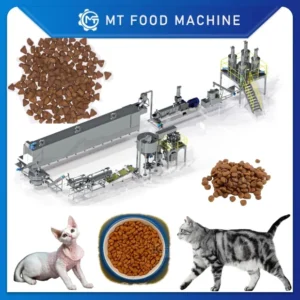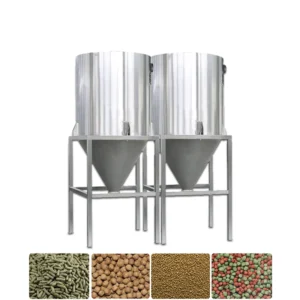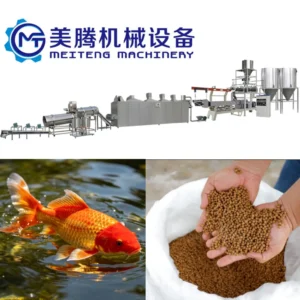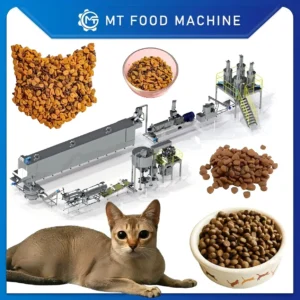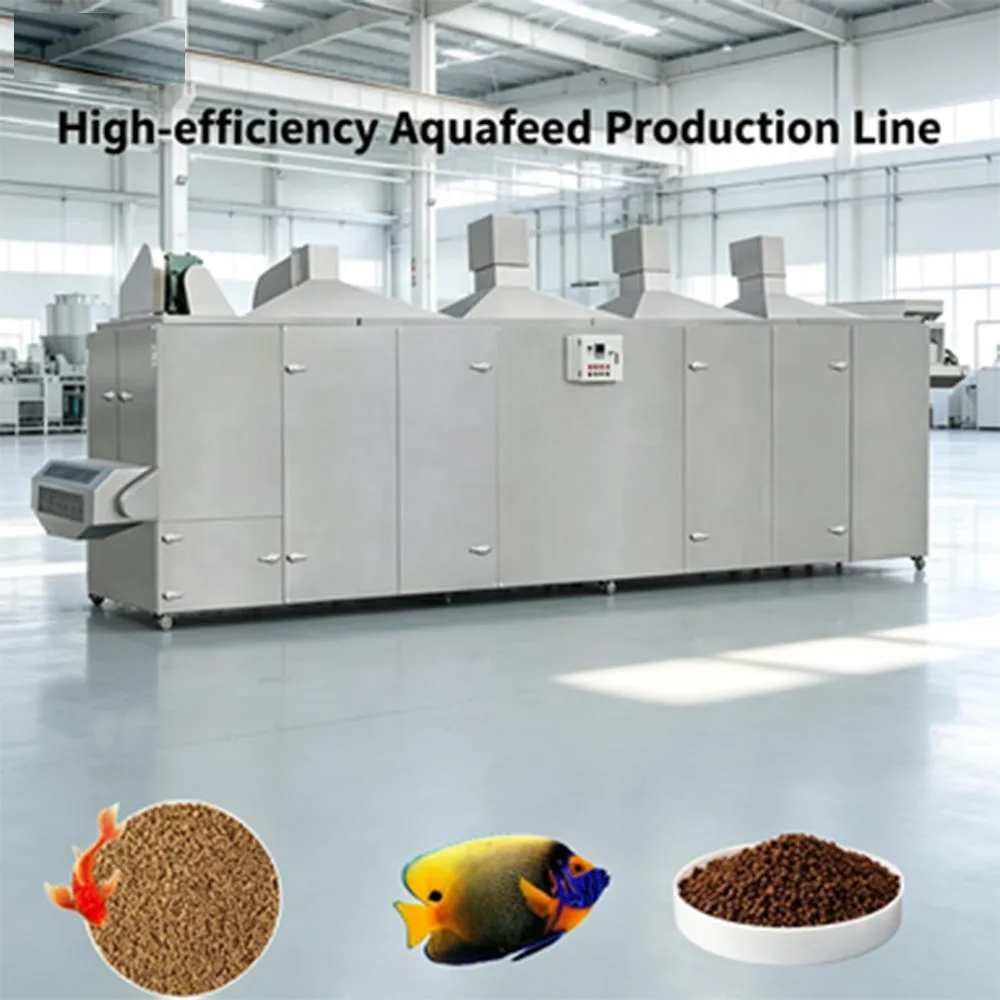
Thermal Profile Integrity — Drying parameters are matched to the specific twin-screw die output and formulation rather than set to a generic curve, validated through in-house trial runs on the buyer’s actual raw material before shipment.
Technical Specifications
| Parameter | Value |
|---|---|
| Product Type | Tunnel Type Fish Feed Pellet Dryer |
| Machine Type | Continuous tunnel dryer |
| Construction Material | Food grade 304 stainless steel (body and contact parts) |
| Control System | PLC automatic control |
| Operating Mode | Continuous working, long-time uninterrupted operation |
| Assembly State | Integrated into matched line (mixer, extruder, dryer, coating, sieve, conveyor) |
| Heating System | Optimized energy-saving transmission and heating design |
| Maintenance Design | Quick replacement of vulnerable parts, convenient daily cleaning |
| Application Scope | Medium to large scale industrial aquatic feed mass production |
| Output Capacity | Basis to be confirmed (dependent on pellet size, moisture target, and extruder throughput) |
| Rated Power | Basis to be confirmed |
| Voltage & Frequency | Basis to be confirmed |
| Overall Dimensions | Basis to be confirmed |
Application Suitability
| Application | Material or Output |
|---|---|
| Floating fish feed drying | Pellets extruded from fish meal, soybean meal, corn flour requiring buoyancy retention |
| Sinking aquatic feed drying | High-density pellets for bottom-feeding species requiring controlled moisture reduction |
| Koi and goldfish feed production | Multi-size pellet batches with varying diameter and surface finish requirements |
| Tropical fish feed processing | Small-diameter pellets demanding gentle, uniform heat distribution |
| Compound additive integration | Formulations incorporating heat-sensitive nutritional supplements post-extrusion |
Why the Moisture Reduction Curve Matters More Than the Barrel Temperature
Floating feed that sinks is rarely an extrusion problem — it is a drying problem.
The twin-screw extruder establishes the pellet’s expansion structure, starch gelatinisation level, and internal cell matrix. But the dryer is what locks those characteristics in or destroys them. When temperature zones are set without reference to the specific formulation entering the belt, surface moisture evaporates too quickly, forming a hardened shell that traps steam inside. The pellet collapses, density climbs, and what was designed to float ends up on the tank floor. I have watched entire production batches of floating feed fail quality checks not because the screw configuration was wrong, but because the dryer’s residence time and zone temperatures were never calibrated to that particular recipe’s moisture migration rate. fish feed pellet dryer extrusion technology specifications must account for the exact raw material behaviour coming off the die. [NEED_CITE: moisture migration dynamics in extruded aquatic feed pellets]
Preserving the Expansion Structure Set by the Screw
Once pellets exit the die, the gelatinised starch matrix is still thermally active. The first dryer zone must apply heat gently enough to begin surface moisture removal without shocking the outer layer. Food grade 304 stainless steel contact surfaces ensure that no corrosion products or surface degradation interfere with the pellet exterior during this critical window. The thermal profile in these early zones determines whether the internal cell structure remains open and buoyant or begins to collapse under uneven stress.
Zone Profiling Through PLC Automation
The PLC control system allows operators to define independent temperature and airflow settings across multiple drying zones. This means the fish feed pellet dryer extrusion technology specifications can be programmed to match a slow, graduated moisture curve for a high-fat koi formulation or a more aggressive profile for a lean corn-based floating pellet. Each zone’s parameters are stored as retrievable recipes, so switching between formulations does not mean starting from scratch. [NEED_CITE: PLC recipe management in continuous food processing dryers]
Reading the Specifications Against Your Extruder Output
The energy-saving heating system is designed for consistent heat distribution across the full belt width, which matters when pellet loading density varies. If the extruder’s die produces a wide spread of pellet sizes, uneven drying can occur in units with poor lateral airflow. The continuous uninterrupted operation design maintains steady-state thermal conditions, so pellets entering the dryer at a constant rate experience the same environment as those that entered an hour earlier. The stainless steel mesh belt allows airflow from both above and below, reducing the chance of a wet underside that would affect coating adhesion downstream.
The Hidden Cost of a Mismatched Dryer Station
A dryer specified only by its nominal throughput, without being matched to the extruder’s actual output and the formulation’s drying kinetics, creates a bottleneck that no upstream adjustment can fix. Pellets that are under-dried arrive at the coating drum with excess surface moisture, causing oil and flavouring to slough off. Over-dried pellets become brittle, generating excessive fines at the vibrating sieve. Both outcomes represent product that fails specification and must be reprocessed or discarded. [NEED_CITE: post-extrusion moisture targets for commercial aquatic feed]
Engineering Matched to Your Actual Production Conditions
Every drying parameter is developed against trial runs on your specific raw material blend, not a reference recipe. The screw and die configuration record from the extruder is cross-referenced with dryer zone settings, so the thermal profile accounts for the exact moisture content, expansion ratio, and pellet geometry leaving the die. The line layout and capacity calculation confirms the dryer’s belt width and residence time align with extruder throughput rather than creating a choke point. Electrical schematics and voltage are confirmed for your facility before production begins, preventing commissioning delays. The in-house testing workshop runs your material through the complete drying cycle, generating a trial run report that documents achievable moisture levels and final pellet density.
Documentation & Verification
- Trial run report on your raw material documenting moisture reduction and pellet density after drying
- Screw and die configuration record cross-referenced with dryer temperature zone settings
- Electrical schematic and voltage confirmation matching your facility’s supply before production
- Line layout and capacity calculation showing dryer throughput matched to extruder output
- CE declaration of conformity and ISO certificate for the complete line configuration
Installation, Commissioning & Support
- Foundation and floor space planning based on confirmed dryer dimensions and belt length
- Dedicated power circuit sized to the dryer’s rated heating load and PLC control requirements
- Assembly of dryer sections on site with belt tension and alignment verified before first run
- Temperature zone calibration and recipe programming during commissioning using your material
- Operator training on PLC interface, recipe storage, and daily cleaning of stainless steel contact surfaces
- Wear parts list covering mesh belt sections, heating elements, and seals for scheduled maintenance
What to Include in Your Inquiry
Provide the formulation you plan to run, including primary protein sources, starch content, and target fat percentage after coating. Specify whether your target products are floating, sinking, or slow-sinking, and the pellet diameter range you need. Confirm your facility’s voltage, frequency, and preferred PLC control language so that electrical and interface specifications are locked before production.
Frequently Asked Questions
Q: How is the dryer’s temperature profile matched to the twin-screw extruder’s die output?
A: The extruder’s screw configuration and die design determine the pellet’s moisture content, expansion ratio, and surface characteristics as it enters the dryer. Zone temperatures and belt speed are then calibrated through trial runs to achieve the target final moisture without collapsing the internal cell structure that was established during extrusion.
Q: What formulations have been trial-run, and how does entering moisture affect buoyancy?
A: Trial runs cover the buyer’s actual formulation before shipment. Higher moisture content entering the dryer requires a longer residence time or more graduated temperature curve. If moisture is removed too aggressively, the pellet surface hardens while the interior retains steam, leading to collapse and loss of buoyancy in floating feed applications.
Q: How does the PLC coordinate with upstream extrusion and downstream coating?
A: The PLC stores complete drying recipes linked to specific formulations and extruder outputs. When the operator selects a recipe, the system applies the correct zone temperatures and belt speed to match the extruder’s production rate and prepare pellets with the right surface moisture for downstream oil and flavour coating adhesion.
Q: What throughput and pellet size range was the dryer tested against?
A: Verified throughput depends on the specific pellet diameter, entering moisture content, and target final moisture. These parameters are confirmed during the trial run on your material, and the resulting data is documented in the trial run report provided before shipment.