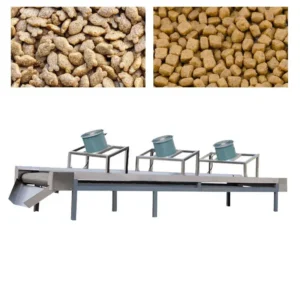
Configured Screw Geometry — Every barrel section and die plate is matched to your meat-meal ratio and target kibble density before the extruder is built.
Technical Specifications
| Parameter | Value |
|---|---|
| Product Type | Twin Screw Pet Food Extrusion Production Line |
| Screw Type | Twin-screw |
| Output Capacity | Up to 3 tons per hour (basis not stated in source — confirm raw material formulation, moisture content, kibble size) |
| Applications | Dry pet food (dog and cat kibble), aquatic feed (fish feed) |
| Assembly State | Complete production line from batching to packing |
| Process Documentation | Fish feed process drawing included |
| Control System | PLC and MCC control |
| Warranty | 1 year |
| Certification | CE |
Application Suitability
| Application | Material or Output |
|---|---|
| Dry dog kibble production | Corn, wheat, rice, poultry meal, fish meal blends |
| Dry cat kibble production | High-protein formulations with meat meal and animal fat |
| Floating aquatic feed | Soybean meal, fish meal, starch-based binders |
| Sinking aquatic feed | Higher-density formulations with reduced expansion ratio |
Why "Rated Capacity" Means Nothing Without Your Recipe
Capacity is a function of your raw material, not the nameplate.
I have watched procurement teams sign off on twin screw food extruder specifications based on a headline number, only to discover during commissioning that a chicken-meal-heavy recipe cuts actual throughput nearly in half. The screw pitch, barrel length, and die geometry that work for a corn-dominant formula will choke or surge on a formulation loaded with animal protein and fat [NEED_CITE: raw material impact on extruder throughput in pet food manufacturing]. When the how to choose pet food extrusion machine conversation skips over your specific formulation, the gap between brochure output and real production becomes an expensive surprise on your factory floor.
Barrel Temperature Zones and Starch Gelatinisation Control
Each barrel section on this twin-screw extruder carries independent heating and cooling circuits. Precise zone control lets you manage the gelatinisation window as the dough moves from the feed section toward the die. Starch conversion directly affects kibble expansion, internal crumb structure, and digestibility. A recipe with high corn content needs a different thermal profile than one dominated by rice flour or potato starch. Getting this right at the extrusion stage prevents downstream issues with coating adhesion and kibble friability during packaging and transport.
Screw Element Sequencing for Shear and Residence Time
The screw configuration is not a fixed build. Kneading blocks, reverse elements, and conveying sections are arranged based on your raw material behavior and the target kibble density. A formulation that requires high shear to break down fibrous protein will use a different element sequence than one that needs gentle mixing to preserve fat integrity. The how to choose pet food extrusion machine decision should always include a review of the proposed screw layout against your actual ingredient list [NEED_CITE: twin-screw element configuration principles in food extrusion].
Die Plate Selection and Kibble Geometry
The die orifice diameter, number of openings, and land length together determine the extrudate strand size before the cutter shapes the final kibble. A die that works for a 10 mm round kibble may produce ragged edges or uneven expansion on a bone-shaped or triangular format. Die design also influences the pressure drop across the barrel, which feeds back into expansion ratio and bulk density. This is where twin screw food extruder specifications move from general claims to documented parameters matched to your product catalog.
The Real Cost of Skipping a Pre-Shipment Trial Run
Lines that ship without a factory trial on your raw material arrive with unresolved variables. The screw configuration may need swapping, the barrel temperature profile may need weeks of adjustment, and the die plate may not produce the kibble density your market expects. Every day of commissioning troubleshooting is a day the line is not generating revenue. I have seen installations drag on far beyond the planned schedule because the extruder was configured for a generic formula rather than the buyer’s actual recipe [NEED_CITE: extrusion line commissioning delays from untested configurations].
Why This Line Is Built Around Your Process
Screw configuration and die design are documented against your raw material before the machine is assembled, not copied from a generic template. The in-house testing workshop runs your formulation before shipment, producing a trial run report you can review before the line leaves the factory. Barrel temperature profiles and moisture parameters are recorded so your operators start commissioning with known baselines rather than blank screens. Complete throughput matching from batching through drying and packing ensures no single station bottlenecks the line. Electrical schematics, voltage specifications, and control language are confirmed for your site before production begins.
Documentation & Verification
- Line layout drawing showing station-by-station throughput balance for your target capacity
- Screw and die configuration record matched to your raw material formulation
- Trial run report on your specific recipe before shipment leaves the factory
- Machine specification sheet with capacity calculation notes for your kibble size
- Electrical schematic with voltage and frequency confirmed for your local grid
- CE declaration of conformity with full technical file
Installation, Commissioning & Support
- Foundation plan referencing twin-screw extruder footprint and load-bearing requirements
- Dedicated power circuit sized to the main drive motor and heating zones
- Assembly sequence for barrel sections, screw shafts, and die plate on arrival
- First-run parameter log covering barrel temperatures, screw speed, and feed rate
- Operator training on screw element inspection and replacement intervals
- Wear parts list identifying screws, dies, and cutter blades for reorder planning
What We Need to Configure Your Line
To build a line that holds capacity on your actual formulation, share your raw material composition, target kibble shapes and sizes, and the bulk density your market requires. Confirm your site voltage, frequency, and preferred control language. If you have existing upstream mixing or downstream drying equipment, provide model details so the new extruder integrates without throughput mismatches. We run your recipe in our testing workshop before quotation finalization so there are no surprises at commissioning.
Frequently Asked Questions
Q: How do I verify that the extruder capacity applies to my raw material?
A: Request a trial run on your specific formulation at the factory testing workshop. The trial run report documents actual throughput, kibble density, and expansion ratio using your ingredients. Compare these results against your production targets before confirming the order. Capacity figures quoted without reference to a specific recipe and moisture level are nominal values only.
Q: How is the screw configuration decided for different kibble types?
A: The screw element sequence is designed around your raw material composition and target kibble density. High-protein recipes require different kneading block placement than starch-dominant formulas. The die plate is selected based on kibble shape and size. Both are documented in the configuration record provided before shipment.
Q: What barrel temperature range is needed for proper starch gelatinisation?
A: Gelatinisation temperature depends on your starch source. Corn, wheat, and rice each convert at different points. The barrel heating zones are set during the factory trial run on your recipe, and the temperature profile is recorded so your operators can replicate the conditions from day one of production.
Q: How are voltage and control language handled for international sites?
A: Electrical schematics and motor specifications are confirmed against your local grid before production. Control interface language is set during the build phase. Providing your site voltage, frequency, and preferred language at the inquiry stage avoids commissioning delays caused by mismatched electrical components.
Q: What does a pre-shipment trial run involve?
A: Your raw material is fed through the complete extrusion line at the factory testing workshop. The run produces kibble samples for your review, and the report records throughput, barrel temperatures, screw speed, moisture addition, and kibble density. This lets you approve the configuration before the line is packed for shipment.