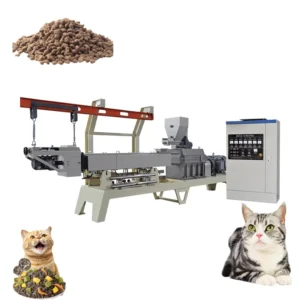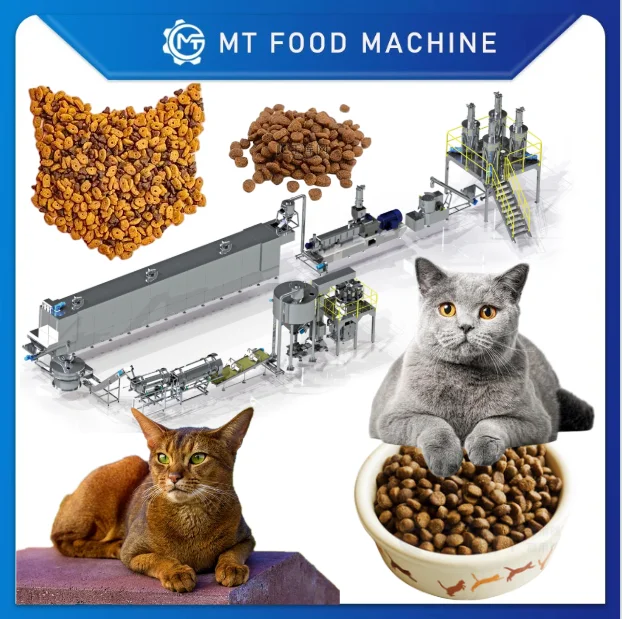
Extrusion Technology Matched to Recipe — Every screw profile and die geometry is validated on your actual formulation in our testing workshop before the line ships.
Technical Specifications
| Parameter | Value |
|---|---|
| Product Type | Twin-Screw Pet Food Extrusion Line |
| Output Capacity | 250-300 kg/h (basis not stated in source — confirm raw material formulation, moisture content, kibble size) |
| Control System | PLC controlled |
| Screw Type | Twin-screw |
| Product Formats Supported | Dry kibble, semi-moist diets, pet treats |
| Automation Level | Full automation |
| Interface | User-friendly intuitive controls |
| Standards | CE, ISO |
Application Suitability
| Application | Material or Output |
|---|---|
| Dry cat kibble production | Poultry meal, fish meal, corn, rice, grain-free formulations |
| Semi-moist cat diets | High-moisture meat slurry blends with starch binders |
| Multi-species pet food lines | Recipe-flexible extrusion for cat, dog, and small pet formats |
| Functional pet treats | Vitamin-fortified or dental-care treat formulations |
What "250-300 kg/h" Actually Means on Your Recipe
A nominal capacity figure is meaningless unless verified on your specific raw material and moisture profile.
I have watched buyers sign off on a quoted throughput number, only to find the line stalls at two-thirds of that rate once their actual meat-slurry-heavy formulation hits the barrel. The problem is rarely the motor or the feeder — it is the screw configuration and die geometry that were copied from a generic build rather than matched to the starch-protein-fat balance in the buyer’s recipe. When fresh meat content climbs above a certain threshold, the material behaves differently under shear, and expansion collapses [NEED_CITE: starch gelatinisation behaviour in high-protein extrusion]. A PLC controlled pet food extrusion line can hold consistent parameters, but only if those parameters were set correctly in the first place. That is why the trial run on your actual raw material matters more than the number on the quotation sheet.
Barrel Temperature Staging and Gelatinisation Control
The barrel is divided into independently heated zones, and the temperature profile across those zones determines how completely starch granules rupture and gelatinise. In a PLC controlled pet food extrusion line, each zone setpoint is maintained within a narrow band, preventing the cold spots that leave raw starch in the kibble centre or the hot spots that scorch the barrel wall. For grain-free cat food where legume flours replace corn, the gelatinisation window shifts, and the profile must be re-mapped before production starts.
Screw Profile and Shear Energy for High-Meat Formulations
A twin-screw configuration allows the screw elements to be rearranged — kneading blocks, reverse-flight segments, and conveying sections positioned to control how much mechanical energy transfers into the dough. High fresh-meat recipes need more shear in the melting zone but gentler conveyance near the die to avoid over-densifying the kibble. Getting this balance wrong is what causes the product to sink in the bowl or come out with a hollow centre. The screw profile is documented per order so the same build can be replicated on future production runs or adjusted when the recipe changes [NEED_CITE: twin-screw element arrangement and shear rate calculation].
Die Geometry and Kibble Density
The die plate determines the cross-section of every piece, but its open-area ratio and land length also control back-pressure inside the barrel. Shorter land length reduces resistance, allowing more expansion at the die face — useful for light, crunchy kibble. Longer land length increases pressure and produces a denser, slower-expanding product suited to semi-moist formats. On a multi-species line where the same extruder may run cat kibble in the morning and dog treats in the afternoon, having interchangeable die plates with documented geometry for each product is what keeps changeover predictable.
The Cost of Skipping the Trial Run
When a line ships without a verified test on the buyer’s formulation, the first week of production becomes an expensive experiment. Kibble density drifts outside specification, coating adhesion fails because the surface porosity is wrong, and the dryer cannot keep up because the moisture content leaving the die is higher than the layout assumed [NEED_CITE: extrusion line throughput bottleneck from unmatched dryer capacity]. The result is product held in quarantine while parameters are dialled in — raw material wasted, delivery deadlines missed, and a commissioning engineer on-site burning through billable days to do the work that should have happened in the factory before packing.
Why Buyers Specify This Line
The screw configuration and die design are selected based on the buyer’s submitted raw material sample, not pulled from a standard catalogue. Throughput across every station — extruder, dryer, flavouring drum, cooler — is calculated so no single unit bottlenecks the others. The PLC and MCC control architecture is wired to the buyer’s confirmed voltage and frequency before the cabinet is closed. An in-house testing workshop runs the buyer’s formulation and produces a trial report covering actual output, expansion ratio, and density. The same twin-screw platform supports pet food, aquatic feed, snacks, and breakfast cereals, so process knowledge from one category informs screw and barrel choices in another.
Documentation & Verification
- Line layout and capacity calculation showing matched throughput at every station
- Screw and die configuration record for repeatable production and future reconfiguration
- Trial run report on customer raw material documenting expansion ratio and kibble density
- Electrical schematic with voltage and frequency confirmed for target market
- CE declaration of conformity and ISO certificate for the complete line
- Operation and maintenance manual with wear parts list and replacement intervals
Installation, Commissioning & Support
- Foundation and utility planning based on the confirmed PLC controlled pet food extrusion line footprint
- Power supply verification matching the line’s rated voltage and dedicated circuit requirements
- Assembly and alignment of extruder barrel sections and twin-screw shafts on site
- First-run parameter setting for barrel zone temperatures, screw speed, and feed rate
- Operator training covering recipe changeover, die swaps, and PLC interface navigation
- Wear parts supply for screws, dies, and barrel liners with documented replacement schedules
What to Include in Your Inquiry
To move from a general enquiry to a configured line proposal, share your target formulation including the main protein source, starch component, and approximate fat percentage. Specify the kibble size range and whether semi-moist or treat formats are in scope. Confirm the local voltage, frequency, and preferred control language so the PLC interface and electrical schematics are built to match from the start.
Frequently Asked Questions
Q: How is screw configuration determined for a specific cat food formulation?
A: We review your raw material data sheet and, where possible, test a sample in our workshop. The screw element arrangement — kneading blocks, conveying flights, reverse segments — is then selected to deliver the right shear and residence time for your starch-protein balance. The final configuration is recorded and shipped with the line documentation.
Q: What extrusion parameters matter most for grain-free cat kibble?
A: Grain-free recipes using pea flour or lentil starch have a different gelatinisation window than corn-based formulas. Barrel zone temperature staging, moisture injection rate, and screw speed must all be adjusted together. A trial run on your exact formulation confirms the parameter set before the line ships.
Q: Can we run a trial on our own recipe before the line is dispatched?
A: Yes. Our in-house testing workshop runs your submitted raw material through the configured extruder and produces a report covering actual throughput, expansion ratio, kibble density, and surface porosity. This report is included with the shipping documentation.
Q: How does PLC control improve batch-to-batch consistency?
A: The PLC maintains barrel zone temperatures, screw speed, and feeder rate within tight tolerances throughout the run. This eliminates the drift that manual adjustment introduces, so kibble density and expansion stay within specification from the first hour of production to the last.