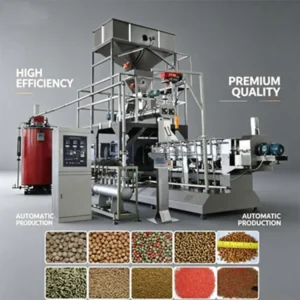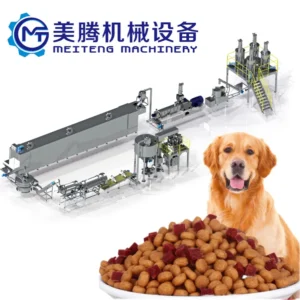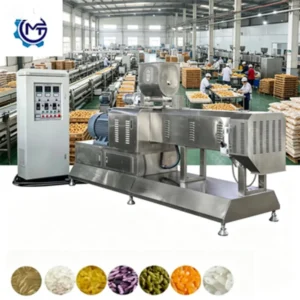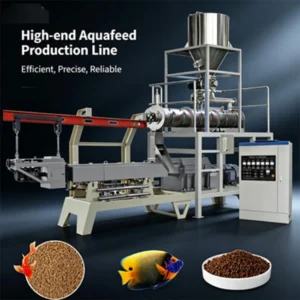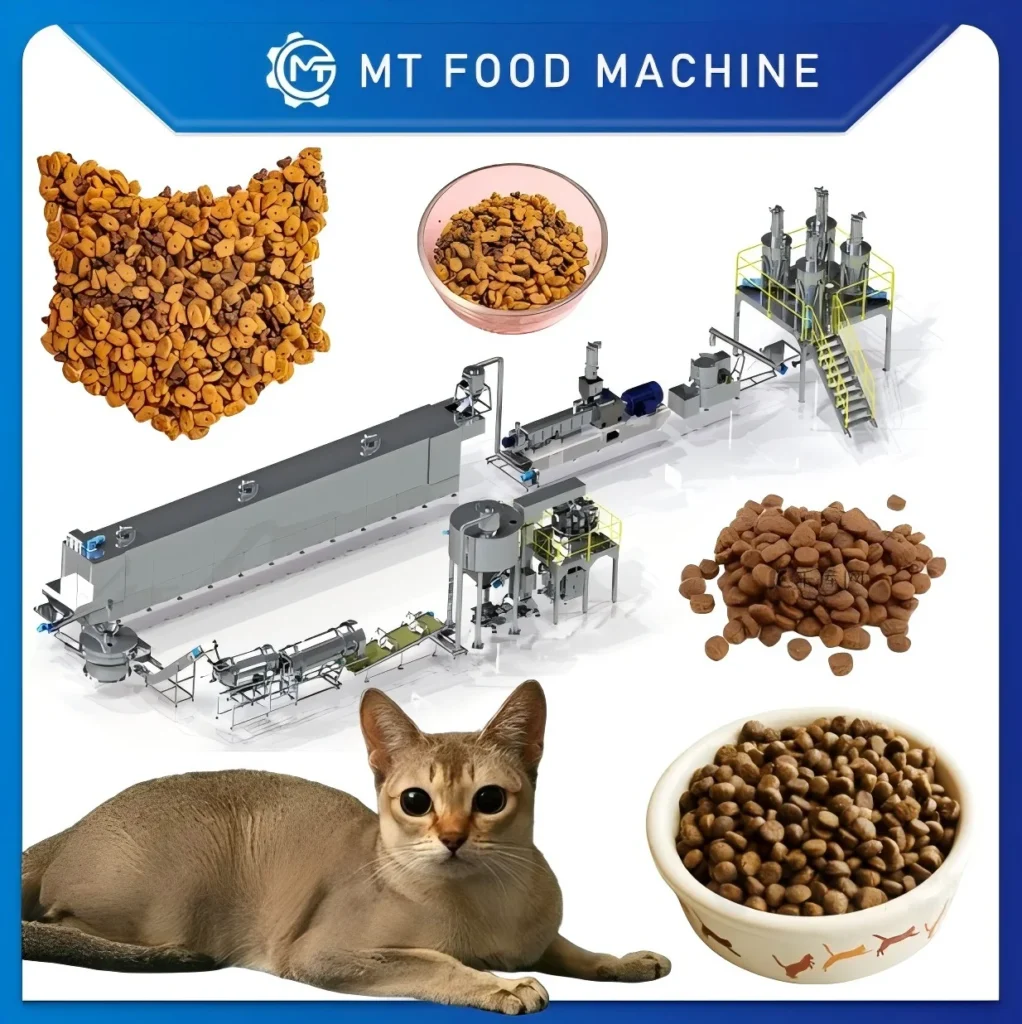
Matched Configuration — Screw profiles and die geometry specified to the buyer’s actual formulation and validated through an in-house trial run on customer-supplied raw material before the line ships.
Technical Specifications
| Parameter | Value |
|---|---|
| Product Type | Cat Food Extrusion Production Line |
| Output Capacity | 100-200 kg/h (basis not stated in source — confirm raw material formulation, moisture content, and kibble size) |
| Screw Type | Twin-screw (inferred from manufacturer profile — verify against quotation) |
| Control System | PLC Controlled |
| Automation Level | Full Automation |
| Line Stations | Batching, extrusion, drying, coating, cooling, packing |
| Recipe Adaptability | Dry kibble, semi-moist, treats |
| Energy Feature | Energy saving design |
| Interface | User-friendly control interface |
| Certification | CE (inferred from manufacturer profile — verify certificate validity for this specific line) |
Application Suitability
| Application | Material or Output |
|---|---|
| Dry kibble production | Poultry meal, fish meal, corn gluten, rendered fats, vitamin premix |
| Semi-moist cat food | High-meat inclusion with humectants and glycerol-based moisture retention |
| Functional treats | Dental care formulations, hairball control fibre blends, supplement carriers |
| Multi-species lines | Kitten to adult life-stage formulations with varying protein-to-starch ratios |
Why Your Raw Material Dictates the Actual cat food extrusion line specifications
Capacity claims on paper only become real when tested against the formulation you actually plan to run.
A production line rated for nominal output on a standard corn flour benchmark often loses significant throughput once a high-protein, high-fat cat food recipe enters the barrel. Fresh meat inclusion changes how starch gelatinises, alters melt viscosity inside the extruder, and shifts the expansion behaviour at the die face. I have watched lines stall within the first shift because the screw configuration was never adjusted away from a generic starch-based profile. The result is blocked dies, inconsistent kibble density, and an entire facility waiting for parameter adjustments that should have been resolved weeks before dispatch [NEED_CITE: raw material variability effects on twin-screw extrusion throughput].
Barrel Temperature Profiles and Meat-Based Formulations
The interaction between barrel zone heating and shear-induced temperature rise behaves differently with high-fat formulations than with simple starch matrices. Each barrel section requires independent temperature management to maintain consistent melt viscosity from the feed zone through to the metering section. The PLC control system on this cat food extrusion production line monitors and adjusts these zones in real time, which becomes critical when switching between a lean kitten formula and an adult maintenance recipe with higher fat content. Operators can store temperature profiles for each recipe, reducing changeover variability between batches.
Die Geometry and Target Kibble Density
The shape, land length, and aperture count of the extrusion die directly control expansion ratio and therefore bulk density of the finished kibble. Cat food markets expect specific texture and density ranges; floating versus sinking characteristics matter less than they do in aquaculture feed, but crunch hardness and internal cell structure influence palatability testing results [NEED_CITE: kibble density and palatability correlation in feline nutrition studies]. Die design for this line is specified after reviewing your target kibble dimensions and the expansion behaviour of your actual recipe, rather than fitted from a generic catalogue selection.
Screw Element Sequencing for Recipe Flexibility
Twin-screw extruders allow the screw shaft to be assembled from individual elements — conveying, kneading, reverse-conveying, and mixing blocks — arranged in sequences that determine residence time, shear intensity, and degree of cook. A semi-moist treat recipe with high glycerol content requires a different screw configuration than a dry kibble formula relying on starch gelatinisation for expansion. The configuration record for your cat food extrusion line specifications documents the exact element arrangement chosen for your formulation, giving your process engineers a baseline to modify as recipes evolve over production life.
What Happens When Throughput Mismatch Hits the Dryer
An extruder running at full output means nothing if the downstream dryer cannot remove moisture at the same rate. Kibble exiting the die and cutter at elevated moisture content requires a specific residence time in the dryer to reach shelf-stable water activity levels. Undersized drying capacity forces the extruder to slow down, creating a bottleneck that operators often do not discover until commissioning week. This cat food extrusion production line addresses throughput matching across every station — extruder, dryer, coating drum, and cooler — so that the rated output is achievable at the packing end, not just at the barrel exit.
Why Procurement Should Insist on Pre-Shipment Validation
Skipping a trial run on your actual raw material means the first test of the line configuration happens on your factory floor, with your production schedule already committed [NEED_CITE: commissioning delays attributed to untested equipment configurations]. Screw profiles, die selections, dryer settings, and PLC recipe parameters all need validation against real formulation behaviour. The cost of a delayed launch — idle operators, postponed retail commitments, contractual penalties — far exceeds the logistics of shipping sample raw material to the manufacturer’s testing workshop before the equipment leaves the factory.
How This Configuration Approach Differs
The line is configured from batching through packing under one supplier scope, meaning throughput calculations account for every station rather than relying on assembled components from separate vendors. Screw configuration and die design are documented against your specific raw material data sheet and target product specification. Electrical schematics, voltage ratings, and PLC control language are confirmed for your destination market before production begins. The testing workshop allows trial runs on customer-supplied formulations, generating a documented report that accompanies the shipment. Maintenance manuals and wear parts lists are produced for the exact screw and die configuration installed, not a generic catalogue version.
Documentation & Verification
- Screw and die configuration record matched to your submitted raw material formulation
- Trial run report generated from your actual recipe in the testing workshop before dispatch
- Line layout drawing showing station throughput calculations from batching to packing
- Electrical schematic with voltage, frequency, and PLC language confirmed for your market
- CE declaration of conformity documentation package for customs and regulatory submission
- Wear parts list specific to the installed screw elements and die geometry
Installation, Commissioning & Support
- Foundation requirements mapped to the full line footprint including extruder, dryer, and cooler stations
- Dedicated power circuits specified for PLC-controlled extruder drive and barrel heating zones
- Assembly sequencing plan for line stations arriving in modular shipping configuration
- First-run parameter setting using the pre-shipment trial run report as the commissioning baseline
- Operator training covering recipe changeover procedures on the user-friendly control interface
- Spare screw elements and die sets listed against the installed configuration for initial inventory
Preparing Your Inquiry
Submit your raw material formulation including protein sources, starch base, fat percentage, and any functional additives so that screw configuration and die design can be scoped accurately. Provide your target kibble dimensions, bulk density range, and daily production volume to allow throughput matching across every line station. Specify your facility voltage, frequency, and preferred PLC control language to ensure electrical documentation aligns with local commissioning requirements.
Frequently Asked Questions
Q: How is the stated capacity range verified against my specific cat food formulation?
A: The output range assumes conditions that vary with raw material composition, moisture content, and kibble size. We request your formulation data sheet and run a trial on your actual material in our testing workshop. The resulting trial run report documents achievable throughput, which forms the basis of the final line specification and quotation.
Q: What determines the screw configuration and die design for my cat food recipe?
A: The protein-to-starch ratio, fat content, moisture level, and target kibble texture all influence screw element sequencing and die geometry. Our engineering team reviews your formulation data and selects a configuration documented in a specification record. This record accompanies your equipment and serves as a baseline for future recipe modifications.
Q: How are voltage, frequency, and PLC control language confirmed before the line ships?
A: During the specification confirmation stage, we collect your facility power supply details and preferred operator interface language. Electrical schematics are then drawn to match these parameters, and the PLC programme is loaded with the correct language before factory testing, eliminating commissioning delays at your site.
Q: Can a trial run be performed on my raw material before shipment?
A: Yes. You supply a representative sample of your actual formulation to our testing workshop. We run the material through the configured extruder and document output rate, kibble density, expansion behaviour, and process parameters. The trial run report ships with your line and guides the commissioning team during initial start-up.