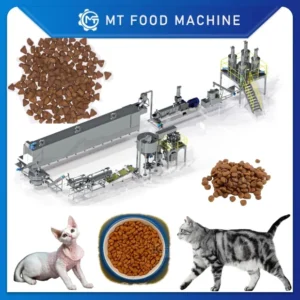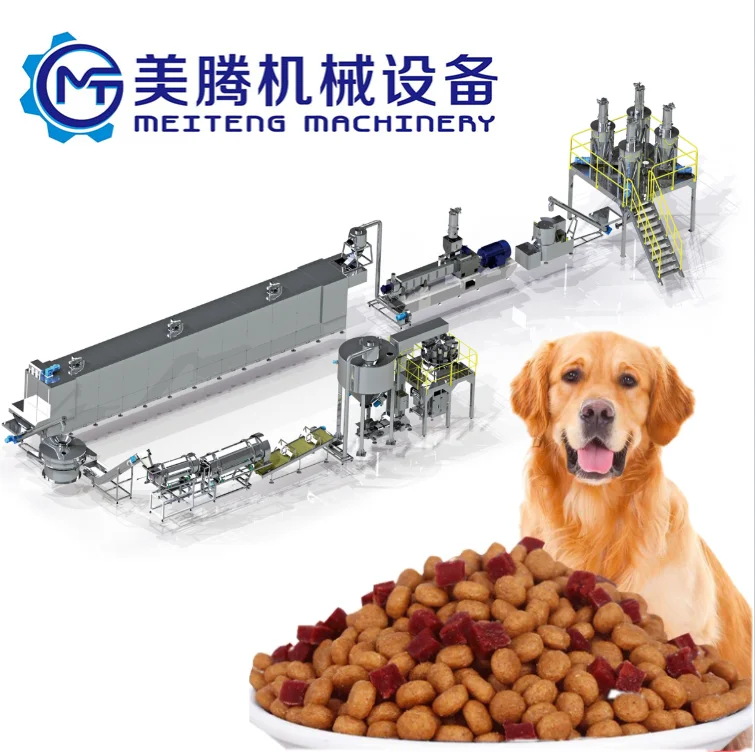
Screw Geometry Matched to Your Formula — Every barrel zone and die land is sized to your actual protein, starch and moisture inputs, not copied from a generic pet food build.
Technical Specifications
| Parameter | Value |
|---|---|
| Product Type | Pet Food Extrusion Production Line |
| Line Stations | Mixing, extrusion, drying, packaging (fully automated) |
| Control System | Advanced sensors and precision controls (specific PLC/MCC type not stated in source) |
| Recipe Adaptability | Dry kibble, semi-moist pet food, treats |
| Energy Design | Energy-saving technology (specific consumption data not stated in source) |
| Material | Food-grade contact materials |
| Assembly State | Complete production line |
| Capacity Range | Customizable (basis to be confirmed with raw material specification) |
| Layout | Flexible configuration for different factory sizes |
| Standards | FDA, CE |
Application Suitability
| Application | Material or Output |
|---|---|
| Dry kibble for dogs and cats | Corn, meat meal, poultry by-product, rice flour blends |
| Bird and fish feed pellets | Fish meal, soy protein, wheat middlings |
| Semi-moist pet food | High-moisture meat slurries with humectants |
| Pet treats and functional bites | Palatant-coated doughs, vitamin premixes |
| Cattle supplement pellets | Grain-based formulations with mineral additives |
Why Screw Configuration Decides Whether Your Kibble Floats or Sinks
A twin-screw profile built for corn grits will collapse a high-meat formula into dense, sinking pellets every time.
I spent three weeks in a Mexican plant watching a brand-new line produce kibble that looked right on the outside but sank the moment it hit water. The screw elements were arranged for a standard starch-heavy recipe, while the customer was running 35% poultry meal. The shear was too low to gelatinise the starch fraction properly, and the die land was too short to build the pressure needed for expansion. The dealer returned two full containers. Pet food extrusion technology screw configuration is not a catalogue choice — it is a calculation that starts with your proximate analysis and ends with a trial run on your actual raw material [NEED_CITE: proximate analysis methods for extruded feed formulations].
How Shear and Residence Time Shape Kibble Density
The arrangement of conveying, kneading and reverse elements inside the barrel determines how long your material stays under heat and mechanical stress. A high-protein formula needs a longer residence time with moderate shear to unfold protein structures without destroying the starch matrix that creates expansion. Pet food extrusion technology screw configuration addresses this by staggering kneading blocks at specific angles — typically 30° and 60° offsets — to control how aggressively the material is worked between the two screws.
When the balance is right, the melt reaches the die at a uniform temperature and viscosity, which is the precondition for consistent expansion. When it is off, you see kibble that is hard on one side and hollow on the other, or pellets that expand in the first hour and then collapse during cooling.
Barrel Temperature Zones and Starch Gelatinisation
Each barrel section has its own heating and cooling circuit, and the profile you set across those zones directly controls the degree of starch gelatinisation. Under-gelatinised starch leaves a gritty mouthfeel and poor digestibility — a problem that shows up in feeding trials rather than on the production floor. Over-gelatinised starch creates a sticky melt that smears on the die face and blocks expansion [NEED_CITE: starch gelatinisation temperature ranges in twin-screw extrusion].
Moisture injection points between barrel zones let you fine-tune the water activity of the melt without flooding the feed zone. This is especially important when you switch from a dry kibble run to a semi-moist formula, where the target moisture at the die is substantially higher and the screw profile must accommodate a more fluid melt.
Reading the Specs That Actually Matter
The length-to-diameter ratio of the screws tells you how much barrel volume is available for mixing and cooking. A higher L/D gives you more zones and more flexibility when you need to run both a low-starch treat formula and a high-corn kibble on the same line. The die plate thickness and the number of die holes determine the pressure drop at exit, which sets the expansion ratio and therefore the final bulk density of the kibble.
Food-grade contact materials throughout the barrel, screws and die mean you can run animal protein and fat-rich recipes without corrosion pitting the surfaces over time. The control system maintains barrel zone temperatures within a narrow band, which is what keeps batch-to-batch density consistent when ambient conditions shift between seasons.
The Hidden Cost of a Copied Screw Profile
When a supplier copies a screw build from a previous customer running a different recipe, the consequences are rarely obvious at commissioning. The line will run, it will produce kibble, and it may even pass a visual inspection. But within weeks the buyer discovers that bulk density is outside the range the market expects, or that the kibble fractures during bagging and fills the packaging line with fines [NEED_CITE: bulk density specifications for dry pet food distribution].
The cost is not just the rejected batch. It is the weeks of production lost while the supplier ships replacement screw elements, the retesting at the lab, and the credibility damage with distributors who have already committed shelf space to a product that does not perform as specified.
What a Process-Engineering Supplier Does Differently
Screw and die configuration is specified against your proximate analysis and target kibble density before metal is cut, not selected from a standard library. The in-house testing workshop runs your actual raw material — not a surrogate flour blend — so expansion, density and texture are verified before the line leaves the factory.
Barrel temperature profiles are documented zone by zone and shipped with the machine, giving your operators a validated starting point rather than a guess. Throughput is calculated station by station so the dryer, cooler and packaging line match extruder output without bottlenecking. Every food food extrusion technology screw configuration record is filed against the buyer’s specific formula and referenced during future screw replacements.
Documentation & Verification
- Screw and die configuration record matched to your proximate analysis and target kibble density
- Trial run report on your raw material showing expansion ratio and bulk density data
- Barrel zone temperature profile sheet with setpoints for each recipe you plan to run
- Machine specification sheet listing all heating zones, motor ratings and utility connections
- Line layout drawing with throughput calculation for every station from mixer to packer
Installation, Commissioning & Support
- Foundation plan accounts for extruder weight and vibration isolation at full screw speed
- Electrical schematic confirms voltage, frequency and control language for your local grid
- Barrel alignment verified on-site before first heating cycle to prevent screw-to-barrel contact
- Die face dressing and screw clearance set during commissioning with your raw material
- Operator training covers recipe changeover procedure including screw element swap sequence
- Wear parts list identifies every screw element, barrel liner and die insert by position number
What to Send With Your Inquiry
To size the screws and die correctly, provide your raw material proximate analysis — protein, starch, fat and moisture percentages — along with the kibble shape, size and target bulk density you need. Include your local voltage and frequency, the control language your operators speak, and whether your existing dryer and packaging line need to be matched to the new extruder throughput. If you can ship a sample of your actual raw material, the testing workshop will run a trial and return a density and expansion report with the quotation.
Frequently Asked Questions
Q: How is screw configuration selected for different raw materials and kibble densities?
A: The process starts with your proximate analysis. Protein content determines kneading block angles and shear intensity, while starch percentage sets the barrel zone temperatures needed for full gelatinisation. Screw element spacing and die land length are then adjusted to achieve the target expansion ratio and bulk density your market requires.
Q: What barrel temperature profile is needed for proper starch gelatinisation?
A: Starch gelatinisation in pet food typically occurs between specific temperature thresholds that vary by source — corn, rice and wheat each behave differently. The barrel zones are set in a stepped profile, starting low in the feed section and rising through the cooking zones, so the starch converts gradually without scorching or leaving ungelatinised cores.
Q: How does die design affect expansion ratio and final product density?
A: The die hole diameter and land length control the pressure drop when the melt exits the barrel. A longer land builds more pressure, producing higher expansion and lower density. The die face geometry also determines kibble shape, and the land must be matched to the screw profile to prevent uneven flow across holes.
Q: Can a trial run be done on my raw material before shipment?
A: Yes. The in-house testing workshop accepts your actual raw material and runs it through a matching screw and die configuration. You receive a trial run report documenting expansion ratio, bulk density, kibble cross-section and starch gelatinisation degree before the production line is shipped.