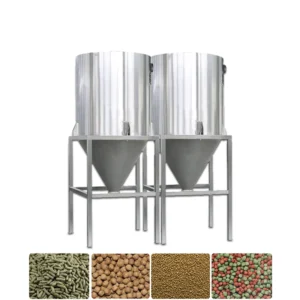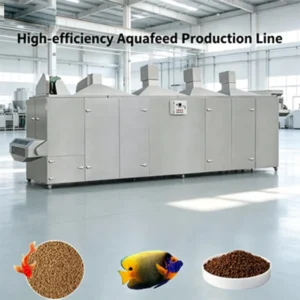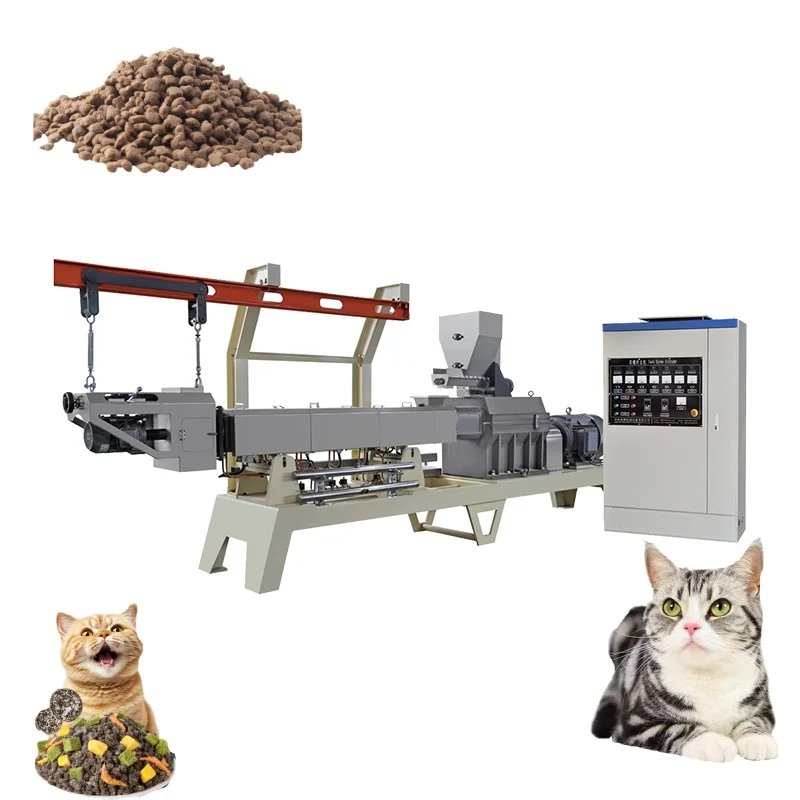
Screw Configuration Matched to Recipe — die geometry and barrel profile specified against the buyer’s actual raw material rather than copied from a generic twin-screw build.
Technical Specifications
| Parameter | Value |
|---|---|
| Product Type | Twin Screw Pet Food Extruder Line |
| Output Capacity | 3 tons per hour (basis not stated in source — confirm raw material formulation, moisture content, kibble size and density) |
| Applications | Dry dog and cat kibble; floating and sinking aquatic feed for fish |
| Process Documentation | Fish feed process drawing included |
| Control System | Available with PLC, MCC, or manual control (confirm per installation) |
| Voltage and Frequency | Configurable per target market (confirm before production) |
| Screw Type | Confirm single or twin screw based on formulation and throughput target |
| Warranty | 1 year |
| Standards | CE, ISO |
Application Suitability
| Application | Material or Output |
|---|---|
| Dry kibble production for dog and cat markets | Corn, meat meal, bone meal, fish meal, vitamins, and palatant blends |
| Floating aquatic feed for tilapia and catfish | Soybean meal, rice bran, fish meal, starch binders at controlled moisture |
| Sinking pellet production for shrimp and bottom-feeding species | High-protein formulations with denser die geometry and lower expansion |
| Multi-species co-manufacturing on one line | Quick screw and die changeover between formulations |
Why "3 Tons per Hour" Means Nothing Without the Raw Material
Nominal capacity is only valid when the formulation, moisture content, and kibble dimensions are defined.
I spent years in the field watching extruder lines fall short of quoted throughput the moment the buyer loaded their own corn and meat meal blend. A line rated for 3 tons per hour on a reference recipe may deliver considerably less on a high-fat kibble formula or a dense aquatic pellet. The bottleneck is rarely the motor — it is the screw configuration, die restriction, and moisture-shear balance interacting with a specific ingredient profile. Buyers who skip the trial run discover this only after installation, when the dryer cannot keep pace or the coating drum overflows [NEED_CITE: throughput matching between extrusion and downstream stations]. This is why every pet food extrusion machinery specifications discussion must begin with the recipe, not the nameplate.
Barrel Temperature Profile and Starch Gelatinisation
The barrel is divided into heating zones, each independently controlled. Starch gelatinisation requires a precise temperature ramp — too low and the kibble collapses after the die, too high and the protein denatures before expansion. On this platform, zone temperatures are matched to the buyer’s formulation so that gelatinisation completes at the right barrel section. This level of control is what separates consistent kibble density from batch-to-batch variation, and it is central to how pet food extrusion machinery specifications should be evaluated by any technical buyer.
Die Geometry and Product Density Control
The die plate determines kibble shape, but more critically it controls expansion ratio and final density. A floating fish pellet needs an open die with high expansion; a dense dog kibble requires tighter die restriction and lower moisture at the die face. Running both formats on the same extruder is feasible, but only when the die inventory and screw elements are specified for each target product. Generic dies produce either sinking floating feed or kibble that is too porous for the pet food market [NEED_CITE: die geometry influence on extrudate density and buoyancy].
Reading the Specs That Actually Matter
The screw configuration — element sequence, pitch, and kneading block arrangement — defines residence time and shear intensity. A high-meat formulation needs different screw elements than a starch-heavy recipe. The control system determines whether process parameters are repeatable: PLC-controlled lines store recipes and log deviations, while MCC panels require manual adjustment each run. Moisture injection rate directly affects expansion — a one percent shift can change kibble bulk density enough to push it outside the target specification. These are the parameters that determine whether a line produces sellable product or generates waste from the first shift.
The Cost of a Generic Screw and Die Build
When the screw configuration is copied from a standard template rather than matched to your raw material, the consequences surface within the first production week. Kibble density drifts outside the specification the market expects. Floating feed sinks. The dryer runs longer to compensate, cutting effective throughput. Coating adhesion fails because the surface porosity is wrong. These are not adjustment issues — they are design failures that require new screw elements and die plates, adding weeks of downtime while replacement parts are manufactured and shipped [NEED_CITE: cost of unplanned line stoppages from mismatched extrusion tooling].
What Sets This Extrusion Platform Apart
Complete line throughput is matched across extrusion, drying, and coating stations rather than assembled from separate vendors with uncoordinated capacities. Screw configuration and die design are specified to your raw material and target product, not pulled from a generic catalogue. An in-house testing workshop runs your actual formulation before shipment, producing a trial report that documents achievable throughput and product parameters. Pre-sales consultation covers layout engineering, utility planning, and electrical confirmation so that commissioning starts with parameters already validated.
Documentation & Verification
- Line layout and capacity calculation matched to your formulation and target kibble specification
- Screw and die configuration record documenting the exact element build for your recipe
- Trial run report on your raw material conducted in the testing workshop before dispatch
- Electrical schematic with voltage and frequency confirmed for your installation site
- Operation and maintenance manual with wear parts list and replacement intervals
Installation, Commissioning & Support
- Foundation and utility plan sized to the extruder motor power and dryer thermal load
- Voltage and frequency confirmed before production to match local supply standards
- Control language set on the PLC or MCC panel per operator requirements
- First-run parameter tuning using the trial report as baseline for your formulation
- Operator training covering screw changeover, die replacement, and barrel cleaning procedures
- Wear parts inventory — screws, dies, barrel liners — specified for your first replacement cycle
Before You Request a Quote
Send your raw material formulation with moisture targets, the kibble or pellet dimensions you need, and your daily production target so the line can be configured around your actual process. Confirm the local voltage, frequency, and preferred control language. If you run multiple species or recipes, list each one — changeover time and die inventory depend on the full product range, not just the primary SKU.
Frequently Asked Questions
Q: How is output capacity verified for my specific formulation?
A: Capacity is confirmed through a trial run on your actual raw material in the in-house testing workshop. The trial report documents achievable throughput at your target moisture content, kibble size, and density. Nominal figures are only meaningful when tied to these parameters — a high-fat recipe or a dense aquatic pellet will yield different results than a standard corn-based reference formulation.
Q: How are screw configuration and die geometry selected for my recipe?
A: The screw element sequence — pitch, kneading blocks, and reverse elements — is designed around your ingredient profile and target texture. Die geometry is chosen to deliver the required expansion ratio and density. Both are documented in a configuration record so you can reorder identical tooling when replacements are needed.
Q: What electrical and control options are confirmed before the machine is built?
A: Voltage, frequency, and control language are confirmed during the specification phase before production starts. The control system can be supplied as PLC with recipe storage, MCC, or manual panel depending on your preference. The electrical schematic is reviewed and signed off so that commissioning begins with the correct supply parameters already in place.
Q: Can the same line produce floating aquatic feed and dense dog kibble?
A: Yes, provided the screw elements and die plates for each format are included in the line package. Changeover involves swapping die plates and adjusting screw element sequence, barrel temperature profile, and moisture injection rate. The trial run covers each target product so that operators have validated parameters for every recipe from the first production day.
Q: Is a trial run performed on my raw material before shipment?
A: A trial run is conducted in the in-house testing workshop using your supplied raw material. The resulting report covers throughput, kibble density, expansion ratio, and surface texture. This ensures the screw configuration and die design are correct before the line ships, so product development does not start only after installation at your facility.