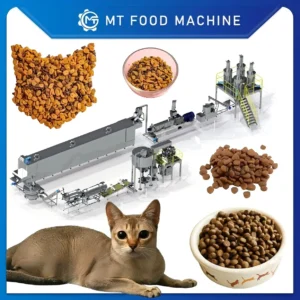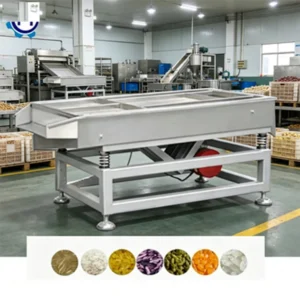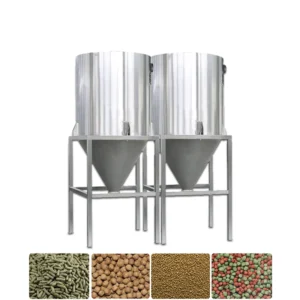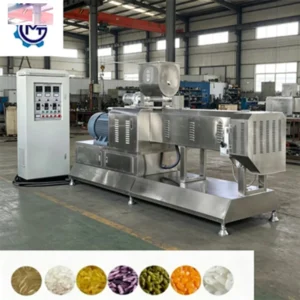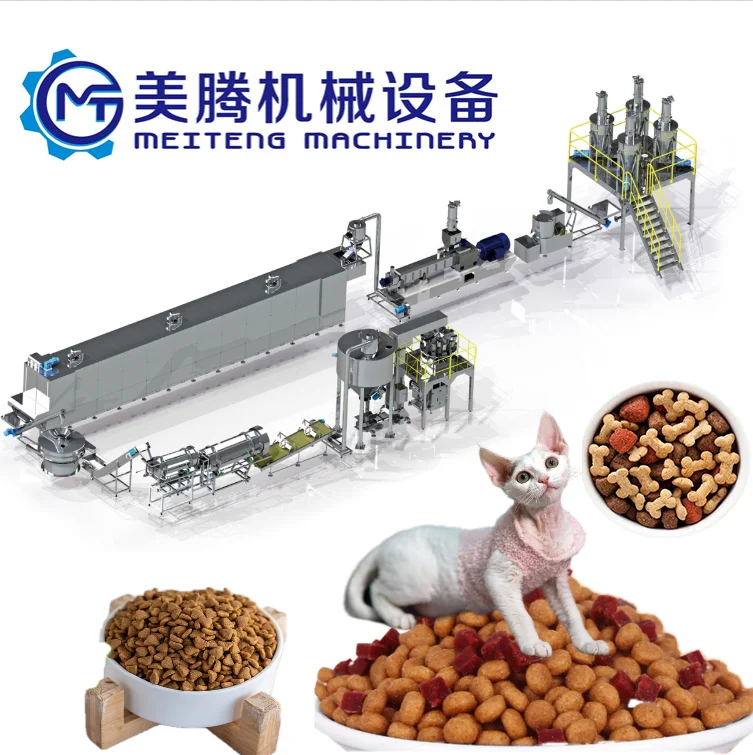
Screw configuration matched to formulation — The MT70 twin-screw line uses a dedicated testing workshop to validate screw profile, die geometry, and barrel temperature on the buyer’s actual pet food blend before the machine ships.
Technical Specifications
| Parameter | Value |
|---|---|
| Model | MT70 |
| Product Type | Twin-Screw Pet Food Processing Line |
| Output Capacity | 100–200 kg/h (basis not stated in source — confirm raw material formulation, moisture content and kibble density) |
| Screw Type | Twin-screw |
| Voltage & Frequency | 380V 50Hz Three Phase |
| Control System | PLC and MCC |
| Line Stations | Mixing and batching → Extrusion → Drying → Packaging |
| Supported Product Formats | Dry kibble, semi-moist pet food, pet treats |
| Construction | Food-grade contact materials throughout |
| Assembly State | Complete processing line |
| Standards | CE, ISO |
Application Suitability
| Application | Material or Output |
|---|---|
| Dry kibble production for dogs and cats | Corn, meat meal, poultry by-product, rice flour, vitamin premix |
| Semi-moist pet food formulation | High-moisture protein blends with humectants and palatants |
| Pet treat extrusion | Jerky-style doughs, starch-based chew treats, dental bones |
| Aquatic-style floating pellet runs | Fish meal and starch blends requiring controlled expansion |
What Generic Screw Configurations Cost Pet Food Producers
A copied screw profile that ignores your formulation will sink kibble density outside market specification.
When a twin-screw pet food extrusion line ships with a generic screw build, the extruder barrel may fail to reach the starch gelatinisation threshold your recipe demands. The result is kibble that either floats when it should sink, or crumbles under packaging vibration. I have watched high-fat Middle Eastern formulations stall on lines where nobody adjusted the screw elements before the trial — an entire batch was scrapped because the shear profile was set for a standard corn-and-meat-meal mix [NEED_CITE: twin-screw extrusion screw element geometry and shear rate effects].
The MT70 addresses this by requiring the buyer’s raw material on-site before configuration is locked.
Barrel Temperature Zones and Starch Gelatinisation Control
The barrel on this twin-screw pet food extrusion line is divided into independently heated zones, each governed by the PLC. Starch gelatinisation in a kibble formulation typically initiates between 70 °C and 90 °C, but the exact window shifts depending on the ratio of corn flour to meat meal and the incoming moisture level. Precise zone-by-zone temperature management prevents premature gelatinisation in the feed section, which can cause surging, and ensures full cook-out before the material reaches the die plate.
Die Geometry and Kibble Expansion Behaviour
Die orifice diameter, land length, and face pattern together govern the expansion ratio of the extrudate as it exits the barrel. A shorter land length produces higher radial expansion — suitable for a light, airy kibble aimed at small-breed dogs. A longer land length restricts expansion and yields a denser pellet for working-dog or large-breed formulations. The MT70 die is specified after the testing workshop confirms the expansion rate on the buyer’s actual blend, removing guesswork from the twin-screw pet food extrusion line specifications.
Reading the Core Parameters for Production Impact
The twin-screw configuration gives the MT70 a self-wiping action that single-screw extruders lack, which matters when switching between a high-fat salmon recipe and a lean chicken-and-rice formula — residue from the previous run is cleared mechanically rather than requiring a full barrel teardown. The PLC and MCC control architecture means that barrel temperature set-points, screw speed, and feeder rates are stored as named recipes, so a shift operator can recall a validated profile instead of re-entering numbers from a printed sheet. Food-grade contact materials throughout the product zone satisfy both CE machinery directive expectations and the hygiene standards that export-market retailers now audit [NEED_CITE: food contact material compliance for extrusion equipment in the EU]. Voltage at 380V 50Hz three-phase is standard for the line, but frequency and control language should be confirmed before production begins — a 60Hz market receiving a 50Hz motor will see screw RPM and throughput drift outside the tested window.
The Hidden Cost of Skipping the Pre-Shipment Trial
When an extruder leaves the factory without a documented trial on the buyer’s formulation, the first production run becomes the trial. Ingredient cost, labour hours, and shipping schedule all burn while operators adjust screw elements, swap die plates, and chase a density target that was never validated. I once saw a South American producer spend three weeks re-calibrating a line because the supplier had shipped a configuration built for wheat-based kibble while the buyer’s recipe relied on cassava starch — completely different gelatinisation behaviour [NEED_CITE: starch gelatinisation temperature variance across botanical sources]. The MT70 testing workshop is designed to catch that mismatch before the crate is sealed.
Why Source This Line from Jinan MT Machinery
Every station — batching, extrusion, drying, packaging — is specified under one supplier, so throughput is balanced across the line rather than bottlenecked at the dryer. Screw and die configuration is documented against the buyer’s raw material and target kibble density, not pulled from a catalogue default. The in-house testing workshop runs the buyer’s formulation before dispatch, producing a trial run report that travels with the shipment. Twin-screw expertise covers pet food alongside aquatic feed, snacks, cereals, and protein applications, meaning process engineers have cross-category experience when a formulation behaves unexpectedly. Pre-sales consultation through installation, commissioning, and ongoing maintenance keeps the same technical team on the file from inquiry to first production shift.
Documentation & Verification
- Machine specification sheet with barrel zone temperature profile and L:D ratio confirmation
- Screw and die configuration record matched to your raw material blend
- Trial run report on your formulation conducted before shipment
- Electrical schematic with voltage, frequency, and control language confirmed prior to production
- CE declaration of conformity and ISO certificate for customs and import compliance
- Operation and maintenance manual with wear parts list
Installation, Commissioning & Support
- Foundation plan sized to the MT70 line footprint with anchoring points for extruder and dryer vibration isolation
- Dedicated three-phase 380V 50Hz circuit with breaker rating matched to total connected load
- Extruder barrel segments and screw shafts arrive separately and are assembled on-site to verified alignment
- First-run commissioning includes barrel temperature calibration and screw speed validation against trial run data
- Operator training covers PLC recipe recall, feeder adjustment, and emergency stop sequences in the confirmed control language
- Wear parts list identifies screw elements, die plates, and cutter bearings with recommended replacement intervals
What to Include in Your Inquiry
Share your target kibble formulation — including the primary protein source, starch type, fat percentage, and desired moisture content after drying. Specify the voltage and frequency available at your facility, and note the control language your operators require. If you can send a sample of your raw material blend, the testing workshop will run it on the MT70 and return a trial report before any purchase commitment is made.
Frequently Asked Questions
Q: How is screw configuration and die design matched to my specific pet food formulation?
A: Before the MT70 ships, your raw material blend is run in our testing workshop. Screw elements are arranged and die geometry is selected based on the expansion rate, density, and texture achieved during that trial. The validated configuration is recorded and shipped with the line so you start production with a proven setup rather than a generic build.
Q: Can I send my raw material for a trial run before the line ships?
A: Yes. We require a sample of your formulation to conduct a trial in the in-house testing workshop. The resulting trial run report documents barrel temperatures, screw speed, moisture levels, and kibble density, giving you verified twin-screw pet food extrusion line specifications before the equipment leaves the factory.
Q: How do barrel temperature zones and moisture injection affect kibble expansion and density?
A: Each barrel zone is independently controlled by the PLC. Moisture injection timing and volume determine where starch gelatinisation initiates. Higher moisture in the early zones promotes earlier gelatinisation and greater expansion at the die; lower moisture delays the cook and produces a denser kibble. The trial run establishes the correct zone profile for your recipe.
Q: What is the difference between twin-screw and single-screw extrusion for my product type?
A: Twin-screw extruders provide a self-wiping action that handles high-fat and high-moisture formulations more consistently than single-screw designs. They also allow a wider range of screw element arrangements, giving process engineers more variables to control texture, density, and cook degree across different pet food recipes.