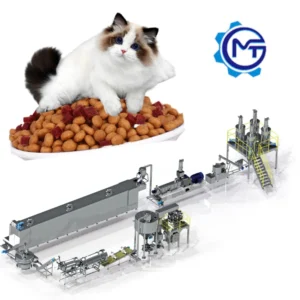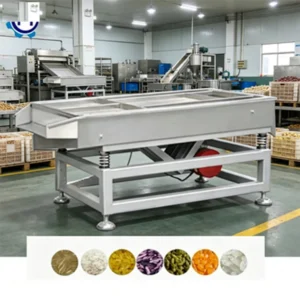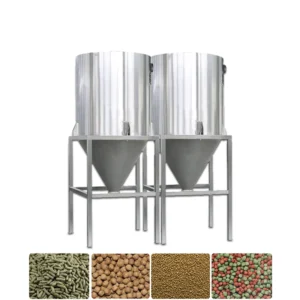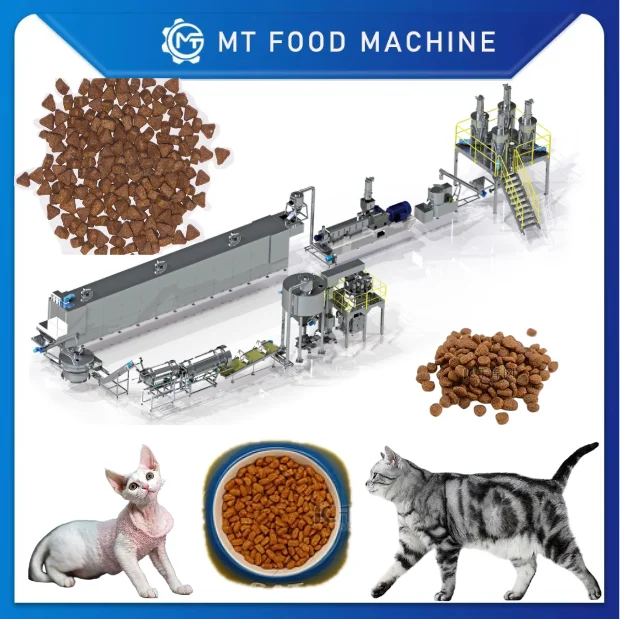
Process-Verified Extrusion — MT100 twin-screw platform configured through in-house trial runs on your actual raw material before shipment, ensuring starch gelatinisation and expansion match your formulation rather than a generic template.
Technical Specifications
| Parameter | Value |
|---|---|
| Model | MT100 |
| Product Type | Pet Food Extrusion Line |
| Screw Type | Twin-screw |
| Output Capacity | up to 550 kg/h (basis not stated in source — confirm raw material formulation, moisture content and kibble size) |
| Nominal Line Capacity | 1.5–2.0 t/h (basis not stated in source — confirm shift length, product format and raw material) |
| Control System | PLC Controlled |
| Target Species | Cat, Dog, Fish, Bird, Cattle |
| Line Stations | Batching → Extrusion → Drying → Flavouring / Coating → Cooling → Packing (confirm exact configuration for this model) |
| Assembly State | Complete production line |
| After-sales Support | Video technical support, online service |
| Voltage & Frequency | Configurable to destination country standard (confirm at order) |
| HMI Language | Confirm at order |
| Standards | CE, ISO |
Application Suitability
| Application | Material or Output |
|---|---|
| Dry kibble for cats and dogs | Corn, wheat, rice, meat meal, bone meal, fish meal blends at varying protein ratios |
| Floating aquatic feed for tilapia and catfish | Soybean meal, fish meal, starch binders requiring low-density expansion |
| Sinking aquatic feed for shrimp | High-protein formulations with controlled density and minimal float |
| Extruded feed for birds and cattle | Grain-based mash with vitamin and mineral premix inclusion |
| Multi-species production on one platform | Switching screw elements and die plates between runs |
Why "Rated Capacity" Means Nothing Without Your Raw Material
The MT100 twin-screw pet food extrusion line is validated on your formulation in our testing workshop before it leaves the factory.
A pet food line quoted at a nominal throughput figure only holds that number when the raw material matches the test conditions. I once watched a Middle East client commission a cat food line where the trial used standard corn-based formula — screw speed and die openings were locked in. When their actual material arrived on site, the fish meal ratio was far higher, and the kibble came out hard and sinking. That twin-screw pet food extrusion line sat idle for days while we reconfigured the screw elements remotely. Since then, every MT100 order I handle starts with the buyer shipping raw material to Jinan for a full trial run [NEED_CITE: importance of raw material validation in extrusion processing]. The trial report documents expansion ratio, bulk density and kibble geometry against your specification — not against a generic benchmark.
Screw Configuration Dictates Kibble Density and Texture
The twin-screw arrangement inside the MT100 barrel allows operators to rearrange conveying, kneading and reverse elements along the shaft. Each element sequence controls residence time, shear intensity and the degree of starch gelatinisation your formulation undergoes. A high-meat cat food recipe demands different screw geometry than a corn-heavy dog kibble — the protein matrix responds to shear and heat differently than pure starch. When we run your material in the testing workshop, we document the exact element arrangement and barrel temperature profile that produces your target expansion. That configuration record ships with the machine.
Barrel Temperature Profiling Across Multiple Zones
Each barrel section on the twin-screw pet food extrusion line carries independent heating and cooling circuits managed by the PLC. The temperature gradient from feed zone to die face determines how completely starch granules rupture and restructure during passage. Inconsistent thermal profiling causes kibble with a cooked exterior and a raw core — a defect that shows up as poor digestibility and short shelf life. The PLC logs temperature data per zone throughout each production run, giving your quality team a traceable record for every batch [NEED_CITE: barrel temperature control standards in food extrusion].
Reading the Specifications That Actually Matter
The output capacity of up to 550 kg/h is meaningful only when paired with your specific formulation moisture content, protein-to-starch ratio and target kibble diameter. A high-fat, low-starch aquatic feed expands less and runs slower through the die than a standard corn-based dog kibble. The PLC control system manages moisture injection, screw speed and barrel temperature as an integrated set — changing one variable shifts the others. Twin-screw geometry gives the MT100 a wider processing window than single-screw alternatives, accepting formulations with higher fat and protein content without surging or stalling at the die. The complete line configuration from batching through packing means throughput is balanced at every station; a dryer or coating drum sized too small creates a bottleneck that no extruder speed increase can solve.
The Hidden Cost of a Generic Screw Build
When an extruder ships with a default screw configuration copied from a catalogue rather than engineered to your raw material, the consequences surface during commissioning. Kibble density drifts outside the range your market expects — floating feed that sinks, or dog kibble that crumbles during bagging. Operators spend weeks adjusting feed rate and moisture to compensate for a geometry problem that only a screw rebuild can fix [NEED_CITE: screw configuration impact on extruded product quality]. That downtime and those replacement elements cost far more than a pre-shipment trial run.
Why This Extrusion Platform Ships Differently
The MT100 is built around a single-supplier line philosophy where every station — batching, extrusion, drying, flavouring, cooling and packing — is sized to match rather than assembled from separate vendors. Screw configuration and die design are specified to your raw material and target kibble format, not pulled from a generic library. The in-house testing workshop runs your actual formulation before the line crates, producing a trial report you can review before authorising shipment. Twin-screw expertise spans pet food, aquatic feed, snacks, cereals, starch and protein applications, so the engineering team recognises formulation challenges across categories. Pre-sales consultation covers line layout and utility planning, and on-site commissioning includes operator training specific to your product range.
Documentation & Verification
- Screw and die configuration record documenting element arrangement matched to your kibble target
- Trial run report on your raw material produced in the testing workshop before dispatch
- Line layout and capacity calculation confirming throughput balance across every station
- Electrical schematic with voltage and frequency confirmed to your destination market
- CE declaration of conformity and ISO certificate for customs and regulatory clearance
- Operation and maintenance manual with wear parts list specific to the MT100 build
Installation, Commissioning & Support
- Foundation and floor space planning based on the confirmed MT100 line layout drawing
- Dedicated electrical circuit sized to the PLC-controlled extruder motor and heating load
- Assembly and alignment of barrel sections and screw shafts during on-site commissioning
- First-run parameter setting using the trial run configuration record as baseline
- Operator training on PLC interface, screw changeover and die plate replacement procedures
- Wear parts list covering screws, dies and barrel liners with recommended reorder intervals
What We Need to Configure Your Line
Before we quote, share your raw material formulation including protein, starch and fat ratios along with target kibble size and density for each species you plan to produce. Confirm your facility voltage, frequency and preferred HMI language so the electrical build matches your site. Let us know whether you need floating aquatic feed capability alongside dry kibble — that determines die plate and dryer specifications from the start.
Frequently Asked Questions
Q: How is the 550 kg/h capacity verified against my raw material?
A: That figure depends on your formulation moisture content, protein-to-starch ratio and kibble diameter. We run your actual material through the MT100 in our testing workshop and document the real throughput alongside expansion ratio and bulk density. The trial report becomes your baseline reference for production planning.
Q: How do you select screw configuration and die design for different species?
A: Each species requires a specific kibble density, size and texture. We adjust screw element sequencing, die hole diameter and barrel temperature profile during the trial run. The final configuration record ships with the machine so your operators can replicate or modify it for future production runs.
Q: What barrel temperature range does the MT100 support for different starch sources?
A: The PLC manages independent heating zones along the barrel, each configurable to your formulation needs. Corn, wheat, rice and tapioca starches gelatinise at different temperatures. During the trial run we map the optimal thermal profile and document it for your quality records.
Q: Can the same line switch between floating aquatic feed and dry pet kibble?
A: Yes. Switching requires changing die plates and rearranging screw elements to alter expansion behaviour. The PLC stores separate recipes for each product format. The trial run covers every format you plan to produce so changeover procedures are documented before shipment.
Q: What does the pre-shipment trial report include?
A: The report records your raw material batch details, screw and die configuration, barrel temperature profile, throughput achieved, expansion ratio, bulk density and kibble geometry measurements. You review and approve it before we authorise packing and shipment.