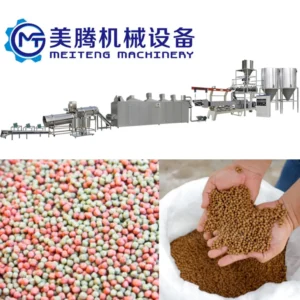
Screw Configuration Matched to Raw Material — twin-screw barrel zones, die geometry and moisture profile specified to your formulation so pellet density stays within the float or sink target your market demands.
Technical Specifications
| Parameter | Value |
|---|---|
| Product Type | Aquatic Feed Extrusion and Drying Line |
| Extruder Type | Twin-screw |
| Pellet Diameter Range | 0.5 mm – 12 mm |
| Output Capacity | 500 kg/h (basis not stated in source — confirm raw material formulation / moisture content / pellet size) |
| Line Stations | Feeding, Mixing, Extruding, Pelletizing, Drying, Cooling |
| Construction Material | Stainless steel (main contact parts) |
| Automation Level | Fully automatic, continuous operation |
| Control System | Simple control panel (PLC / MCC not specified in source — confirm) |
| Voltage & Frequency | Not stated in source — confirm against target market |
| Barrel Zones | Not stated in source — confirm based on formulation |
| Die Configuration | Not stated in source — matched to pellet diameter and density target |
| Screw Diameter / L:D Ratio | Not stated in source — specify per raw material shear requirement |
| Steam Injection / Moisture Range | Not stated in source — confirm for preconditioning needs |
| Certification | CE available per company profile — verify applicability to this line |
Application Suitability
| Application | Material or Output |
|---|---|
| Floating aquaculture feed | Catfish and tilapia pellets requiring controlled expansion and low bulk density |
| Sinking aquaculture feed | Shrimp and bottom-feeding species pellets requiring high density and minimal buoyancy |
| Multi-stage grow-out feed | Pellet diameters from 0.5 mm fry feed up to 12 mm adult feed on the same extrusion platform |
| Small and medium feed mills | Continuous production replacing batch-style processing for consistent pellet geometry |
Why "500 kg/h" Means Nothing Without the Formulation Behind It
The twin-screw fish feed production line is rated on a specific raw material mix and moisture baseline that must match your actual inputs before the number holds any meaning.
I have watched a buyer commission a line that was quoted at a rated capacity on a standard corn-starch formulation, only to find their high-fat fishmeal blend dropped actual throughput and left the dryer overloaded with wet pellets. The extruder was not the problem; the screw profile and barrel temperature had never been matched to the oil content in the real recipe. When the aquatic feed extrusion line ships without a documented configuration tied to your formulation, the rated number is a starting guess at best [NEED_CITE: twin-screw extrusion throughput dependency on raw material fat and starch ratios].
Barrel Temperature and Shear Profile in Twin-Screw Extrusion
The twin-screw fish feed production line relies on barrel zone heating and screw element geometry to control starch gelatinisation inside the barrel before the pellet exits the die. Different raw materials — high-protein fishmeal versus high-starch grain blends — demand distinct temperature ramps and screw configurations to achieve the correct expansion ratio.
A formulation rich in fat requires lower shear and gentler barrel temperatures to prevent oil separation, while a starch-heavy blend needs aggressive shear to fully gelatinise before the die. Getting this wrong at the specification stage means pellets either collapse after extrusion or fail to reach the target float rate in water.
Die Geometry and Pellet Density Control
Die hole diameter, land length and face-cut knife speed together determine the cut length and surface finish of each pellet. For floating feed, the die must allow sufficient expansion at the exit so that internal steam creates the porous structure needed for buoyancy. For sinking shrimp feed, a longer die land compresses the extrudate and reduces post-die expansion [NEED_CITE: die land length effect on extrudate density in aquatic feed production].
Matching the die to the pellet diameter range of 0.5 mm through 12 mm often means swapping die plates between production runs. The changeover procedure and die inventory should be confirmed before the line ships, so the first production day does not turn into a fabrication exercise.
Reading the Spec Sheet: What Matters for Aquatic Feed
The twin-screw configuration gives this aquatic feed extrusion line a self-wiping action that handles sticky, high-protein formulations without material buildup between the screws. This is the primary reason twin-screw extruders are preferred over single-screw designs for aquaculture feed where fishmeal and binder content can exceed levels that a single screw can convey reliably.
The stainless steel construction on main contact parts addresses the corrosive environment created by fishmeal salts and moisture. Pellet diameter adjustability from 0.5 mm to 12 mm covers fry feed through adult grow-out rations on one platform, reducing the number of dedicated lines a medium-scale mill needs to install.
The continuous, fully automatic operation mode depends on throughput matching between the extruder, dryer and cooler. If the dryer belt speed or cooler airflow is sized for a nominal extruder output that your actual formulation cannot reach, the line will either under-utilise the downstream equipment or, worse, the extruder will be pushed beyond its real capacity to fill the dryer, degrading pellet quality.
The Hidden Cost of a Mismatched Line Configuration
When the dryer capacity is specified to a quoted extruder output rather than to verified throughput on the buyer’s raw material, wet pellets enter the cooler and create condensation that blocks the cooling bed and promotes mould growth in storage. The line does not break down; it produces feed that fails shelf-life tests weeks later.
I have seen feed mills shut down for days to clear compacted pellet fines from a cooler that was never designed for the actual moisture load arriving from the dryer. The root cause was always the same: no trial run on the customer’s formulation before the line left the factory [NEED_CITE: post-extrusion moisture management in aquatic feed lines].
Why Source the Aquatic Feed Extrusion Line Here
The screw configuration and die design are specified against the buyer’s raw material data sheet rather than copied from a generic build, so the twin-screw fish feed production line arrives with documented barrel zone settings and screw element arrangements matched to your formulation.
An in-house machine testing workshop runs your actual raw material through the extruder before shipment, producing a trial run report that confirms pellet float rate, density and diameter tolerance — not just a video of the machine running empty.
Throughput matching across every station — feeder, mixer, extruder, dryer, cooler — is calculated under one supplier, eliminating the bottleneck that appears when a buyer assembles stations from separate vendors who each size to their own equipment’s nominal rating.
Pre-sales consultation covers line layout and capacity calculation, and on-site installation includes operator training on screw changeover, die swapping and control panel operation so your team is producing sellable feed from the first shift.
Documentation includes an electrical schematic and voltage confirmation matched to the installation site, preventing the commissioning delay that occurs when a control panel arrives wired for a voltage standard that does not match the local supply [NEED_CITE: industrial voltage and frequency standards by export market].
Documentation & Verification
- Screw and die configuration record matched to your raw material formulation and target pellet density
- Trial run report on your actual aquatic feed formulation confirming float rate before dispatch
- Electrical schematic and voltage confirmation sheet for the target installation site
- CE declaration of conformity applicable to the specific line configuration shipped
- Operation and maintenance manual covering screw changeover and die swap procedures
- Wear parts list with part numbers for screws, dies and dryer belt segments
Installation, Commissioning & Support
- Foundation and floor space layout confirming footprint for all six stations from feeder through cooler
- Dedicated power circuit specification matching the line voltage and frequency confirmed for your site
- Extruder barrel alignment and screw insertion verified on-site during commissioning
- Dryer belt tension and cooler airflow balanced against actual extruder output during first production run
- Operator training on control panel functions, die plate changeover and emergency stop procedures
- Initial spare parts package covering screw elements, die plates and dryer belt sections for the first replacement cycle
Before You Request a Quote
Provide your raw material formulation including protein, fat and starch percentages along with target moisture content so the screw configuration can be specified before quotation. Confirm the pellet diameter range you need for each production run and the target daily output based on your actual recipe.
Share the installation site voltage, frequency and preferred control language so the electrical specification is locked before production begins. If you have existing upstream batching or downstream packing equipment, provide interface dimensions so the line layout integrates without modification on arrival.
Frequently Asked Questions
Q: How is screw and die configuration determined for my raw material and target pellet density?
A: We review your formulation data sheet — protein, fat, starch and moisture content — then select screw element geometry and barrel zone temperatures to achieve the required starch gelatinisation. Die hole diameter and land length are matched to your target pellet size and float or sink specification, with the configuration documented before production.
Q: How is output capacity verified before shipment?
A: Capacity is verified during an in-house trial run using your actual raw material formulation, not a generic test recipe. The trial run report documents throughput, pellet float rate, diameter consistency and moisture content at the dryer exit, so the capacity figure you receive is tied to your specific inputs.
Q: What is the procedure for an in-house trial run on my raw material?
A: You ship a representative sample of your raw material to our testing workshop. We run it through the configured extruder and downstream stations, recording screw speed, barrel temperatures, die pressure and pellet quality metrics. The trial run report is shared for your review before the line is approved for final assembly and dispatch.
Q: How are dryer and cooler capacities matched to the extruder output?
A: Dryer belt length, airflow temperature and cooler bed depth are calculated based on the verified extruder throughput from the trial run, not the nominal rated figure. This ensures pellets reach the target moisture level before entering the cooler and prevents condensation or blockage in continuous operation.
Q: What documentation is provided with the aquatic feed extrusion line?
A: You receive a screw and die configuration record, trial run report on your raw material, electrical schematic with voltage confirmation, CE declaration of conformity, operation and maintenance manual, and a wear parts list. All documents are matched to the specific line configuration that ships to your facility.