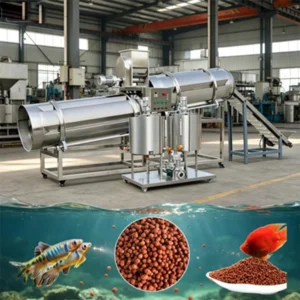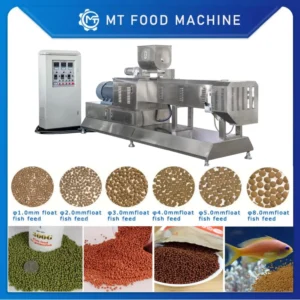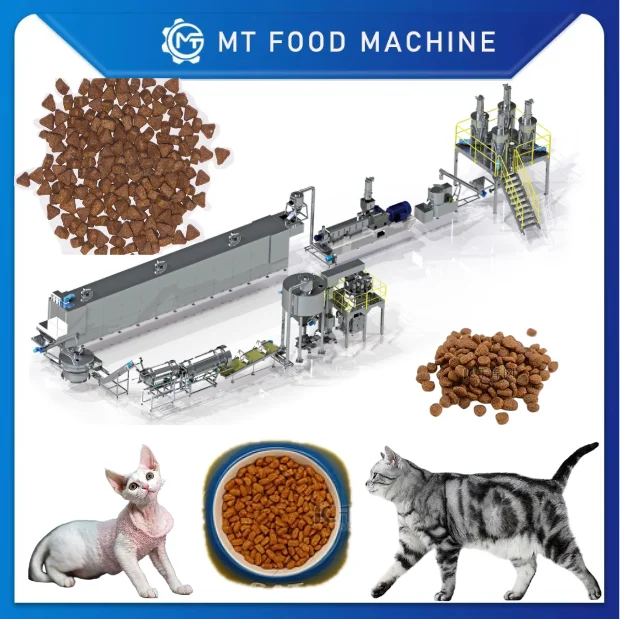
Pre-Shipment Trial Validation — every MT100 barrel zone and screw element is verified against your specific meat meal, starch ratio, and target kibble density before the line leaves our Jinan workshop.
Technical Specifications
| Parameter | Value |
|---|---|
| Model | MT100 |
| Product Type | Multi-Species Pet Food Processing Line |
| Control System | PLC Controlled Automation |
| Extrusion Type | Twin-Screw Configuration |
| Nominal Output Capacity | 1.5–2.0 t/h (basis not stated in source — confirm raw material, moisture, kibble size, and operating hours) |
| Throughput Reference | up to 550 kg/h (basis not stated in source — confirm raw material, moisture, kibble size) |
| Application Scope | Cat, dog, fish, bird, and cattle feed kibble or pellets |
| Line Configuration | Complete processing line from batching to packing |
| Certification Standard | CE Conformity |
| Voltage & Frequency | Configurable to destination market (to be confirmed prior to build) |
| Screw & Die Setup | Matched to buyer formulation and target expansion ratio |
| After-Sales Support | Video technical support and online service |
Application Suitability
| Application | Material or Output |
|---|---|
| Dry kibble for cats and dogs | Poultry meal, fish meal, corn, wheat, rice, vitamin premix |
| Floating and sinking aquatic feed | Soybean meal, shrimp head meal, starch binders for catfish, tilapia, shrimp |
| Bird feed pellets | Millet, sorghum, sunflower meal, calcium carbonate |
| Cattle feed supplementation | Corn gluten, soybean hulls, molasses, mineral premix |
| Multi-species consolidation | Single extrusion platform switching die plates and screw profiles per run |
What "1.5 to 2.0 Tons per Hour" Actually Requires from Your Formulation
Nominal capacity means nothing if your high-protein fish meal behaves differently than the corn grits the factory tested with.
I once spent five days on-site in the Middle East recalibrating barrel zones and swapping screw elements because the customer’s actual high-fresh-meat recipe expanded completely differently from the trial formula. The twin-screw pet food extrusion line specifications you see on a brochure assume a baseline material that may not match yours. When protein content shifts or fat ratios climb, gelatinisation temperature windows narrow, and a generic screw build will push out kibble that either sinks when it should float or crumbles before it reaches the coating drum [NEED_CITE: starch gelatinisation thresholds in high-protein extrusion]. This is why the MT100 line configuration is never finalized until your raw material runs through our testing workshop and the die output matches your density target.
Shear, Moisture, and Barrel Temperature Profiling
The MT100 twin-screw configuration gives operators independent control over mechanical shear and thermal input across multiple barrel zones. For a high-meat cat food recipe, the feed section needs aggressive conveying while the melt zone requires gentler shear to prevent protein denaturation before the die. Moisture injection points are mapped to where starch granules reach their gelatinisation threshold, ensuring uniform expansion without surface blistering. Getting this balance right is the core of reliable twin-screw pet food extrusion line specifications, and it changes every time the formulation changes.
Die Geometry and Kibble Density Control
Die plate thickness, orifice diameter, and land length directly govern how much the extrudate expands the moment it exits the barrel. A floating fish pellet demands a different die geometry than a dense, slow-sinking shrimp feed, even when both run on the same twin-screw platform. Our die design is specified to the buyer’s target bulk density and water stability requirement, not pulled from a catalogue shelf [NEED_CITE: die land length effect on extrudate expansion ratio]. This is where multi-species flexibility either works or fails — swap the die plate, adjust the cutter speed, and the same MT100 line shifts from producing 6 mm cat kibble to 3 mm aquaculture pellets within a single shift.
Reading the Specs That Matter for Your Output
The L:D ratio of the twin-screw assembly determines residence time inside the barrel, which controls how thoroughly starch gelatinises before the material reaches the die. A shorter ratio may suffice for simple corn-based dog kibble, but fortified infant formula powders or high-protein aquatic feeds need longer residence to achieve full cook-out. The PLC automation logs temperature and moisture data per barrel zone, so when a batch drifts, operators trace the deviation to a specific heating element or dosing pump rather than guessing. Rated power draw across the main drive motor correlates directly to the shear energy available for difficult formulations — high-fat or high-fiber recipes demand more torque at the screw shaft [NEED_CITE: motor torque requirements for high-fat extrusion feeds].
The Cost of Skipping the Trial Run
Procurement teams often compare lines on price and nominal output, then discover during commissioning that the dryer cannot keep up with extruder throughput, or the coating drum tumbles kibble too aggressively and breaks the surface. These mismatches happen when stations are sourced from different vendors who never verified throughput as a system. A bottlenecked dryer means wet kibble backs up, mould risk climbs, and the line runs at a fraction of its quoted capacity [NEED_CITE: throughput mismatch between extruder and downstream drying]. The hidden cost is not the machine — it is the weeks of lost production while engineers redesign the layout on your factory floor.
Why Source This Line from Meiteng
Meiteng engineers the entire MT100 line — batching, extrusion, drying, coating, cooling, and packing — under one supplier, so throughput at every station is matched rather than assembled from mismatched quotes. The screw configuration and die design are specified to your raw material, not copied from a generic template build. Before shipment, your actual formulation runs through the in-house testing workshop, and the trial run report documents kibble density, expansion ratio, and moisture content against your target. PLC and MCC control systems are configured to your site voltage, frequency, and preferred operator language before the electrical cabinet is sealed. Post-installation support covers on-site commissioning, operator training, and a documented wear parts list so replacement screws and dies are available when the first changeover is due.
Documentation & Verification
- Line layout drawing with throughput calculation at each MT100 station from batching through packing
- Screw element arrangement and die plate specification record matched to your formulation trial
- PLC electrical schematic confirming voltage, frequency, and control language for your facility
- Trial run report documenting expansion ratio, bulk density, and moisture on your raw material
- CE declaration of conformity covering the complete MT100 line scope
- Operation manual with barrel zone temperature profiles and preventive maintenance intervals
Installation, Commissioning & Support
- Foundation plan specifying load points and leveling requirements for the MT100 extruder and dryer footprint
- Dedicated power circuit sizing based on confirmed total connected kW and local voltage
- Modular line sections shipped labeled for sequenced assembly matching your facility entry constraints
- First-run parameter logging across all PLC-monitored barrel zones and motor loads during commissioning
- Operator training covering screw changeover, die swap, and PLC alarm response for the MT100 platform
- Wear parts list with lead times for screw elements, barrel liners, and die plates specific to your configuration
What We Need to Configure Your Line
To build an accurate MT100 layout and quotation, share your target kibble or pellet format, the primary protein and starch sources in your formulation, and your expected daily output volume. We also need your facility’s available floor length and ceiling height, local voltage and frequency standards, and preferred PLC display language. If you can send a sample batch of your raw material, we will run it through the testing workshop and include the trial data with our proposal.
Frequently Asked Questions
Q: How is the nominal output capacity verified against my specific raw material?
A: We run your actual formulation — including your protein source, starch ratio, and fat content — through our in-house testing workshop before the MT100 line ships. The trial run report documents real throughput, kibble density, and expansion data, so the capacity figure you receive is tied to your material, not a generic benchmark.
Q: What screw and die configuration will I receive for my formulation?
A: Every screw element arrangement and die plate is specified based on your raw material behaviour and target product density. You receive a configuration record and trial run report showing the results on your formulation before the line is crated for dispatch.
Q: How do you prevent dryer and coating bottlenecks on the MT100 line?
A: Every downstream station — dryer, coating drum, cooler — is sized to match the extruder’s verified output on your material. The line layout document shows throughput at each station, so no single unit restricts the flow and forces the extruder to idle.
Q: What electrical and control details are confirmed before the line ships?
A: Your site voltage, frequency, and preferred PLC interface language are confirmed during the specification stage and documented in the electrical schematic. The control cabinet is wired and labeled to match your facility’s power supply before factory testing.
Q: How are starch gelatinisation and kibble density controlled during production?
A: The PLC system monitors and logs temperature at each barrel zone alongside moisture dosing rates, so operators maintain consistent gelatinisation across shifts. Die geometry and cutter speed are set during the trial run to hold your target bulk density within specification.