词汇验证: – Industrial(通用限定词库) – Corn Flakes Production Line(来自【分类】breakfast cereals corn flakes machine + 【产品草稿】.product_type “Corn Flakes Production Line”) – Complete Line(站点修饰词池:产线方案类角色→Production Line / Turnkey Solution / Complete Line) 记录ID 10631 数字和=11,11%6=5(结构5),11%3=2(池索引2→Complete Line) 无禁用词/无编造规格/无价格/无禁用符号](https://mtextrusion.com/wp-content/uploads/2026/05/He55b4c1cec294192a848b7f7f2ee8e4dS.webp)
Extrusion Technology Focus — Twin-screw corn flakes extrusion technology production line with screw configuration and barrel temperature profile matched to your specific cereal blend, ensuring consistent starch gelatinisation and expansion control from first batch to continuous operation.
Technical Specifications
| Parameter | Value |
|---|---|
| Model | MT70 |
| Product Type | Corn Flakes Production Line |
| Installed Power | 160 kW |
| Power Consumption | 120 kW |
| Output Capacity | 150-200 kg/h (basis not stated in source — confirm raw material / moisture content) |
| Overall Dimensions (L×W×H) | 41 × 1.5 × 2.2 m |
| Control System | PLC |
| Screw Type | Twin-screw |
| Heating Source (Dryer) | Gas / Electric |
| Flaking Machine Features | Hydraulic system for double rollers; Double motors for separate roller driving; Infrared sensor temperature control |
| Roasting Oven | Hot air roasting with conciliation burner; Two separate circulating fans; Cyclone dust removal device |
| Coating System | Double tumble for sugar melting; Elevator; Coating drum; Spraying nozzle |
| Standards | CE, ISO certified |
Application Suitability
| Application | Material or Output |
|---|---|
| Natural corn flakes production | Corn, rice, wheat, oat, barley powder |
| Sugar-coated breakfast cereals | Corn grits with sugar coating |
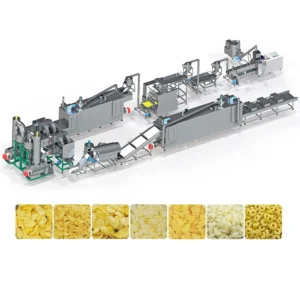
| Extruded cereal shapes | Ball, tube, stick, ring, fruit loop, star, wheel, flower, heart forms |
| Fortified breakfast cereal manufacturing | Multi-grain blends with nutritional additives |
What "150-200 kg/h" Actually Means for Your Cereal Blend
Capacity numbers mean nothing without the raw material context that produced them.
I spent a week in the field last year troubleshooting a corn flakes line where the output dropped significantly from quoted figures. The trial runs used standard corn flour, but the customer’s actual production ran on degerminated corn grits with different particle size distribution. The starch gelatinisation behaviour changed completely, and the flake structure collapsed during roasting. That corn flakes extrusion technology production line needed screw configuration adjustments and barrel temperature profile recalibration before it could hold steady output on the customer’s actual material [NEED_CITE: raw material variability in cereal extrusion processes].
When capacity claims lack raw material specifications, moisture content baselines, or product density targets, they become marketing numbers rather than engineering commitments. The extrusion parameters that work for fine corn powder will not transfer directly to coarse grits without modification.
Screw Configuration and Material Interaction
The twin-screw design in this corn flakes extrusion technology production line allows precise control over residence time and shear force distribution. Different cereal raw materials require distinct screw element arrangements to achieve target starch gelatinisation levels. Corn grits demand higher shear input than wheat flour to break down the protein matrix before starch granules can fully hydrate and gelatinise. The PLC control system manages screw speed independently from barrel temperature, giving process engineers the flexibility to adjust mechanical energy input without disrupting the thermal profile.
Barrel Temperature Profile and Starch Gelatinisation
Starch gelatinisation in corn flakes production requires careful temperature progression through multiple barrel zones. Starting with moderate heat in the feeding section prevents premature gelatinisation that would cause bridging or uneven flow. The cooking zones must reach temperatures sufficient to fully gelatinise starch while avoiding excessive degradation that reduces dough viscosity before the die. Each cereal blend—whether pure corn or multi-grain formulations with wheat, oat, or barley—requires its own temperature profile to achieve the target expansion and final flake density [NEED_CITE: starch gelatinisation temperature ranges for different cereal grains].
Hydraulic Flaking System and Sheet Thickness Control
The hydraulic system driving the double rollers in the flaking machine provides consistent pressure across the roller gap. Separate motors for each roller eliminate speed differential issues that cause sheet tearing or uneven thickness. Infrared sensor temperature control monitors roller surface conditions, preventing dough from sticking when rollers run too cool or scorching the sheet when they run too hot. Uniform sheet thickness directly affects how evenly the flakes roast and whether they achieve the target crispness and bowl life that breakfast cereal markets expect.
Hot Air Roasting and Surface Bubbling
The roasting oven uses hot air circulation with two separate fans and a conciliation burner to create the characteristic surface bubbles on corn flakes. The cyclone dust removal device captures fine particles that would otherwise recirculate and cause burnt spots on subsequent batches. Proper roasting transforms the compressed sheet into a crisp flake with the right moisture content for packaging. Insufficient roasting leaves the centre doughy; excessive heat darkens the surface before the interior reaches target moisture levels.
Selecting the Wrong Configuration Creates Hidden Problems
When screw configuration gets copied from a generic build rather than matched to specific raw material, the extruder may produce the right output volume but wrong product texture. Flakes that are too dense sink in milk rather than floating. Flakes that are too porous disintegrate within seconds of contact with liquid. The die design must match the target sheet thickness before flaking, and the barrel temperature profile must account for the specific cereal blend’s gelatinisation behaviour [NEED_CITE: extrusion parameter effects on final cereal texture and density].
Why Source This Line From a Single Supplier
The complete corn flakes extrusion technology production line from batching through packing operates as one integrated system rather than assembled components from separate vendors. The extruder output capacity matches the dryer throughput, which matches the flaking machine speed, which matches the roasting oven residence time. Screw configuration and die design get specified to your raw material and target product before production begins. The in-house testing workshop runs trial production on your actual cereal blend, verifying expansion, density, and flake structure before the equipment ships. Twin-screw extrusion expertise covers pet food, aquatic feed, snacks, cereals, starch, and protein applications, bringing cross-category knowledge to cereal processing challenges.
Documentation & Verification
- Screw and die configuration record matched to your specific cereal blend and target flake density
- Trial run report on your actual raw material from in-house testing workshop before shipment
- Barrel temperature profile documentation with zone-by-zone settings for your product specification
- Electrical schematic with voltage, frequency, and control language confirmed for your facility
- Line layout showing throughput matching between extrusion, flaking, drying, and roasting stations
Installation, Commissioning & Support
- Foundation requirements for 41-meter line length with utility connections mapped to your floor plan
- Power distribution for 160 kW installed capacity with dedicated circuits for PLC control system
- Assembly sequence for extruder, flaking machine, dryer, and roasting oven with alignment procedures
- Parameter validation on your cereal blend with screw speed and barrel temperature adjustments
- Operator training covering hydraulic flaking system controls and infrared sensor calibration
- Wear parts inventory for screws, dies, and roller surfaces with replacement schedules
Information Needed for Accurate Quotation
Provide your specific cereal formulation—whether pure corn grits, multi-grain blends, or fortified recipes with nutritional additives—along with target flake thickness and density specifications. Share your facility’s voltage and frequency standards, available floor space for the 41-meter line, and preferred control language for the PLC interface. Confirm whether you need natural corn flakes only or sugar-coated variants, as the coating system configuration affects overall line layout and utility requirements.
Frequently Asked Questions
Q: How is screw configuration matched to different cereal raw materials and moisture levels?
A: The twin-screw arrangement allows modular screw element selection based on your specific cereal blend’s starch content, protein structure, and particle size. Process engineers calculate the required shear input and residence time for complete gelatinisation at your target moisture level, then configure the screw profile accordingly before trial runs validate the settings on your actual material.
Q: What barrel temperature profile produces the target expansion and density for corn flakes?
A: Temperature progression through multiple barrel zones starts moderate in the feeding section, increases through cooking zones for starch gelatinisation, then adjusts at the die for target expansion ratio. The specific profile depends on your cereal formulation—corn, wheat, oat, or multi-grain blends each require distinct thermal profiles to achieve consistent flake density and bowl life characteristics.
Q: How do you verify output capacity on my actual raw material before shipment?
A: The in-house testing workshop runs production trials using your specific cereal blend at your target moisture content and particle size distribution. These trials measure actual throughput, expansion ratio, flake density, and product consistency, generating a detailed report that confirms the line will perform on your material rather than generic test formulations.
Q: What die design options are available for different flake thickness and final product shapes?
A: Die configurations support various shapes including ball, tube, stick, ring, fruit loop, star, wheel, flower, and heart forms. The die geometry determines pre-flake sheet thickness and expansion behaviour, working in conjunction with the hydraulic flaking system to produce your target final flake dimensions and texture characteristics.
Q: How is starch gelatinisation controlled through moisture and shear in the extrusion process?
A: The PLC control system manages moisture addition, screw speed, and barrel temperature as integrated variables. Shear force from the twin-screw configuration breaks down protein matrices while thermal energy hydrates starch granules. The balance between mechanical and thermal energy input determines gelatinisation completeness, which directly affects flake structure, crispness, and shelf stability.