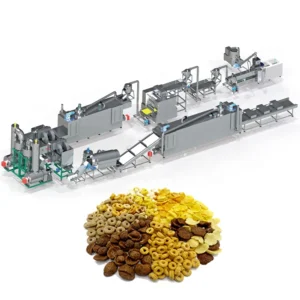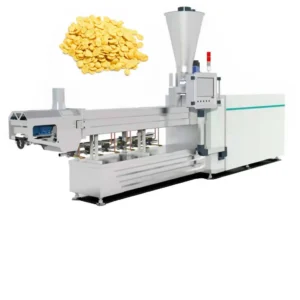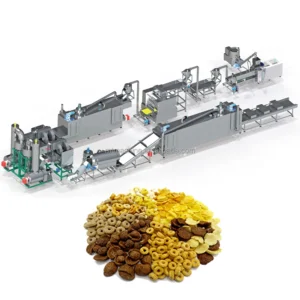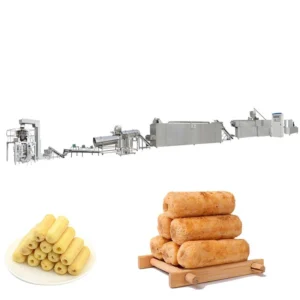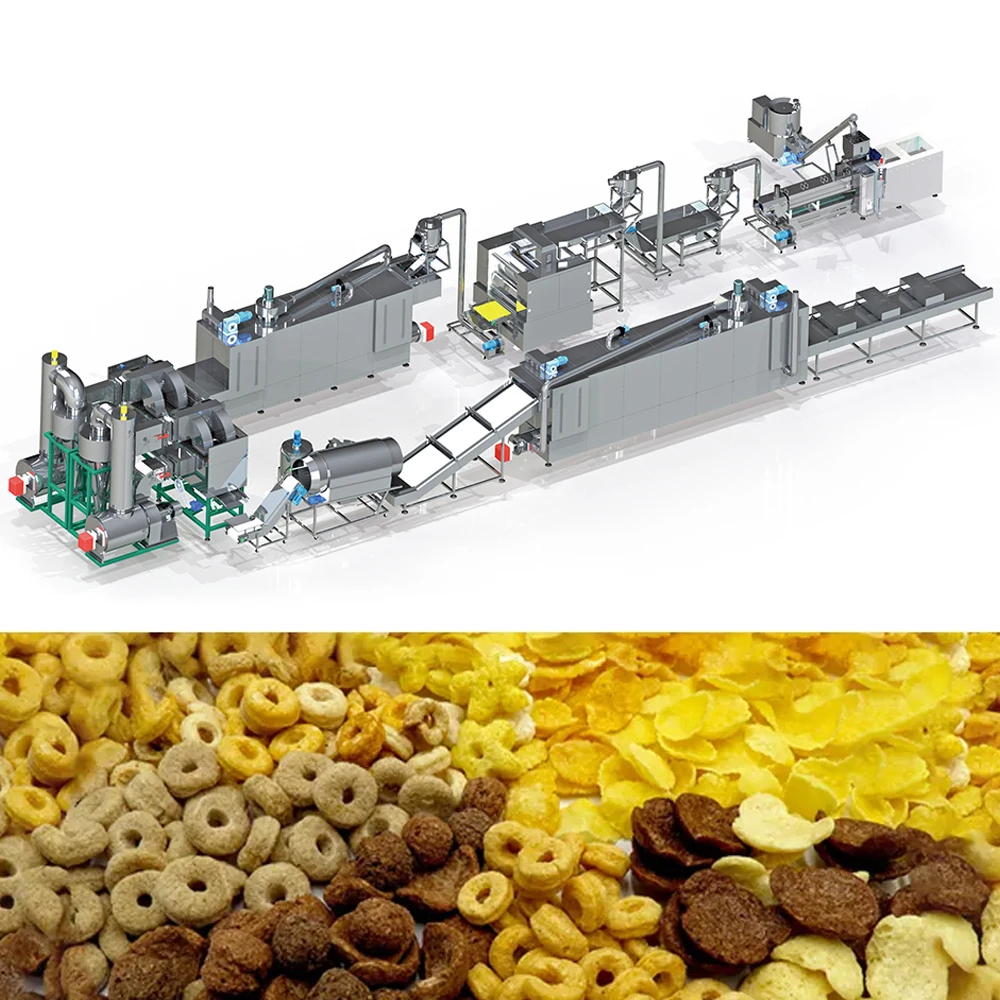
Precision screw and die matching — every MT75 barrel and die set is configured after testing the buyer’s actual cereal blend, not copied from a generic build.
Technical Specifications
| Parameter | Value |
|---|---|
| Model | MT75 |
| Product Type | Twin Screw Extruder for Corn Flakes and Breakfast Cereals Production Line |
| Installed Power | 210 kW |
| Power Consumption | 150 kW |
| Output Capacity | 200–300 kg/h (source value — verify against manufacturer catalog) |
| Overall Dimensions | 45 × 1.5 × 3.5 m |
| Screw Type | Twin screw |
| Control System | PLC control; MCC and PLC available for line |
| Die Configuration | Interchangeable moulds — ball, tube, stick, ring, fruit loop, star, wheel, flower, heart |
| Flaking System | Hydraulic double rollers, double motors, infrared sensor temperature control |
| Dryer Heating Source | Gas or electric |
| Hot Air Roasting Oven | Conciliation burner, dual circulating fans, cyclone dust removal, precise temperature control |
| Coating System | Double tumble sugar melting, elevator, coating drum, spraying nozzle |
| Voltage & Frequency | Configurable (commonly 415V 50/60Hz, 440V 50/60Hz, 220V 60Hz) |
| Standards | CE (since 2014), ISO certified |
Application Suitability
| Application | Material or Output |
|---|---|
| Natural corn flakes | Corn grits or corn flour at controlled moisture |
| Sugar-coated corn flakes | Corn base with sugar spraying and coating drum |
| Extruded cereal shapes (loops, stars, rings) | Corn, rice, wheat, oat, or barley powder blends |
| Fortified breakfast cereals | Grain blends with added nutritional premix |
| Puffed snack formats | Multi-grain or single-grain flour bases |
Why "Nominal Capacity" Means Nothing Without Raw Material Data
A corn flakes line rated at 300 kg/h on standard corn flour may stall at half that output when the buyer switches to a high-fat local maize variety.
I learned this the hard way. Last year a Southeast Asian buyer came to us for a breakfast cereal line. We ran trials on our standard corn flour and the MT75 held steady output with good expansion. Then the machine arrived at their facility and they loaded their local high-fat corn — the extrudate came out dense, under-expanded, nothing like the trial samples. The screw combination had to be completely reconfigured on-site, and that cost them roughly two weeks of production time [NEED_CITE: impact of raw material lipid content on extrusion expansion behaviour]. Since then, I insist on receiving the buyer’s actual raw material before any trial run or final screw specification is locked in. The corn flakes extrusion technology twin screw process is unforgiving when feedstock variables are ignored.
Screw Configuration Against Starch Gelatinisation
The MT75 twin-screw assembly is configured segment by segment — conveying elements, kneading blocks, and reverse screws — to control how long the cereal mash stays inside the barrel and how much shear it receives. Corn starch gelatinises within a narrow temperature and moisture window, and the barrel heating zones are set to hold that window across the full screw length. When the raw material shifts to a waxy maize or a high-protein oat blend, the gelatinisation point changes, and the screw profile must follow. This is where corn flakes extrusion technology twin screw design earns its keep over single-screw alternatives.
Die Geometry and Flake Thickness Control
The die plate determines the cross-section of the extrudate pellet before it reaches the flaking rollers. A fruit loop die produces a ring that flakes differently from a solid star die — the wall thickness, expansion ratio, and surface area all change. The MT75 carries interchangeable moulds covering ball, tube, stick, ring, fruit loop, star, wheel, flower, and heart profiles. Die selection is not just cosmetic; it governs how the pellet compresses between the hydraulic double rollers and ultimately how the finished flake behaves in milk [NEED_CITE: relationship between die geometry and bowl life in breakfast cereals].
Reading the Specification Sheet Against Your Process
Installed power at 210 kW and operating consumption at 150 kW tell you the thermal and mechanical headroom available for tough, high-moisture cereal mashes. The hydraulic flaking system with infrared sensor temperature control keeps roller gap and surface temperature consistent — critical when you need every flake pressed to the same thickness for uniform roasting downstream. The hot air roasting oven uses a conciliation burner with dual circulating fans and cyclone dust removal, which gives precise surface blistering without scorching. These are not optional extras; they directly determine whether your corn flakes have the crunch and colour the market expects.
The Cost of Skipping the Raw Material Trial
When a line is built on assumed feedstock rather than tested material, the problems do not show up in the factory acceptance test — they show up after commissioning, when the buyer’s own grain lot enters the hopper. Expansion drops, flake density climbs outside specification, and the roasting oven cannot compensate for a pellet that was never properly gelatinised. Correcting this after installation means new screw elements, new die plates, and lost production days while the line sits idle [NEED_CITE: typical cost of post-installation screw reconfiguration in food extrusion].
Why Source the Corn Flakes Line Here
The MT75 is specified as part of a complete line from batching to packing — extruder throughput is matched to the flaking rollers, dryer belt width, and roasting oven capacity so no single station bottlenecks the rest. Screw configuration and die design are documented against the buyer’s specific raw material, not pulled from a catalogue default. The in-house testing workshop runs the buyer’s actual cereal blend before the machine ships, so expansion and texture are confirmed in advance. Voltage, frequency, and control language are locked in during the specification stage to prevent commissioning delays. PLC control on the flaking machinery and MCC options for the full line give operators repeatable batch-to-batch settings.
Documentation & Verification
- Screw and die configuration record matched to your cereal raw material and target flake density
- Trial run report on your grain blend executed in the testing workshop before dispatch
- Electrical schematic with voltage and frequency confirmed to your facility supply
- Line layout drawing showing throughput balance across extruder, flaker, dryer, and roaster
- CE declaration of conformity and ISO certificate for the complete line
- Operation and maintenance manual with wear parts list for screw elements and die plates
Installation, Commissioning & Support
- Foundation plan accounts for the MT75 footprint of 45 × 1.5 × 3.5 m and flaking station mass
- Dedicated electrical circuit sized for 210 kW installed load with voltage matched to your supply
- Line arrives in modular sections for sequential assembly from mixer through packing station
- First-run parameter setting covers barrel temperature profile, roller gap, and roasting oven curve
- Operator training on PLC interface language and MCC panel logic for your production crew
- Wear parts inventory list for screw segments, die plates, and flaking roller surfaces provided at handover
Before You Request a Quote
Send your raw material data sheet — grain type, moisture percentage, fat content, and any nutritional premix additions. Confirm your target flake thickness and whether you need natural or sugar-coated output. Provide your facility voltage and frequency so the electrical package is built correctly from the start.
Frequently Asked Questions
Q: How is the screw configuration matched to my specific cereal raw material?
A: We run your actual grain blend in the testing workshop and measure expansion ratio, pellet density, and gelatinisation behaviour. The screw segments — conveying, kneading, and reverse elements — are then selected and documented in a configuration record specific to your material, not copied from a generic template.
Q: What moisture range is needed for proper starch gelatinisation during extrusion?
A: Corn starch typically gelatinises between specific moisture and temperature thresholds that vary by grain variety. We confirm the correct barrel temperature profile and preconditioning moisture for your exact blend during the trial run, then record those parameters in the machine specification sheet.
Q: Can I run a trial on my own raw material before the machine ships?
A: Yes. The in-house testing workshop is set up for exactly this purpose. Your grain blend is fed through the MT75, and the extrudate is evaluated for expansion, texture, and flaking behaviour. Results are documented in a trial run report shared before shipment approval.
Q: How do I confirm voltage and control language match my facility?
A: During the specification stage we collect your supply voltage, frequency, and preferred control language. The electrical schematic and PLC programming are built to those parameters, and confirmation documents are shared before production begins so there are no surprises at commissioning.
Q: How is throughput balanced between extruder, flaker, and roaster?
A: Each station is sized so the MT75 output rate matches the hydraulic flaking roller capacity, the dryer belt width, and the hot air roasting oven volume. The line layout drawing shows calculated throughput at every station to confirm no bottleneck exists before the equipment is built.