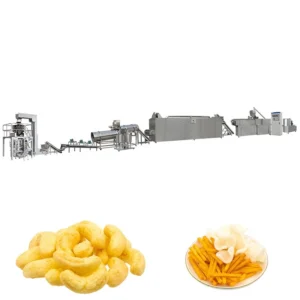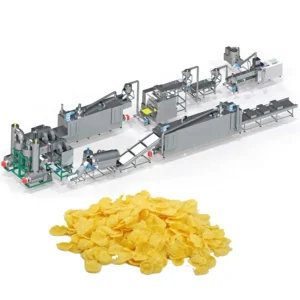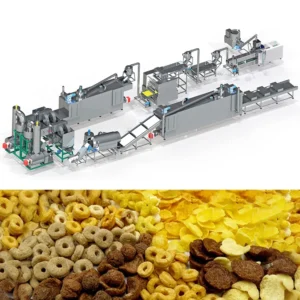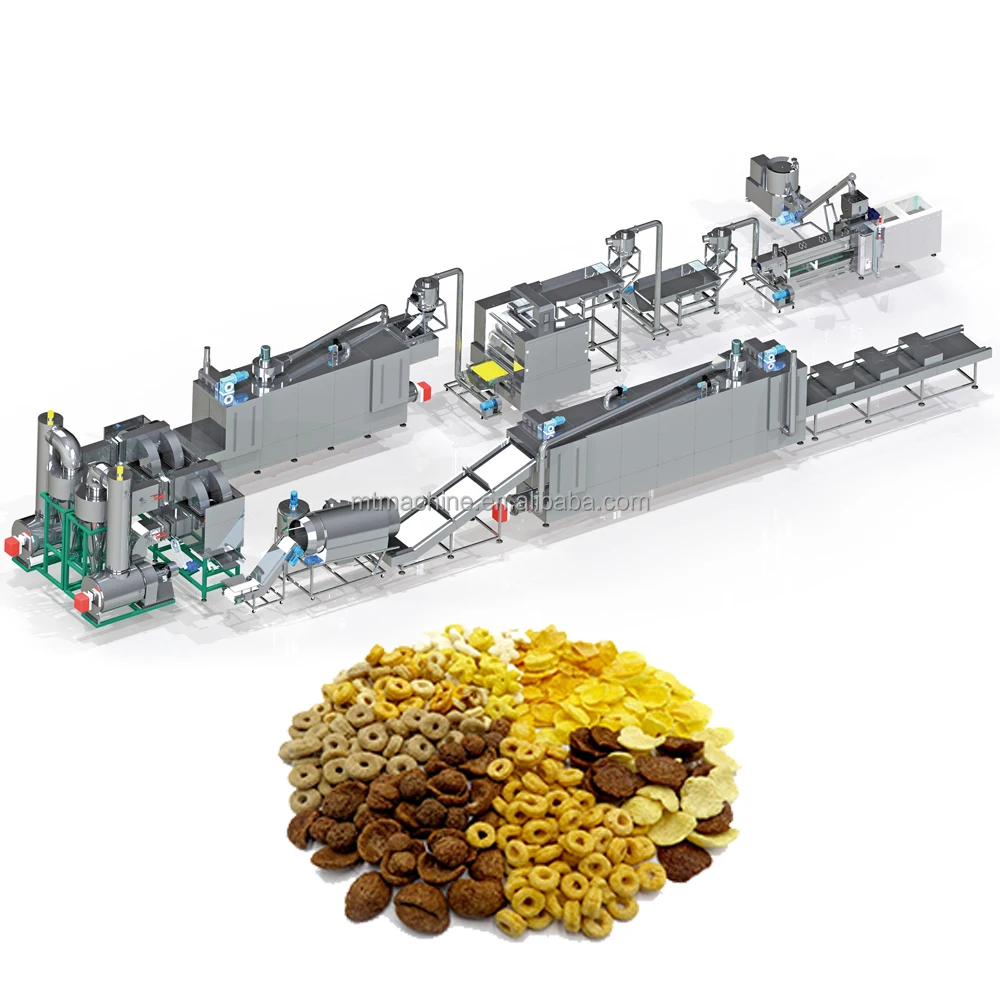
Screw Geometry Matched to Your Grain — Barrel temperature profiles and die design on the MT-75 are configured against the specific corn, wheat, oat or rice variety you ship to us for trial, locking starch gelatinisation before the flaking roller ever sees the extrudate.
Technical Specifications
| Parameter | Value |
|---|---|
| Model | MT-75 |
| Product Type | Twin Screw Corn Flakes Extrusion Production Line |
| Screw Type | Twin-screw |
| Output Capacity | 200-300 kg/h (basis not stated in source — confirm raw material, moisture content and product format) |
| Voltage | 220V/380V (frequency to be confirmed) |
| Control System | PLC control system (flaking station) |
| Flaking Drive | Double motors for separate roller driving; hydraulic system for double rollers |
| Dryer Heating Source | Gas or Electric |
| Hot Air Roasting Oven | Vibrating pan with high temperature spraying tubes; conciliation burner; two separate circulating fans; cyclone dust removal device |
| Coating System | Double tumble for sugar melting, elevator, coating drum, spraying nozzle |
| Line Configuration (Natural) | Mixing → Extruding → Flaking → Drying → Hot Air Roasting → Cooling → Packing |
| Line Configuration (Sugar-coated) | Mixing → Extruding → Flaking → Drying → Hot Air Roasting → Sugar Spraying → Sugar Coating → Drying → Cooling → Packing |
| Core Components | Gearbox |
| Warranty | 1 Year |
| Machinery Test Report | Provided |
| Video Outgoing-inspection | Provided |
Application Suitability
| Application | Material or Output |
|---|---|
| Natural corn flakes | Corn grits, corn flour |
| Sugar-coated breakfast flakes | Corn, rice, wheat, oat, barley base with sugar or honey coating |
| Multi-grain breakfast cereals | Blends of rice, wheat, oat and barley with varied starch profiles |
| Cereal format variation | Die changes produce different flake shapes and pellet intermediates |
What "Rated Capacity" Means When the Screw Meets Your Corn
Capacity is a function of your raw material, not a label on the machine plate.
I spent two weeks in a Bogotá plant watching a corn flakes extrusion production line churn out thick, uneven sheets that shattered under the flaking roller. The root cause was not the motor or the gearbox — it was a screw configuration calibrated to a fine corn flour the factory no longer sourced. The local corn meal was coarser, absorbed moisture differently, and the barrel temperature profile had never been adjusted. When throughput claims ignore raw material particle size and moisture content, the number on the spec sheet becomes meaningless the day commissioning ends [NEED_CITE: starch gelatinisation behaviour across corn particle size distributions].
How the Twin-Screw Profile Controls Flake Density
On a corn flakes extrusion production line, the twin-screw extruder determines how completely starch granules rupture inside the barrel. Configurable screw elements let you adjust shear intensity and residence time so that a high-amylose corn variety receives longer dwell under moderate shear, while a waxy corn with rapid gelatinisation onset sees shorter residence at higher shear. Get this wrong and the extrudate either over-expands — making it impossible to flatten into a coherent flake — or under-gelatinises, leaving a dense chip that stays hard in milk.
Moisture, Barrel Temperature and the Flaking Window
The gap between a successful flake and a cracked one is measured in moisture percentage points and barrel zone temperatures. Moisture injected or evaporated inside the barrel sections must leave the extrudate pliable enough for the hydraulic flaking station to compress it uniformly between the independently driven rollers. If the die face temperature is too high, surface moisture flashes off and the pellet skins over before it reaches the rollers; too low and the extrudate sticks, tearing under pressure. The PLC-controlled flaking station with infrared feedback holds roller gap tolerance across the full roller face, which is where consistent flake thickness actually originates [NEED_CITE: flaking roller gap tolerance and cereal bowl-life correlation].
Reading the Specification Sheet Against Your Production Target
The MT-75 output figure of 200-300 kg/h is stated without a confirmed raw material basis — meaning the real throughput on your specific corn or multi-grain blend must be established during a pre-shipment trial. The gearbox drives the twin screws through the full barrel length, while the hot air roasting oven with two separate circulating fans and a cyclone dust removal device controls the final moisture reduction that gives the flake its bowl-life. Dryer heating is available in gas or electric configurations, and the choice affects both operating cost and temperature ramp speed during roasting. The double-tumble coating system for sugar-coated variants includes a dedicated melting stage, elevator and spraying nozzle, so sugar distribution is applied in layers rather than dumped in a single pass. Voltage is configurable between 220V and 380V, but frequency must be confirmed against your site supply before electrical schematics are finalised.
When a Generic Build Lands on Your Factory Floor
A screw configuration copied from a reference project without accounting for your corn source, particle size and target flake weight per litre produces one of two outcomes: the extrudate over-expands and disintegrates in the dryer, or it exits under-cooked and the roaster cannot recover the texture. Either way, the flaking roller sees inconsistent feed and the packing station receives off-spec product. Commissioning then turns into a re-engineering exercise conducted at your expense rather than ours [NEED_CITE: twin-screw extrusion reconfiguration cost during on-site commissioning].
Why the Extrusion Technology Matters at This Station
Every cereal format — natural corn flake, sugar-coated wheat flake, multi-grain cluster — demands a different balance of gelatinisation, expansion and surface moisture at the die face. This corn flakes extrusion production line is built around that principle: screw elements are selected to match your grain’s starch behaviour, barrel zones are profiled to hold that gelatinisation curve, and the downstream flaker, dryer and roaster are sized so that no single station creates a bottleneck. The two line configurations, natural and sugar-coated, share the same extrusion front end and diverge only after roasting, which keeps changeover between SKUs a matter of coating parameters rather than a full mechanical reconfiguration.
Documentation & Verification
- Screw configuration and die design record matched to your corn variety and target flake density
- Trial run report on your shipped raw material, confirming expansion ratio and throughput before packing
- Electrical schematic with confirmed voltage, frequency and PLC language for your operators
- Line layout showing throughput balance across extruder, flaker, dryer, roaster and coating drum
- CE declaration of conformity and ISO certificate applicable to this line configuration
- Factory test video with outgoing inspection record
Installation, Commissioning & Support
- Foundation and floor loading plan provided for the full MT-75 line footprint including roaster and coating stations
- Voltage and frequency confirmed pre-build; dedicated circuit sizing specified for the hydraulic flaking drive
- Gearbox and twin-screw barrel inspected at our testing workshop before crating and dispatch
- On-site commissioning includes flaker roller gap calibration against your first production batch
- Operator training covers screw element changeover, PLC parameter recall and roaster fan balancing
- Wear parts list supplied with recommended screw element and die replacement intervals
What to Prepare Before Requesting a Quotation
Send us the exact corn or grain variety you intend to run, including particle size distribution and typical moisture at intake. Confirm your local voltage and frequency, the PLC language your operators need, and whether the target SKU is natural, sugar-coated or both. Share your available floor area and ceiling height so that the line layout accounts for the roaster exhaust and cyclone dust removal routing.
Frequently Asked Questions
Q: How is screw configuration and barrel temperature profile selected for different cereal bases?
A: We start with the starch gelatinisation curve of your specific grain — corn, wheat, oat, rice or a blend. Screw elements are arranged to deliver the shear and residence time that grain requires, and barrel zone temperatures are set to hold that curve through to the die face. A pre-shipment trial on your raw material locks the configuration before the machine leaves our testing workshop.
Q: How do you verify that the extruder’s rated capacity holds on my actual raw material blend?
A: The 200-300 kg/h figure is a reference range, not a guarantee. We run your shipped raw material in our in-house testing workshop, measure actual throughput at your target moisture level, and document the result in a trial run report. That report accompanies the machine and forms the baseline for on-site commissioning adjustments.
Q: What extrusion parameters control flake density and bowl-life?
A: Flake density is set by the interplay of extrudate expansion at the die, moisture content entering the flaking roller, and the hydraulic pressure applied during flaking. Bowl-life depends on how completely starch is gelatinised inside the barrel and how uniformly the hot air roasting oven removes residual moisture without scorching the flake surface.
Q: How is the flaking roller gap and pressure set for consistent flake thickness?
A: The hydraulic flaking station on the MT-75 uses double motors for independent roller driving, with PLC control and infrared temperature feedback. Roller gap is calibrated during our workshop trial to your target flake thickness, then fine-tuned on your floor during commissioning using your first production batch as the reference.
Q: What die shapes are available and how does die geometry affect the final product?
A: Die geometry determines the cross-section and initial expansion ratio of the extrudate before it reaches the flaking roller. Different die profiles produce varying flake shapes and thicknesses. We match die selection to your target SKU during the pre-shipment trial, and additional dies can be specified for future product formats.