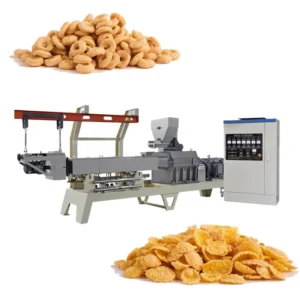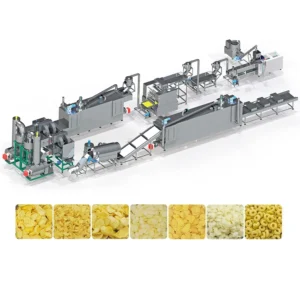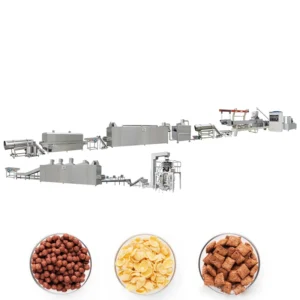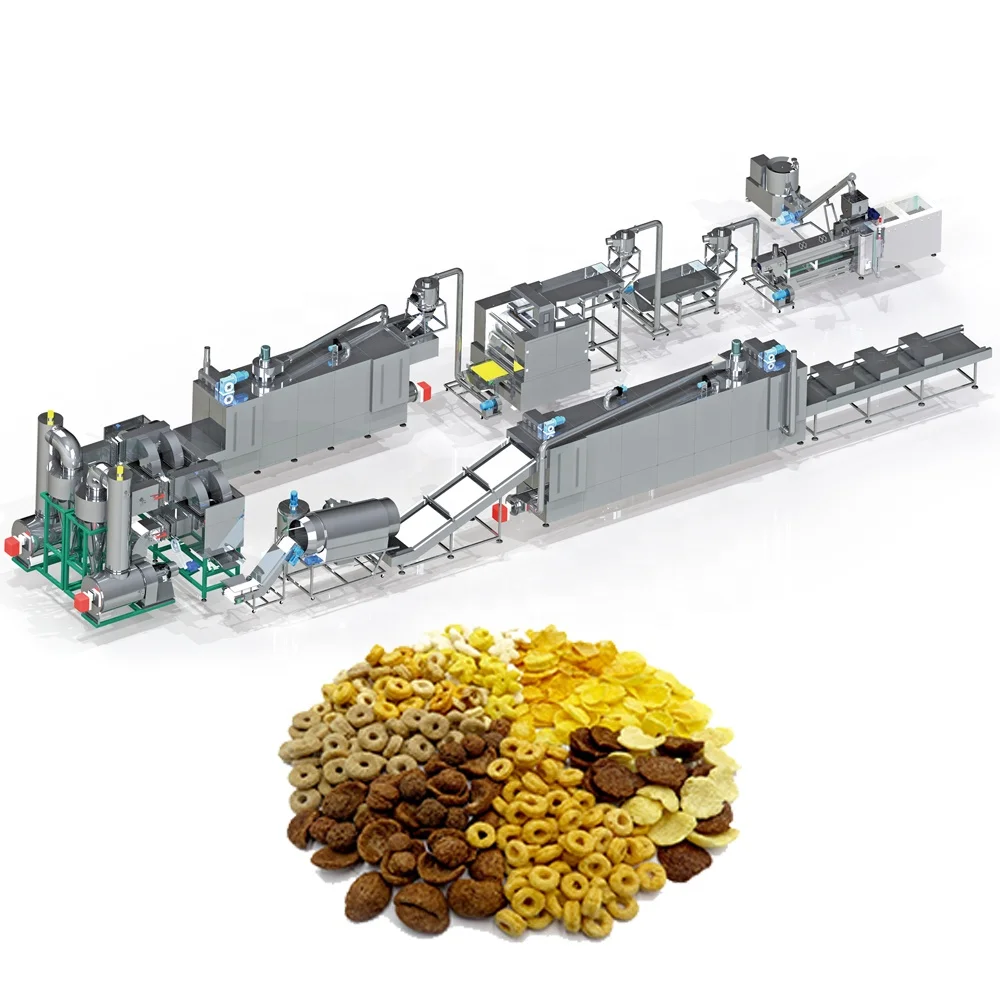
Screw configuration matched to raw material — We configure the barrel temperature profile and die geometry to your specific cereal blend rather than relying on a generic build, verified through in-house trial runs before the line ships.
Technical Specifications
| Parameter | Value |
|---|---|
| Model | MT75 (MT70 / MT85 configurations available) |
| Product Type | Corn Flakes Breakfast Cereal Production Line |
| Extruder Type | Twin Screw |
| Installed Power | 210 kW (MT75) |
| Power Consumption | 150 kW (MT75) |
| Output Capacity | 300–500 kg/h (basis not stated in source — confirm raw material type, moisture content and product format) |
| Overall Dimensions | 45 × 1.5 × 3.5 m (MT75) |
| Control System | PLC |
| Flaking Mechanism | Hydraulic double rollers, independent motor drives, infrared temperature control |
| Roasting Oven | Hot air circulation, dual fans, conciliation burner, cyclone dust removal |
| Dryer Heating Source | Gas or Electric (configurable) |
| Raw Materials | Corn, rice, wheat, oat, barley powder |
Application Suitability
| Application | Material or Output |
|---|---|
| Natural corn flakes production | Corn grits or maize flour |
| Sugar-coated corn flakes | Corn base with syrup or sugar glaze |
| Multi-grain breakfast flakes | Blends of rice, wheat, oat, and barley powder |
| Shaped extruded cereal formats | Rings, loops, stars, wheels via die exchange |
What "Nominal Capacity" Leaves Out on a Corn Flakes Line
A rated output figure means nothing if it was measured on a standard corn blend while your local grain carries higher moisture.
When buyers compare lines, they often look at the headline kg/h number. But extrusion is a reaction between the screw profile, barrel heat, and the exact moisture and starch content of the grain entering the feed hopper. I have stood beside a flaking mill watching thick, hard pellets come off the roller because the local maize had a few percentage points more water than the test batch, pushing the gelatinisation window out of reach. That is why a corn flakes extrusion production line turnkey must be validated on your actual raw material before it leaves the factory, not after it arrives on your floor [NEED_CITE: starch gelatinisation temperature and moisture dependency in cereal extrusion].
Barrel Temperature Profile and Starch Gelatinisation
The twin-screw extruder on this line manages the moisture and shear balance that determines how completely the starch granules rupture. A proper corn flakes extrusion production line turnkey relies on a barrel temperature profile that rises through the zones, ensuring the dough reaches the gelatinisation threshold without premature expansion at the die face. When the profile is off, the flakes come out dense instead of crisp.
Die Design and Flake Geometry Control
The die plate defines the cross-section of the extrudate before it hits the flaking rolls. For natural corn flakes, a narrow slot die produces the thin, flat pellet that roasts into a blistered flake. For shaped formats like rings or loops, the die is swapped and the cutter speed adjusted. The hydraulic double-roller flaking machine then compresses each pellet to a uniform thickness, with infrared sensors monitoring roller temperature to prevent sticking or uneven deformation [NEED_CITE: hydraulic flaking roll pressure and surface temperature in cereal processing].
Reading the Specs That Actually Matter
The installed power of the MT75 extruder sits at 210 kW, with operating consumption around 150 kW. That power budget drives both the mechanical shear inside the barrel and the heating elements across the zones. The PLC control system coordinates feed rate, screw speed, and zone temperatures so that batch-to-batch consistency does not depend on operator intuition. The hydraulic flaking station uses independent motors for each roller, allowing differential speed adjustment that influences how the pellet spreads under pressure. The roasting oven uses a conciliation burner with two circulating fans and a cyclone dust collection unit, which together control the blistering pattern and surface moisture removal that defines the final flake crispness.
The Hidden Cost of Mismatched Line Stations
An extruder running at full capacity is useless if the dryer downstream cannot remove moisture fast enough, or if the coating drum cannot tumble the flakes through the sugar spray before they clump. When stations are sourced from separate vendors, each one quotes a nominal throughput without accounting for the losses and dwell times of the others. The result is a bottleneck that caps your real output below what any single machine promised. This is one of the most common reasons a corn flakes extrusion production line turnkey fails to meet the buyer’s business plan [NEED_CITE: throughput matching across extrusion, drying, and coating stations].
Why Source the Complete Line from One Supplier
Every station on this corn flakes line — from the batching mixer through the extruder, flaking rolls, dryer, roasting oven, coating drum, and packing conveyor — is specified as a single throughput-matched system. The screw configuration and die design are selected against your raw material sample, not pulled from a generic template. Before dispatch, the line runs a trial on your actual grain blend in the testing workshop, producing a written report on output, flake density, and texture. Electrical schematics confirm voltage, frequency, and control language to your site specification before production starts. Wear parts including screws, dies, and roller surfaces are catalogued with lead times so that your first replacement order is not a surprise.
Documentation & Verification
- Line layout and capacity calculation showing throughput at every station
- Screw and die configuration record matched to your cereal blend
- Trial run report on your raw material from the in-house testing workshop
- Electrical schematic with voltage and frequency confirmed to your site
- Operation and maintenance manual with wear parts list and reorder codes
Installation, Commissioning & Support
- Foundation plan accounts for the 45 m line footprint and roasting oven load
- Power supply must support 210 kW installed load with dedicated circuit protection
- Line arrives in modular sections for sequential assembly and alignment
- First-run commissioning includes PLC parameter tuning on your local grain supply
- Operator training covers screw wear inspection and flaking roller gap calibration
- Spare screws, dies, and roller shells stocked with documented reorder lead times
What to Include in Your Inquiry
To configure the line correctly, share the type and source of your grain — whether it is maize flour, rice grits, or a multi-grain blend — along with the typical moisture content you receive from your mill. Specify your target daily output and whether you plan to run natural flakes, sugar-coated flakes, or both. Confirm your facility voltage, frequency, and preferred control language so that the electrical package matches your site before fabrication begins.
Frequently Asked Questions
Q: How is line capacity verified on my specific raw material blend before shipment?
A: We run your actual grain sample through the extruder and flaking station in our testing workshop. The trial records output rate, flake thickness, and surface texture under controlled barrel temperatures. You receive a written report confirming the achievable throughput on your material before the line is cleared for dispatch.
Q: How is screw configuration selected for natural versus sugar-coated corn flakes?
A: Natural flakes require a screw profile that produces a dense, low-expansion pellet suitable for thin flaking. Sugar-coated variants need a slightly more open texture so the syrup penetrates during tumbling. We adjust the screw element arrangement and die geometry based on your target product and confirm both during the pre-shipment trial.
Q: What electrical and control options are confirmed before the line is built?
A: We document your site voltage, frequency, and preferred PLC display language on the electrical schematic before production starts. This prevents commissioning delays caused by incompatible motor ratings or control interfaces that your operators cannot read.
Q: How are the flaking rolls and roasting oven calibrated for the target flake texture?
A: The hydraulic flaking station uses independent roller motors and infrared temperature control to set pellet compression and prevent surface sticking. The roasting oven burner and dual fan speeds are tuned during commissioning to achieve the blister pattern and moisture level your market expects.
Q: What wear parts are included and how are replacements handled?
A: The initial shipment includes spare screw elements, die plates, and flaking roller shells. Each part is catalogued with a reorder code and typical lead time so you can plan inventory before your first scheduled changeout.