Screw Configuration Matched to Grain — Die design and barrel profiling are specified after reviewing the buyer’s actual corn, wheat, or multi-grain formula, not copied from a generic breakfast cereal build.
Technical Specifications
| Parameter | Value |
|---|---|
| Model | MT70 / MT85 / MT75 |
| Product Type | Breakfast Cereal Corn Flake Production Line |
| Screw Type | Twin Screw |
| Installed Power | MT70 — 160 kW; MT85 — 190 kW; MT75 — 210 kW |
| Power Consumption | MT70 — 120 kW; MT85 — 140 kW; MT75 — 150 kW |
| Output Capacity | MT70 — 150–200 kg/h (basis to be confirmed); MT85 — 300–400 kg/h (basis to be confirmed); MT75 — 300–500 kg/h (basis to be confirmed) |
| Overall Dimensions (L×W×H) | MT70 — 41 × 1.5 × 2.2 m; MT85 — 43 × 1.5 × 3.2 m; MT75 — 45 × 1.5 × 3.5 m |
| Basic Raw Materials | Powder of corn, rice, wheat, oat, barley |
| Control System | PLC control (flaking machinery); MCC and PLC across line |
| Flaking Machinery Features | Hydraulic system for double rollers; double motors for separate roller driving; infrared sensor for temperature pipe control |
| Dryer Heating Source | Gas or Electric |
| Hot Air Roasting Oven | Vibrating pan; conciliation burner combustion chamber; two separate circulating fans; cyclone dust removal device; precise temperature control |
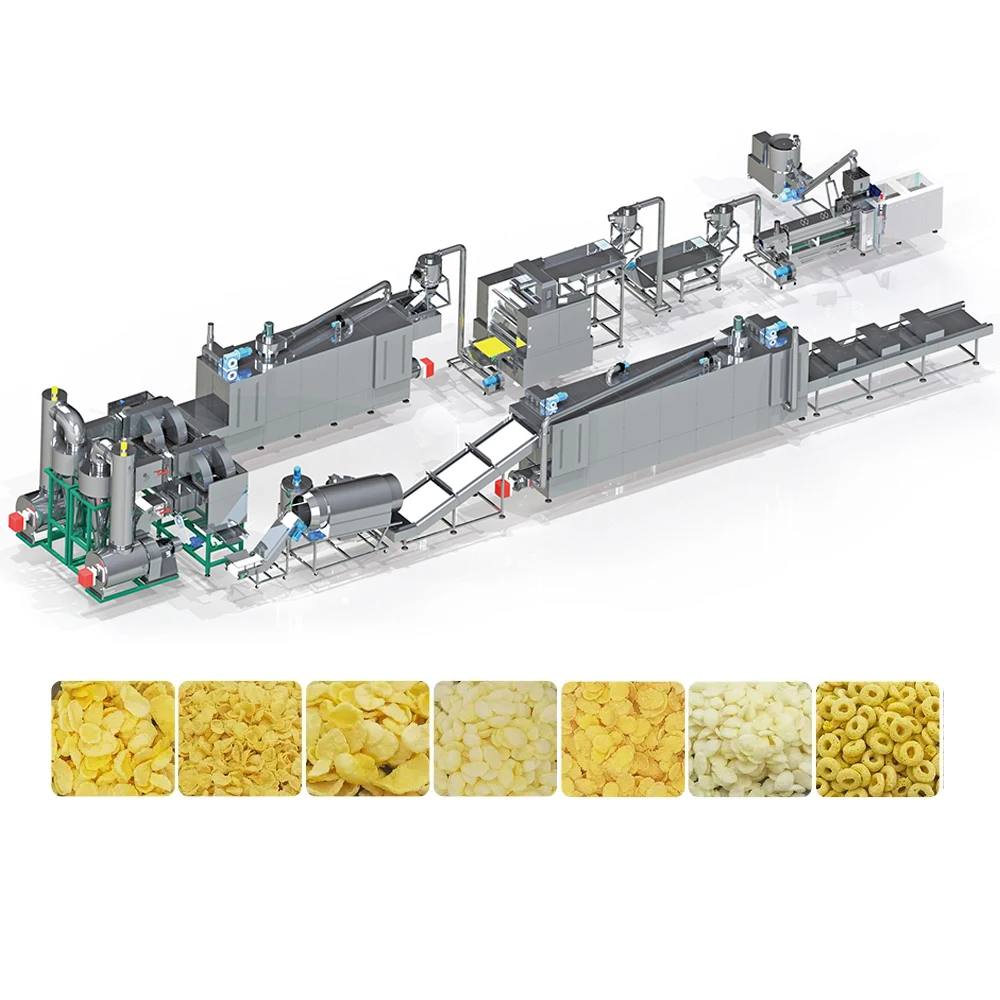
| Final Product Shapes | Natural corn flakes, sugar-coated corn flakes, ball, tube, stick, ring, fruit loop, star, wheel, flower, heart (by adjusting extruder mould) |
| Standards | CE; ISO |
Application Suitability
| Application | Material or Output |
|---|---|
| Natural corn flake production | Corn grits and corn flour processed through extrusion, flaking, and hot air roasting |
| Sugar-coated breakfast cereals | Corn or multi-grain pellets with sugar spraying and coating drum application |
| Multi-grain cereal blends | Wheat, oat, barley, and rice powder blends requiring specific starch gelatinisation profiles |
| Shaped extruded cereal formats | Fruit loops, stars, rings, and wheels produced by die changes on the same extrusion platform |
What "300 kg per Hour" Leaves Out on a Corn Flake Line
Nominal capacity means nothing until the grain blend, moisture content, and target flake density are defined.
I have watched buyers receive a corn flakes extrusion technology production line rated for a certain output on pure corn grits, then feed it a 60/40 wheat-corn blend without informing the supplier. Wheat starch gelatinises at a different temperature window and absorbs water differently. The barrel profile calibrated for corn pushes wheat into over-gelatinisation too early, producing a sticky extrudate that clogs the flaking rollers. Throughput drops, and the line never reaches the quoted rate [NEED_CITE: starch gelatinisation temperature differences between corn and wheat].
This happens more often than it should. A buyer sees a capacity figure in a brochure and assumes it transfers directly to their recipe. The corn flakes extrusion technology production line is then built around generic screw elements and a default die plate. When the first production run falls short, everyone points fingers. The capacity figure on a spec sheet only becomes real once it is anchored to a specific raw material formula, incoming moisture level, and the flake thickness the market expects.
Barrel Temperature Zones and Starch Gelatinisation Control
A twin-screw extruder for corn flakes works through distinct thermal zones along the barrel. Each zone governs a different phase: hydration, gelatinisation, and melt homogenisation. Corn requires a gradual ramp so that starch granules swell uniformly before reaching the die. If zone three spikes too early, the outer layer of the extrudate skins over while the core remains undercooked, and the resulting pellet fractures unevenly under the flaking rollers.
The MT series extruder divides the barrel into independently controlled heating zones. The operator sets the profile based on the grain blend entering the feed hopper. A high-oat formula demands a flatter curve because oat starch is more shear-sensitive, while a pure corn recipe tolerates a steeper ramp. Getting this right determines whether the flake roasts into a crisp sheet or crumbles into dust.
Die Geometry, Moisture, and Flake Expansion Behaviour
Die design controls the pressure drop at the extruder exit, which directly governs how much the extrudate expands. For traditional corn flakes, the goal is minimal expansion — a dense pellet that flattens cleanly between the flaking rollers without tearing. A die with too large an orifice reduces back-pressure, the extrudate puffs prematurely, and the flaking station produces ragged edges instead of smooth, round flakes.
The screw configuration works together with the die. Forward-conveying elements dominate the feed section, while kneading blocks in the mid-barrel build the shear needed for complete gelatinisation. A corn flakes extrusion technology production line configured for minimal expansion uses a higher proportion of conveying elements and a restrictive die. Switch to a fruit loop or ring format, and the screw profile shifts toward more kneading blocks with an open die to allow controlled puffing [NEED_CITE: twin-screw extrusion screw element configuration principles for food applications].
Reading the Spec Sheet Like a Process Engineer
The installed power ratings — 160 kW for the MT70 up to 210 kW for the MT75 — indicate the mechanical energy available for shear and conveyance inside the barrel. Higher installed power supports longer barrels with more kneading zones, which improves gelatinisation uniformity across difficult grain blends. Power consumption figures run roughly 70–75% of installed capacity during steady-state operation, reflecting actual energy draw under typical load.
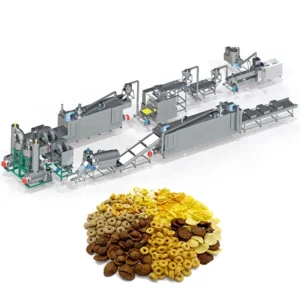
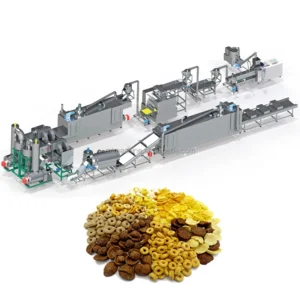
Overall line length stretches from 41 metres for the MT70 to 45 metres for the MT75. That footprint covers mixing, extruding, flaking, drying, hot air roasting, and cooling. Each station must be throughput-matched. An extruder producing at a rate the dryer cannot handle creates a bottleneck where moisture remains trapped, and the flakes emerge soft rather than crisp. The hot air roasting oven uses dual circulating fans and a vibrating pan to ensure every flake receives even heat exposure, developing the surface blistering that gives corn flakes their characteristic crunch.
The PLC-controlled flaking station uses hydraulic pressure on double rollers with independent motor drives. This allows fine adjustment of roller gap and nip pressure, producing uniform flake thickness across the full roller width. Infrared temperature monitoring on the pipe prevents the extrudate from cooling too much before it reaches the rollers — cold pellets crack rather than flatten.
The Cost of Skipping the Raw Material Conversation
Buyers who withhold their grain formula to speed up the quotation process often pay for it during commissioning. A screw configuration specified for corn grits will not handle a wheat-heavy blend without modification. The extruder runs, but the product texture misses the target, the flake density falls outside what the packaging line expects, and the roasting oven cannot compensate for an under-gelatinised pellet [NEED_CITE: extrusion process validation on customer raw material before shipment].
Voltage and frequency mismatches compound the problem. A line wired for 380V/50Hz arrives at a 440V/60Hz facility. Motors over-speed, barrel heaters overshoot their setpoints, and the PLC throws faults that take days to diagnose. These issues are preventable with a single electrical schematic confirmation before production begins.
Why Source the Extrusion Technology Here
The screw configuration and die design are specified to the buyer’s actual grain blend and target flake density, not pulled from a standard template. Each corn flakes extrusion technology production line ships with a documented configuration record tying screw elements to the formula provided.
An in-house testing workshop runs trial production on the buyer’s raw material before shipment. The trial run report captures barrel temperatures, screw speed, moisture levels, and flake density measurements, so process parameters are established before the line arrives on site.
Throughput is matched across every station — extruder, flaking rollers, dryer, and roasting oven — under one supplier. This eliminates the common failure where individual machines from separate vendors create bottlenecks. The hot air roasting oven, with its dual circulating fans and cyclone dust removal, is sized to handle the output the extruder delivers.
CE certification has been held since 2014, and ISO standards are maintained across production. Electrical schematics are confirmed to the buyer’s local voltage and frequency before the control panel is wired.
Documentation & Verification
- Screw and die configuration record tied to your grain formula and target flake density
- Trial run report on your raw material from the in-house testing workshop before dispatch
- Line layout with throughput calculations confirming station-to-station capacity matching
- Electrical schematic with voltage and frequency locked to your facility specification
- Operation and maintenance manual covering barrel cleaning, roller gap adjustment, and roasting oven service intervals
- Wear parts list identifying screw elements, die plates, and flaking roller surfaces with replacement intervals
Installation, Commissioning & Support
- Foundation plan accounts for the 41–45 metre line length and vibrating pan load in the roasting section
- Dedicated electrical circuit sized to the MT75 peak draw of 210 kW installed power with voltage confirmed pre-wiring
- PLC interface language configured to operator preference before the control cabinet leaves the factory
- First-run commissioning includes barrel temperature profiling on your grain blend with flake density verification
- Operator training covers screw element inspection, hydraulic roller gap calibration, and roasting oven fan balance checks
- Spare screw elements and die plates shipped with the line to cover the first replacement cycle
Before You Request a Quotation
To build a line configuration that actually holds its output on your material, we need the grain formula — corn percentage, wheat or oat additions, and any minor ingredients — along with the incoming moisture content of your flour or grits. Confirm your local voltage, frequency, and the control language your operators will use. If you are targeting a specific flake thickness or bowl-life duration, share that specification so the die and roasting parameters can be set accordingly.
Frequently Asked Questions
Q: How is screw configuration selected for different grain blends in corn flake extrusion?
A: Corn, wheat, oat, and barley each have distinct starch gelatinisation temperatures and shear sensitivities. The screw profile is adjusted by varying the ratio of conveying elements to kneading blocks along the barrel. A high-corn formula uses more kneading zones for thorough gelatinisation, while an oat-heavy blend reduces shear to prevent starch degradation. Configuration is documented against your specific formula before production.
Q: What barrel temperature profile is needed for proper starch gelatinisation in corn flake extrusion?
A: Corn typically requires a gradual temperature ramp across the barrel zones, starting with hydration and building toward full gelatinisation before the die. Wheat demands a flatter profile because its starch window is narrower. The operator sets each zone independently on the PLC, and the profile is validated during the pre-shipment trial run on your actual raw material.
Q: How is flake density and crunch texture controlled through extrusion and roasting parameters?
A: Density is governed by die geometry, extruder moisture content, and screw speed — all controlling how much the extrudate expands before reaching the flaking rollers. Crunch texture is then developed in the hot air roasting oven, where dual circulating fans and precise temperature control create surface blistering. Roasting time and temperature are adjusted to hit the target bowl-life.
Q: Can the same extrusion platform produce both traditional corn flakes and shaped cereal formats?
A: Yes. The twin-screw extruder accepts different die plates and screw configurations. Switching from flat flakes to fruit loops, stars, or rings involves changing the die and adjusting the screw profile to allow controlled expansion. The downstream flaking station is bypassed for shaped products, with the extrudate going directly to drying and roasting.
Q: How is a trial run conducted on the buyer’s raw material before shipment?
A: The buyer sends a representative sample of their grain blend to the in-house testing workshop. The line is configured with the proposed screw and die setup, and a production run is executed at target moisture and temperature settings. Flake density, thickness, and roasting response are measured, and the results are documented in a trial run report shared before the equipment ships.