Precision extrusion configuration — screw and die geometry matched to your grain formulation to control gelatinisation and achieve predictable flake density across every batch.
Technical Specifications
| Parameter | Value |
|---|---|
| Product Type | Breakfast Cereals Corn Flakes Production Line |
| Available Models | MT70, MT85, MT75 |
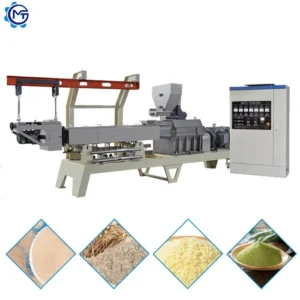
| Extruder Type | Twin Screw |
| Installed Power (MT70) | 160 kW |
| Power Consumption (MT70) | 120 kW |
| Output Capacity (MT70) | 150–200 kg/h (basis not stated in source — confirm raw material / moisture) |
| Overall Dimensions (MT70) | 41 × 1.5 × 2.2 m |
| Installed Power (MT85) | 190 kW |
| Power Consumption (MT85) | 140 kW |
| Output Capacity (MT85) | 300–400 kg/h (basis not stated in source — confirm raw material / moisture) |
| Overall Dimensions (MT85) | 43 × 1.5 × 3.2 m |
| Installed Power (MT75) | 210 kW |
| Power Consumption (MT75) | 150 kW |
| Output Capacity (MT75) | 300–500 kg/h (basis not stated in source — confirm raw material / moisture) |
| Overall Dimensions (MT75) | 45 × 1.5 × 3.5 m |
| Extruder Control | PLC with automatic lubricating and cooling |
| Flaking System | Hydraulic double-roller, dual-motor drive, infrared temperature monitoring |
| Dryer Heating Options | Gas, Electric |
| Roasting Oven | Vibrating pan, high-temperature spray tubes, conciliation burner, dual circulating fans, cyclone dust removal |
| Coating System | Double tumble sugar melting, elevator, coating drum, spraying nozzle |
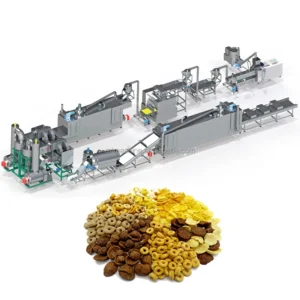
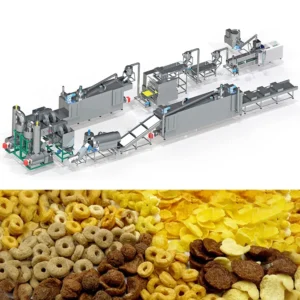
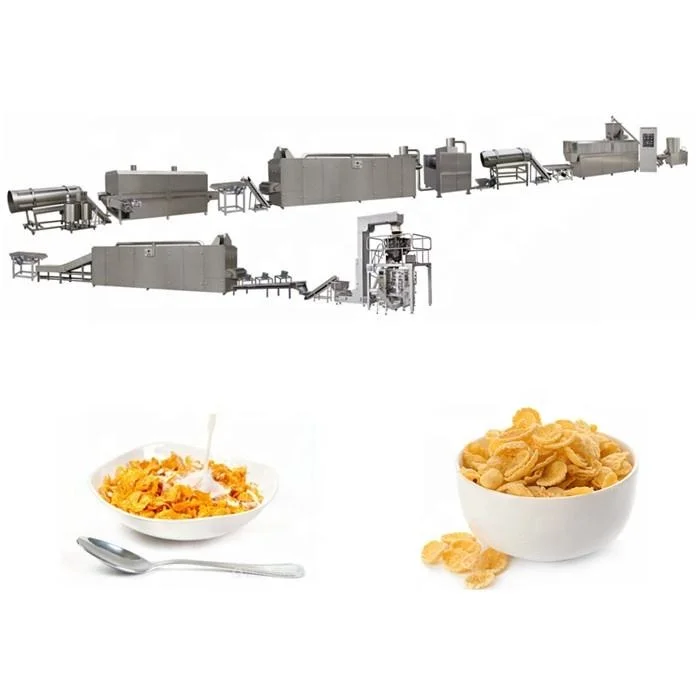
| Line Stations | Mixing → Extruding → Flaking → Drying → Hot Air Roasting → Sugar Spraying → Sugar Coating → Drying → Cooling → Packing |
| Raw Materials | Corn, rice, wheat, oat, barley powder |
| Certifications | CE, ISO |
Application Suitability
| Application | Material or Output |
|---|---|
| Natural corn flakes for breakfast cereal market | Corn grits and corn flour |
| Sugar-coated corn flakes and frosted variants | Corn base with sugar, honey, or malt coating |
| Shaped breakfast cereals (rings, balls, fruit loops, stars) | Corn, rice, and wheat blends |
| Multi-grain and oat-based flake cereals | Oat, barley, and mixed grain powders |
| Fortified cereal production for institutional nutrition programmes | Grain blends with added vitamin and mineral premix |
What "Rated Capacity" Doesn’t Tell You About Your Corn Flake Line
The extruder nameplate output means nothing unless it was validated on your exact grain blend at your target moisture content.
I have watched buyers sign off on a breakfast cereals corn flakes extrusion production line based on a brochure figure, only to discover on commissioning day that their oat-corn blend behaves completely differently from the standard corn grits the machine was tested on. The dough never reached the right gelatinisation window, the flakes came out dense and pale, and actual throughput sat well below the quoted number. That mismatch is not a machine defect — it is a specification gap that should have been closed before the purchase order was signed. [NEED_CITE: starch gelatinisation temperature variance across grain types]
How Screw Configuration Controls Starch Gelatinisation
The twin-screw extruder is where your raw grain transforms into a plasticised dough with the correct degree of starch gelatinisation for flaking. Screw element arrangement — forward conveying flights, kneading blocks, and reverse elements — determines the shear history and residence time that each particle experiences inside the barrel. When I set up a breakfast cereals corn flakes extrusion production line for a buyer blending oat flour with corn, we had to shorten the kneading zone and adjust moisture injection points because oat starch gelatinises at a lower temperature and absorbs water differently than corn.
Barrel temperature zones work in concert with the screw profile. Too much heat input too early causes premature gelatinisation and dough stickiness before the material reaches the die. Too little, and the extrudate exits undercooked, producing flakes that crack rather than crisp during roasting. The PLC-controlled automatic lubricating and cooling function on the MT series extruder stabilises barrel temperature across long production runs, reducing thermal drift that would otherwise shift your flake density over the course of a shift.
Why Die Design and Moisture Input Define Flake Expansion
The die opening geometry governs how the extrudate expands as it exits the barrel pressure. A die designed for pure corn grits will produce the wrong cross-section when you run a wheat-heavy blend because wheat gluten adds elasticity that resists expansion. On every breakfast cereals corn flakes extrusion production line we configure, the die profile is specified after reviewing the buyer’s actual formulation — not copied from a generic build.
Moisture content at the die face is equally decisive. Even a small deviation from the target moisture window changes the expansion ratio and, downstream, the thickness of the flattened pellet. This is why we treat moisture as a process parameter to be locked in during the pre-shipment trial, not a variable left for operators to chase during commissioning. [NEED_CITE: effect of extrudate moisture on expansion ratio in twin-screw processing]
Reading the Specs That Actually Matter
The installed power ratings across the MT70, MT85, and MT75 reflect different barrel volumes and screw diameters, which directly influence shear intensity and throughput range. A higher installed power figure on the MT75 (210 kW) corresponds to its larger screw profile and longer barrel, necessary for processing higher-viscosity dough blends at greater output. The power consumption figures (120 kW, 140 kW, 150 kW respectively) represent typical running load rather than peak draw.
The flaking machinery uses a hydraulic system for the double rollers, with separate motors driving each roller independently. This matters because differential roller speed prevents the dough sheet from tearing as it passes through the nip. The infrared temperature sensor on the temperature pipe ensures roller surface heat stays within the window that prevents sticking without prematurely drying the flake surface before it enters the dryer.
The hot air roasting oven specification includes a conciliation burner in the combustion chamber paired with two separate circulating fans and a cyclone dust removal device. The dual-fan arrangement creates a controlled convection pattern across the vibrating pan, ensuring that every flake receives uniform thermal exposure for consistent blistering and colour development — the visual and textural signature of a quality corn flake.
The Hidden Cost of a Mismatched Extrusion Setup
Buyers who skip the raw-material-specific screw configuration often end up with a line that technically runs but produces flakes outside market tolerance — too dense for the cereal bowl, too fragile for the packing line, or both. [NEED_CITE: common causes of texture defects in extruded breakfast cereals] When the extruder output does not match downstream flaking, drying, and roasting capacity, the bottleneck shifts unpredictably between stations, forcing operators to run the whole line at reduced speed. I have seen a buyer lose weeks of production time chasing a density problem that traced back to a screw combination copied from a standard build rather than matched to their multi-grain recipe.
Why the Process Engineering Matters Before the Purchase Order
The extrusion process for breakfast cereals corn flakes extrusion production line equipment is specified to the buyer’s raw material and target flake density before the line enters production, not after installation. Screw configuration records and die design profiles are documented and retained for future reference and reconfiguration.
An in-house testing workshop allows trial runs on the buyer’s actual grain blend before the equipment ships, so gelatinisation behaviour, expansion ratio, and flake thickness are validated in advance rather than debugged on the factory floor.
Line layout and capacity calculations match throughput across the extruder, flaking station, dryer, roasting oven, and coating drum so that no single station constrains the rest of the line.
Electrical schematics include voltage and frequency confirmation for the target installation site, preventing commissioning delays caused by incompatible power supply specifications.
Documentation & Verification
- Screw and die configuration record matched to your grain blend and target flake density
- Trial run report on your raw material conducted before shipment
- Line layout with throughput calculation across all stations
- Electrical schematic confirming your site voltage and frequency
- CE declaration of conformity and ISO certification documents
- Operation and maintenance manual with wear parts list
Installation, Commissioning & Support
- Foundation plan accounts for the 41–45 m line footprint and individual station loads
- Dedicated power circuits sized for up to 210 kW installed extruder capacity plus dryer and roaster draw
- Modular station delivery with staged assembly aligned to your facility readiness
- First-run parameter setting covering barrel temperature zones, roller pressure, and roasting oven airflow
- Operator training on PLC interface, moisture adjustment, and screw changeover procedure
- Wear parts list with initial spare screw elements and die plates supplied at delivery
- Maintenance schedule covering automatic lubrication system checks and hydraulic roller inspection
What We Need to Configure Your Line
To move from general specifications to a line layout that matches your production reality, share your primary grain formulation and any secondary ingredients, your target flake density and bowl-life expectation, and the daily output volume you need to sustain. We also need your facility voltage and frequency, available floor length and ceiling height, and whether your existing packing system needs to be integrated into the cooling conveyor discharge. If you are working with a blend we have not processed before, a sample shipment for the in-house testing workshop is the most efficient way to lock in the screw configuration and die design before production begins.
Frequently Asked Questions
Q: How does screw configuration affect starch gelatinisation and final flake density?
A: Screw element arrangement controls shear intensity, residence time, and thermal history inside the barrel. Kneading blocks and reverse elements create the mechanical energy input needed for complete gelatinisation. We specify the screw profile based on your grain blend’s starch composition and target flake density, then validate it through a trial run on your raw material before the line ships.
Q: What barrel temperature profile and moisture range work for different grain blends?
A: Pure corn grits typically require higher barrel temperatures and longer conditioning than oat or barley blends, which gelatinise at lower thresholds. The PLC-controlled heating zones allow independent temperature setting along the barrel length. Moisture at the die face must be locked within a narrow window; even small deviations shift expansion ratio and downstream flake thickness.
Q: How does flaking roller pressure and temperature control influence flake quality?
A: The hydraulic double-roller system applies consistent nip pressure to produce uniform flake thickness, while infrared-monitored roller temperature prevents surface sticking without premature drying. Separate motor drives on each roller prevent dough tearing. Uniform flake thickness directly determines how evenly the flakes roast and how they perform in the cereal bowl.
Q: How is throughput balanced across extrusion, flaking, drying, and roasting stations?
A: Each station is sized during the layout phase so that the extruder output feeds the flaking machinery at a rate the dryer and roasting oven can absorb. A bottleneck at any single station forces the entire line to run below capacity. Our line configuration matches throughput across every station rather than assembling equipment from separate vendors with unmatched ratings.
Q: What trial runs are conducted on customer raw materials before shipment?
A: We run your actual grain formulation through the extruder in our testing workshop, measuring gelatinisation degree, extrudate expansion, flake thickness after the flaking station, and final texture after roasting. The results are documented in a trial run report that includes the validated screw configuration, barrel temperature settings, and moisture parameters, forming the baseline for commissioning at your facility.