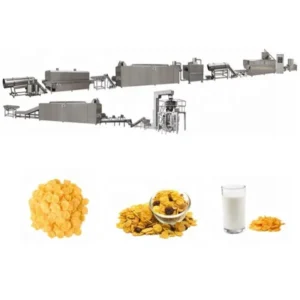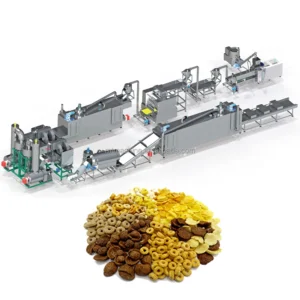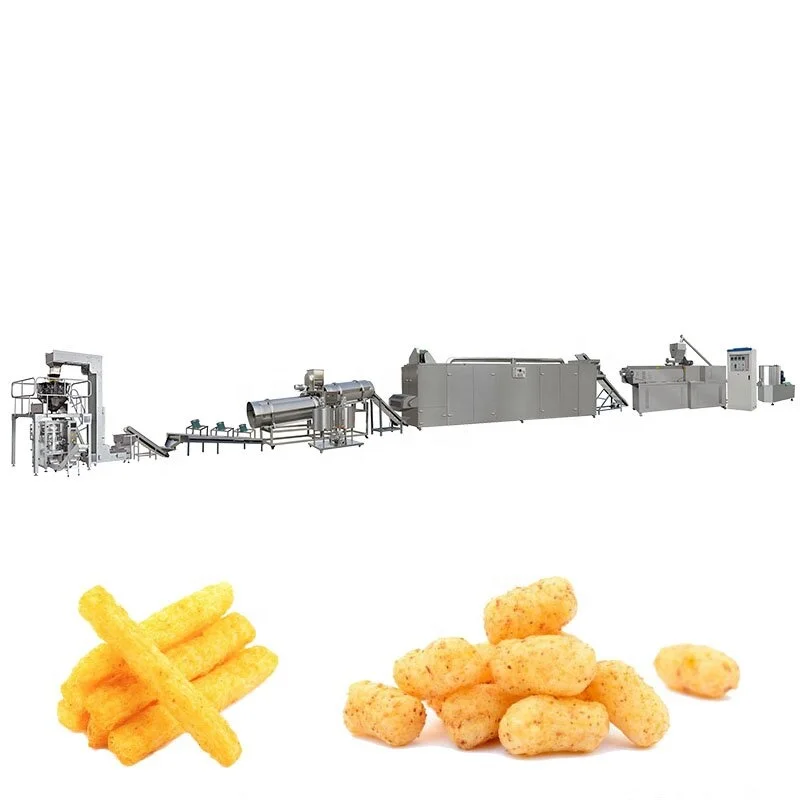
Screw configuration matched to raw material — Trial runs on the buyer’s actual grain blend in our testing workshop verify starch gelatinisation and expansion before the extruder ships.
Technical Specifications
| Parameter | Value |
|---|---|
| Model | MT75 |
| Product Type | Twin Screw Extruder Corn Flakes Production Line |
| Screw Type | Twin Screw |
| Installed Power | 210 kW |
| Power Consumption | 150 kW |
| Output Capacity | 300–500 kg/h (basis not stated in source — confirm raw material, moisture content, and product format) |
| Overall Dimensions | 45 × 1.5 × 3.5 m |
| Control System | PLC and MCC |
| Flaking Machine | PLC control, hydraulic double rollers, separate motor drive, infrared sensor temperature control |
| Dryer Heating Source | Gas or Electric |
| Roasting Oven | Vibrating pan, high-temperature spraying tubes, conciliation burner, dual circulating fans, cyclone dust removal |
| Coating System | Double tumble sugar melting, elevator, coating drum, spraying nozzle |
| Raw Materials | Corn, rice, wheat, oat, barley powder |
| Final Product Shapes | Natural corn flakes, coated corn flakes, ball, tube, stick, ring, fruit loop, star, wheel, flower, heart |
| Assembly State | Complete line from mixing to packing |
| Certification | CE, ISO |
Application Suitability
| Application | Material or Output |
|---|---|
| Natural corn flake production | Corn flour or grits processed through extrusion, flaking, drying and roasting |
| Sugar-coated corn flake lines | Extruded and flaked corn with sugar spraying, coating and secondary drying |
| Multi-grain flaked cereals | Blends of rice, wheat, oat and barley powder adjusted through screw and die configuration |
| Alternative cereal shapes | Tube, ring, star, wheel and ball formats by changing extruder die inserts |
When Corn Flakes Collapse After Extrusion
Starch gelatinisation depends on the exact screw configuration and barrel temperature profile matching the raw material’s moisture and fat content.
A generic twin-screw build copied from a standard template will process one type of corn flour perfectly and fail completely on another. I have watched entire batches of flaked cereal crumble or flatten into dense chips because the corn flakes extrusion technology twin screw parameters were never adjusted for a local grain supply with higher oil content. The extruder runs, the flaking rollers turn, but the output does not match the crispness and density the market expects [NEED_CITE: starch gelatinisation temperature ranges for different cereal grains].
Barrel Temperature Profile and Moisture Management
The barrel zones along the twin-screw extruder must maintain a precise temperature gradient that drives starch gelatinisation without scorching the grain matrix. Moisture injection and shear force work together: too little moisture and the corn mass will not gelatinise fully, producing flakes that shatter during roasting; too much and the extrudate becomes sticky, clogging the flaking rollers downstream.
Die Design and Expansion Ratio Control
The die plate determines the shape and initial expansion of the extrudate before it reaches the flaking station. A die with incorrect aperture sizing for the target corn flake thickness will produce pellets that either expand beyond the roller gap or remain too dense to flatten into the familiar flake geometry. Corn flakes extrusion technology twin screw systems allow die changes to accommodate different cereal formats — from standard flakes to rings, balls and tubes — without replacing the entire extruder head.
Reading the Specification Sheet Beyond Nominal Output
The MT75 line lists an installed power of 210 kW and a power consumption of 150 kW, reflecting the energy drawn across the extruder, flaking machine, dryer and roasting oven simultaneously. The overall dimensions of 45 × 1.5 × 3.5 m define the floor space required for the full sequence from mixing through packing. The hydraulic double-roller flaking machine with infrared sensor temperature control maintains uniform flake thickness, which directly affects how evenly the product roasts in the vibrating pan oven. PLC and MCC control across every station means the operator sets parameters once and the system holds them through the entire batch [NEED_CITE: PLC control advantages in continuous food extrusion processes].
The Hidden Cost of Skipping Raw Material Trials
When an extruder ships without a trial run on the buyer’s actual corn supply, all product development happens after installation — on the factory floor, burning raw material and production time. Flakes that are too dense survive coating and packing but fail the consumer crunch test. Flakes that are too fragile break into fines during the tumble coating stage, generating waste that accumulates shift after shift. These losses are not visible in the quotation and only surface weeks into production [NEED_CITE: post-installation product development costs in cereal extrusion].
Why Source This Line From Meiteng
The screw configuration and die design are specified to the buyer’s grain raw material and target flake texture, not pulled from a generic catalogue. Every station — mixing, extruding, flaking, drying, roasting, coating and packing — is sized so throughput matches across the line rather than bottlenecking at one stage. The in-house testing workshop runs the buyer’s actual corn or multi-grain blend before shipment, generating a trial report that locks in parameters. Twin-screw expertise spans corn flakes, multi-grain cereals, puffed snacks and aquatic feed, meaning the engineering team understands how starch behaviour shifts between grain types. Pre-sales consultation covers line layout, utility planning and voltage confirmation so that commissioning proceeds without electrical surprises.
Documentation & Verification
- Line layout drawing with capacity calculation matched to your grain blend and target output
- Screw and die configuration record specifying the exact setup trialled on your raw material
- Trial run report documenting flake density, expansion ratio and texture from your corn sample
- Electrical schematic with voltage and frequency confirmed for your local grid standard
- CE declaration of conformity and ISO certificate for customs and regulatory clearance
- Operation and maintenance manual covering PLC parameter ranges and roller adjustment procedures
Installation, Commissioning & Support
- Foundation must support 45 m line length with level concrete pad for flaking roller alignment
- Dedicated power circuit rated for 210 kW installed load with confirmed voltage and frequency
- Line arrives in modular sections; extruder barrel and flaking machine require on-site assembly
- First run includes PLC parameter setting for barrel zones, roller pressure and oven temperature
- Operator training covers die changeover for alternative cereal shapes and screw cleaning procedures
- Wear parts list identifies screw segments, die plates and roller surfaces with replacement intervals
- Hydraulic system on flaking machine requires periodic fluid inspection per maintenance schedule
What We Need to Configure Your Line
Provide the specific corn or grain flour type, including moisture and fat content if available, along with the target flake density and crispness your market requires. Confirm the local voltage and frequency, the control language your operators read, and whether your existing facility has gas supply for the dryer and roasting oven or requires full electric heating. If you are producing sugar-coated flakes, specify the coating thickness and sugar melting point so the tumble system is matched accordingly.
Frequently Asked Questions
Q: How is screw configuration determined for my specific grain blend and target flake density?
A: We review your raw material data — grain type, moisture, fat and starch content — then select screw element geometry, pitch and barrel zone lengths that deliver the shear and residence time needed for complete gelatinisation. A trial run in our testing workshop on your actual sample confirms the configuration before the extruder ships.
Q: What barrel temperature profile and moisture range support proper starch gelatinisation in corn flakes?
A: Corn starch typically gelatinises between specific temperature thresholds that vary with moisture content and grain variety. The PLC-controlled barrel zones maintain a gradient across feeding, compression and metering sections, while moisture injection is adjusted based on your raw material’s baseline water content to reach the correct expansion at the die.
Q: Can a trial run be performed on my raw material before shipment?
A: Yes. Our in-house testing workshop processes your actual corn flour or multi-grain blend through the configured MT75 extruder and flaking station. The trial generates a report covering flake thickness, expansion ratio, density and texture, and the locked-in screw and die configuration travels with the machine.
Q: How is throughput balanced between the extruder, flaking rollers, dryer and roasting oven?
A: Each station is sized during line layout so that the extruder output rate matches the flaking machine intake capacity, which in turn matches the dryer belt speed and roasting oven residence time. This prevents material pile-up at any single point and keeps the corn flakes extrusion technology twin screw line running continuously without manual feed adjustments.
Q: What die and mould options allow production of cereal shapes beyond standard flakes?
A: The extruder accepts interchangeable die plates that produce tube, ring, star, wheel, ball, fruit loop and other geometries. Changing the die does not require replacing the screw configuration entirely, though we verify that the current screw setup remains suitable for the new shape’s expansion and density requirements.