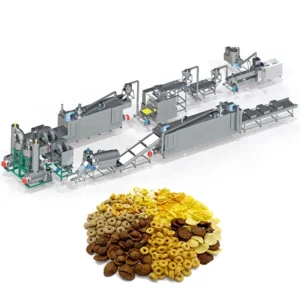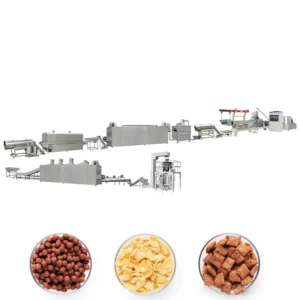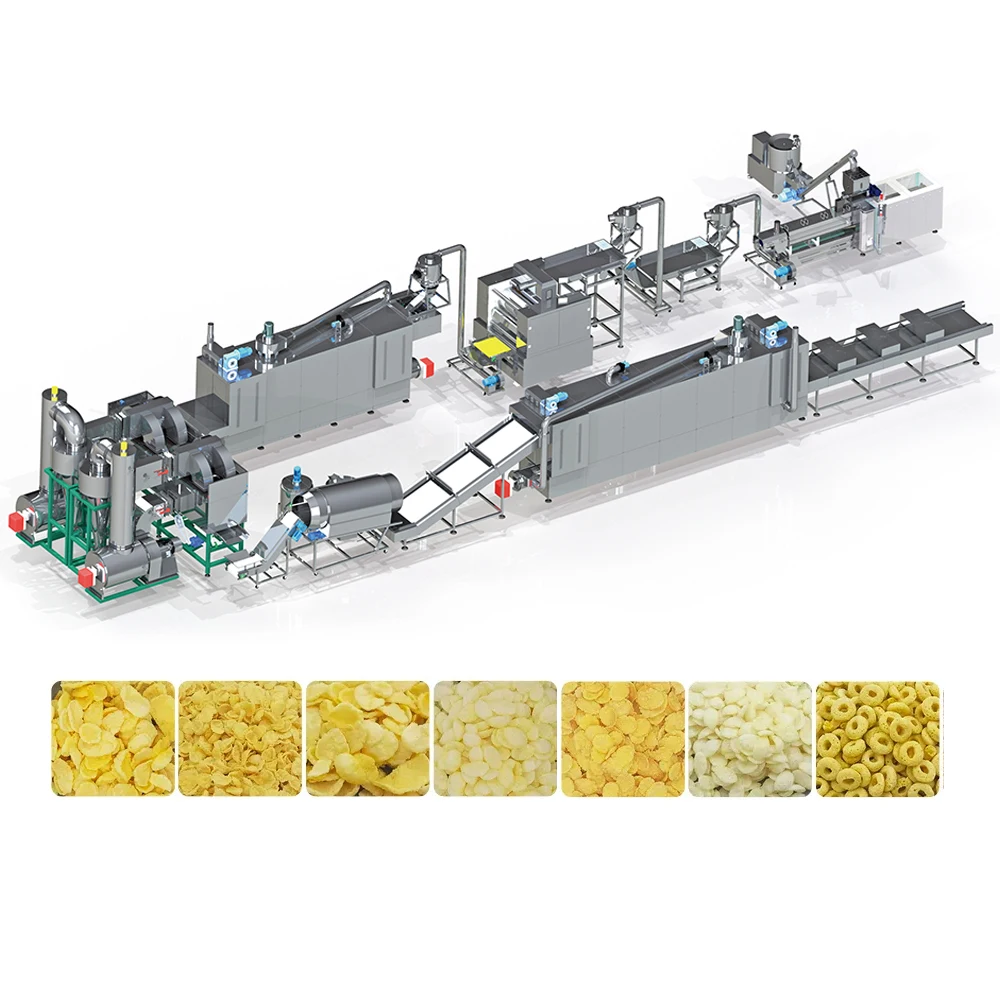
Screw Geometry Tuned to Your Grain — every MT-65 barrel zone and die plate is configured against the buyer’s actual corn, rice, or oat formulation before the line ships, not copied from a generic breakfast cereal build.
Technical Specifications
| Parameter | Value |
|---|---|
| Product Type | Corn Flakes Breakfast Cereal Production Line |
| Extruder Model | MT-65 |
| Screw Type | Co-rotating twin-screw, sectional modules |
| Extruder Functions | Forward/backward transport, mixing, de-gassing, cooking, forming |
| Mixer Tank Size | φ600 × 500 mm |
| Mixer Power | 4 kW |
| Mixer Output | 10–30 kg/load |
| Mixer Dimensions | 1000 × 800 × 1200 mm |
| Screw Conveyor Power | 0.75 kW |
| Screw Conveyor Dimensions | 2700 × 500 × 2400 mm |
| Press Roller Size | 510 × 310 × 1050 mm |
| Press Machine Dimensions | 1550 × 1300 × 2000 mm |
| Press Machine Power | 16.12 kW |
| Press Features | Big roller, integrated cooling system, adjustable gap for flake thickness |
| High-Temperature Oven Size | 4.5 × 1.4 × 1.8 m |
| High-Temperature Oven Power | 3.75 kW |
| Oven Heating Method | Gas-fired, both-side baking |
| Sugar Spraying System Power | 28.75 kW |
| Sugar Spraying System Dimensions | 4000 × 1900 × 1880 mm |
| Sugar Spraying Roller Size | approx. φ600 × 2700 mm |
| Line Stations | Flour Mixer → Screw Elevator → Twin-screw Extruder → Elevator → Dryer → Elevator → Coating Line → Vibrating Spreader → Elevator → Dryer → Cooling Conveyor |
| Control System | PLC and MCC (automation level per station to be confirmed) |
| Contact Material | Stainless steel, food-grade |
| Voltage & Frequency | Customizable (e.g., 3ph 380V 50Hz, 3ph 415V 60Hz) |
| Output Capacity | Basis not stated in source — to be confirmed against raw material and target format |
| Assembly State | Complete line |
| Certification | CE |
Application Suitability
| Application | Material or Output |
|---|---|
| Traditional corn flakes | Corn grits and corn flour at controlled moisture |
| Multi-grain breakfast flakes | Rice, oat, and blended grain powders |
| Fortified breakfast cereal | Grain base with vitamin and mineral additives |
| Coated cereal snacks | Sugar syrup or honey coating on ring, ball, star, stick shapes via interchangeable moulds |
| Puffed snack variants | Same extrusion platform adapted for direct-expanded formats |
What "Nominal Capacity" Leaves Out on a Corn Flakes Extrusion Line
A corn flakes extrusion technology production line rated for a certain throughput on standard corn grits may stall entirely when the buyer switches to a local high-fat grain blend.
I spent years on the assembly floor in Jinan before moving into technical sales, and one early project still shapes how I handle every inquiry. A Southeast Asian buyer ordered a complete corn flake line and ran trials with our standard corn flour. Everything performed within specification. But after the machines arrived on site, they switched to a locally sourced high-fat formulation. The sheets stuck to the press rollers, the oven baked unevenly, and the entire line sat idle for over two weeks while we reconfigured screw elements and die geometry remotely. [NEED_CITE: raw material variation effects on twin-screw extrusion behaviour] Since then, every corn flakes extrusion technology production line we build requires the buyer to ship their actual raw material to our testing workshop first.
How Screw Configuration Determines Flake Texture and Density
The MT-65 co-rotating twin-screw extruder uses sectional screw modules that can be rearranged along the shaft to control residence time, shear intensity, and melt temperature inside the barrel. For corn flakes, the goal is partial starch gelatinisation — enough to bind the dough pellet but not so much that it fully expands. The screw profile, barrel zone temperatures, and moisture feed rate together determine whether the pellet emerging from the die is glassy, rubbery, or already starting to puff. Getting this wrong means the downstream flaking press either crushes a brittle pellet or smears a gummy one.
Barrel Temperature Profile and Starch Gelatinisation Control
Each barrel zone on the twin-screw extruder operates under independent heating and cooling, giving the process engineer a temperature gradient to work with from the feed port to the die face. Corn starch gelatinises in a specific moisture and temperature window; rice and oat starches behave differently. A corn flakes extrusion technology production line that applies a single barrel profile across all grain types will produce inconsistent pellets — some undercooked and crumbly, others over-gelatinised and sticky. We build the barrel profile around the buyer’s target cereal grain and confirmed moisture content before the machine leaves the workshop. [NEED_CITE: starch gelatinisation temperature ranges for corn rice and oat]
Reading the Specification Sheet Like a Process Engineer
The press machine carries 16.12 kW across a big roller pair with an integrated cooling system and adjustable gap. The roller size of 510 × 310 mm and the adjustable distance between them are what let you dial in flake thickness to a specific product brief — thicker flakes for a hearty bowl-life, thinner for a crisp snap. The gas-fired high-temperature oven at 4.5 metres long with both-side baking ensures the flakes dry through without case-hardening on the surface. The sugar spraying system runs a temperature-keeping roller at roughly φ600 × 2700 mm so the syrup stays fluid during coating rather than crystallising on contact. These are the parameters that separate a cereal line that holds its specification from one that drifts with every ambient temperature change.
The Hidden Cost of Skipping the Raw Material Trial
When a cereal line ships without a trial run on the buyer’s own grain, the first weeks of production become the trial — on the buyer’s floor, with the buyer’s labour and raw material budget absorbing every adjustment. Screw elements get swapped blindly, barrel zones overshoot, and the press rollers accumulate residue that damages the belt and the flake surface. [NEED_CITE: commissioning delays caused by untested raw material in food extrusion] The downtime compounds because each parameter change takes hours to stabilise across a continuous line that includes a dryer, a coating drum, and a second drying pass.
Why Source the Extrusion Core from the Same Supplier
Every station on this corn flakes extrusion technology production line — from the 4 kW flour mixer through the twin-screw extruder, the press, the gas oven, and the sugar coating system — is specified and supplied under one engineering responsibility. Throughput between stations is calculated so the press never starves while the extruder runs full, and the oven never backs up while the coating line waits. The screw configuration and die design are matched to the buyer’s grain formulation, not pulled from a catalogue default. An in-house testing workshop runs the buyer’s actual raw material before the line ships, producing a trial report that documents screw arrangement, barrel profile, moisture setting, and pellet behaviour. Electrical schematics confirm voltage, frequency, and control language before fabrication begins, so commissioning on site starts from a known baseline rather than a guess.
Documentation & Verification
- Line layout drawing with throughput matched across every station from mixer to cooling conveyor
- Screw and die configuration record specifying module arrangement for your grain type
- Trial run report on your raw material documenting pellet density, moisture, and barrel settings
- Electrical schematic confirming voltage, frequency, and PLC control language before production
- Factory test record with continuous run data before the line is crated for dispatch
- CE declaration of conformity covering the full line assembly
Installation, Commissioning & Support
- Foundation plan provided based on the 4.5 m oven and press machine footprint of 1550 × 1300 mm
- Dedicated power circuits mapped to the 28.75 kW sugar spraying system and 16.12 kW press
- Assembly sequence documented for the eleven-station line from mixer to cooling conveyor
- First-run parameter set transferred from workshop trial to your production floor
- Operator training covers screw module changes and press roller gap adjustment
- Wear parts list specifies screw elements, die plates, and roller surfaces with replacement intervals
What to Include with Your Inquiry
Tell us the grain type or blend you intend to process, the target flake thickness and bowl-life characteristics, and the moisture range of your incoming raw material. Confirm the voltage and frequency at your facility, along with the preferred control language for the PLC interface. If you have existing upstream milling or downstream packing equipment, share the interface specifications so the corn flakes extrusion technology production line connects without bottlenecks. Sending a sample of your raw material allows us to run a workshop trial and return a configuration proposal backed by actual test data rather than catalogue assumptions.
Frequently Asked Questions
Q: How is screw configuration and die design matched to different grain flours and moisture levels?
A: We rearrange the sectional screw modules along the MT-65 shaft to control shear, residence time, and melt temperature for each grain type. Die geometry is selected based on the target pellet size and shape. The buyer sends a raw material sample, and we run trials in our workshop, documenting the exact screw arrangement, barrel zone temperatures, and moisture feed rate that produce the correct pellet for flaking.
Q: Can the barrel temperature profile be adjusted for starch gelatinisation targets in corn versus rice or oat?
A: Yes. Each barrel zone on the co-rotating twin-screw extruder heats and cools independently. Corn, rice, and oat starches gelatinise at different moisture-temperature combinations. We build a zone-by-zone temperature profile specific to your grain during the workshop trial and record it in the configuration document so your operators can replicate it during production.
Q: How is flake density and crispness controlled through extrusion parameters versus dryer settings?
A: Flake density is primarily set during extrusion — the degree of starch gelatinisation and pellet moisture determine how the flake behaves under the press rollers. Crispness is then developed in the gas-fired oven, where baking time and temperature remove residual moisture without case-hardening. Both stages must be balanced, which is why we test the full sequence in our workshop before shipping.
Q: What raw material trial runs are performed before shipment to validate extrusion behaviour?
A: The buyer ships a batch of their actual grain formulation to our Jinan testing workshop. We run the complete sequence — mixing, extrusion, pelleting, flaking, and drying — and record screw configuration, barrel profile, press roller gap, oven temperature, and final flake density. A full trial report accompanies the shipment so production starts from a validated baseline.
Q: How does the line handle moisture variation and shear control across twin-screw barrel zones?
A: The twin-screw design provides positive forward transport and consistent shear across the barrel length. Moisture is introduced at the mixer stage and monitored before the extruder feed. If ambient humidity or raw material moisture drifts, operators adjust barrel zone temperatures and screw speed to compensate, keeping pellet quality within specification through each production run.