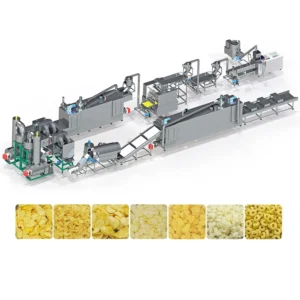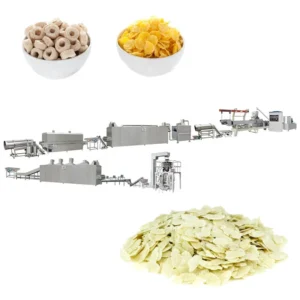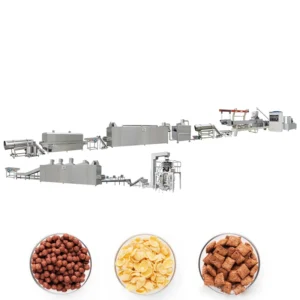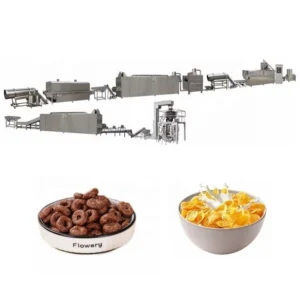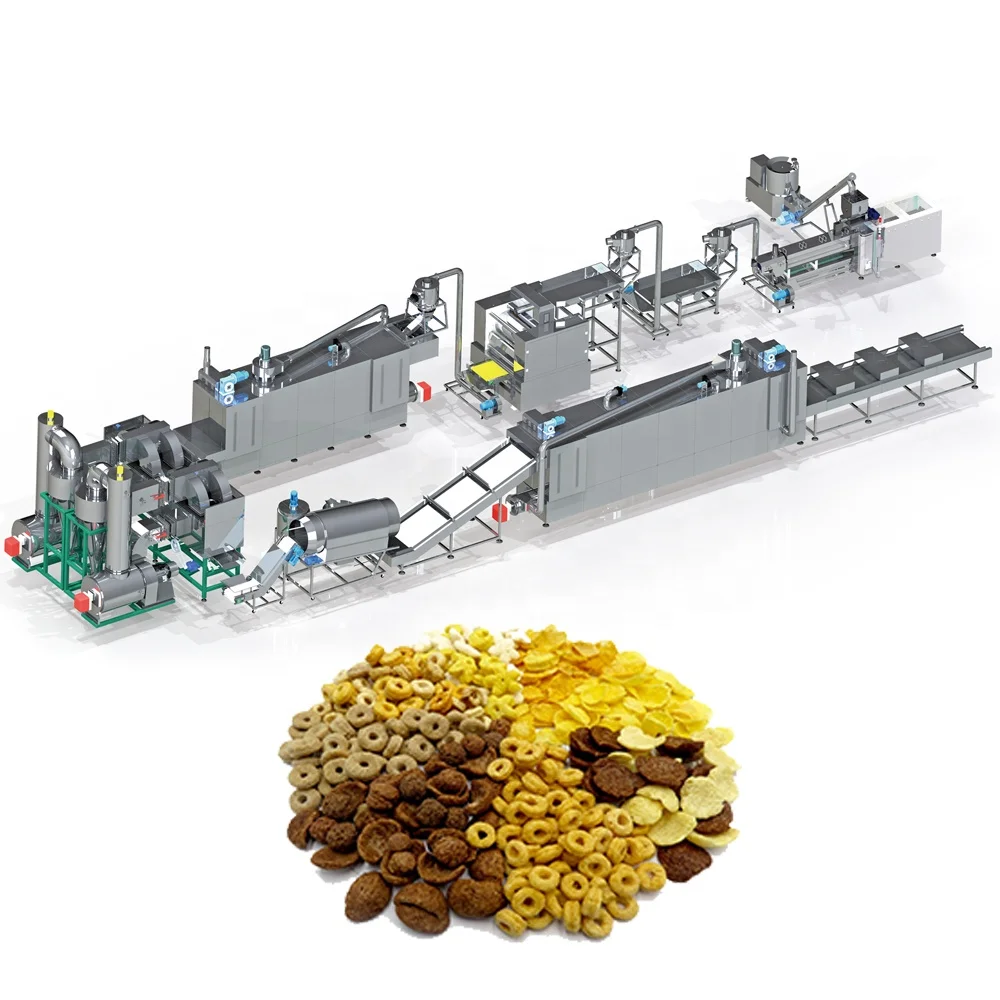
Precision Extrusion Tuning — Every screw element and die geometry on the MT70, MT85, and MT75 platforms is specified against your actual grain blend and target flake density before metal is cut.
Technical Specifications
| Parameter | Value |
|---|---|
| Model | MT70, MT85, MT75 |
| Product Type | Corn Flakes Breakfast Cereal Production Line |
| Extruder Type | Twin Screw |
| Screw Configuration | Matched to raw material and target product |
| Control System | PLC control (flaking machinery), MCC and PLC (line-level) |
| MT70 Installed Power | 160 kW |
| MT70 Power Consumption | 120 kW |
| MT70 Capacity | 150–200 kg/hr (basis to be confirmed) |
| MT70 Overall Dimensions | 41 × 1.5 × 2.2 m |
| MT85 Installed Power | 190 kW |
| MT85 Power Consumption | 140 kW |
| MT85 Capacity | 300–400 kg/hr (basis to be confirmed) |
| MT85 Overall Dimensions | 43 × 1.5 × 3.2 m |
| MT75 Installed Power | 210 kW |
| MT75 Power Consumption | 150 kW |
| MT75 Capacity | 300–500 kg/hr (basis to be confirmed) |
| MT75 Overall Dimensions | 45 × 1.5 × 3.5 m |
| Dryer Heating Source | Gas or Electric |
| Flaking Machinery | Hydraulic double-roller system with infrared temperature sensing |
| Hot Air Roasting Oven | Vibrating pan, conciliation burner, dual circulating fans, cyclone dust removal |
| Coating System | Double tumble sugar melting, elevator, coating drum, spraying nozzle |
| Raw Materials | Corn, rice, wheat, oat, barley powder |
| Final Product Shapes | Ball, tube, stick, ring, fruit loop, star, wheel, flower, heart |
| Assembly State | Complete turnkey line |
| Voltage & Frequency | Confirmed per customer local standard before production |
| Certification | CE (since 2014), ISO certified |
Application Suitability
| Application | Material or Output |
|---|---|
| Natural corn flakes production | Corn grits or corn flour, roasted without coating |
| Sugar-coated corn flakes | Corn base with sugar syrup coating and secondary drying |
| Multi-grain breakfast cereals | Blends of corn, rice, wheat, oat, and barley |
| Varied-shape cereal formats | Ring, ball, tube, stick, star, wheel, flower, heart via die changes |
| Fortified cereal lines | Grain blends with added vitamin and mineral premix |
Why Generic Screw Builds Destroy Flake Texture on a Corn Flakes Extrusion Technology Production Line
A screw and die copied from a standard build will either over-gelatinise or under-cook your dough, and no amount of roaster tuning fixes what the extruder got wrong.
I have watched a small-scale breakfast cereal line in Southeast Asia run standard corn flour through a generic twin-screw setup. The flakes came out dense, barely blistered in the roaster, and snapped rather than crunched in the bowl. The buyer blamed the roaster first, then the flaking rollers. The real problem was upstream: the screw configuration had been lifted from a puffed snack build, so the residence time and shear profile never matched the starch gelatinisation window that corn flakes demand. When the buyer switched to de-germed corn grits with a different particle size and moisture content, the same screw build produced an entirely different result — hard pellets that no roaster could rescue [NEED_CITE: starch gelatinisation temperature windows for maize versus rice in twin-screw extrusion].
This is the pattern I see most often with buyers entering breakfast cereal production. The line is quoted on a nominal capacity figure, but nobody asks what raw material you actually source locally, what moisture range your supplier delivers, or whether you are targeting a light, porous flake or a dense, crunchy one. The corn flakes extrusion technology production line only works when every station — extruder, flaker, dryer, roaster — is tuned around the same material assumption.
Barrel Zone Profiling and Starch Gelatinisation Control
A twin-screw extruder for corn flakes operates across distinct thermal zones. The feed section must convey the grits or flour without premature gelatinisation, while the compression and metering zones bring the dough through the gelatinisation threshold evenly. On the MT70, MT85, and MT75 platforms, barrel temperature profiling is adjusted zone by zone to match the specific starch behaviour of your grain blend. Corn, rice, wheat, oat, and barley each gelatinise at different moisture and temperature combinations, and a blend shifts that window further. Getting this wrong means the dough exits the die either under-cooked — leading to hard, glassy flakes — or over-sheared, producing fragile flakes that shatter during coating and packing.
Die Geometry and Its Effect on Flake Expansion
The die opening determines the cross-section of the extruded rope before it reaches the flaking rollers. For corn flakes, the die must produce a consistent, flat-profile pellet that the hydraulic double-roller flaking station can compress into a uniform sheet thickness. Die geometry also governs how much expansion occurs at the die face — too much and the pellet is already porous before flaking, which collapses under roller pressure; too little and the pellet is too dense to blister properly in the hot air roaster. The conciliation burner and dual circulating fans in the roaster depend on a specific moisture and density range to generate the surface blistering that defines a quality corn flake [NEED_CITE: die land length and expansion ratio relationship in twin-screw cereal extrusion].
Reading the Specs That Actually Matter
The installed power figures — 160 kW on the MT70, 190 kW on the MT85, 210 kW on the MT75 — tell you the thermal and mechanical headroom available for your specific dough viscosity. Higher installed power means the extruder can handle denser grain blends or higher moisture additions without stalling. The screw’s special manufacturing technology with wear-resistant treatment and automatic lubricating and cooling function matters because corn grits are abrasive; worn screws change the shear profile gradually, and you lose batch consistency before anyone notices. The hydraulic flaking station with infrared temperature sensing and separate roller motors gives you independent control over each roller, so you can adjust nip pressure and surface temperature to hold flake thickness within tolerance. The hot air roasting oven’s vibrating pan and cyclone dust removal keep flakes moving through the heat zone without scorching or accumulating fines that trigger fire risk.
The Hidden Cost of Skipping a Material-Specific Trial Run
When a line ships without a trial run on your actual raw material, the first weeks of production become your process development phase — on your floor, with your downtime. I have seen buyers spend an entire commissioning period chasing flake density issues that a pre-shipment trial would have diagnosed in hours. The extruder arrives with a generic screw build, the flaker pressures are set for a different pellet hardness, and the roaster temperature profile does not match the moisture curve your material actually follows. By the time the process engineer re-tunes every station, you have burned through raw material, missed delivery windows, and lost confidence in equipment that was never wrong — just never matched to your grain [NEED_CITE: cost of post-installation process development versus pre-shipment material trials].
Why the Engineering Starts Before the Quotation
Every corn flakes extrusion technology production line from Meiteng begins with your raw material specification, not a catalogue page. The screw configuration and die design are documented against your exact grain blend and target flake density before production starts. The in-house testing workshop runs your actual material — not a reference sample — so that gelatinisation, expansion, and flake texture are validated before the line ships. Throughput is matched across every station, from the batching system through extrusion, flaking, drying, roasting, coating, and packing, so no single machine bottlenecks the rest. Voltage, frequency, and control language are confirmed to your facility standard before the electrical panels are wired. The PLC and MCC control systems are programmed with operator prompts in your local language, reducing commissioning friction.
Documentation & Verification
- Screw and die configuration record matched to your grain blend and target flake density
- Trial run report on your actual raw material from the in-house testing workshop
- Line layout and capacity calculation showing throughput matching across all stations
- Electrical schematic with voltage and frequency confirmed to your facility standard
- CE declaration of conformity and ISO certificate for customs and compliance
- Operation and maintenance manual with wear parts list and replacement intervals
Installation, Commissioning & Support
- Foundation and utility planning based on MT70/MT85/MT75 footprint and 160–210 kW installed power range
- Dedicated circuit sizing confirmed per your local voltage and frequency before panel fabrication
- Line arrives in modular sections for staged installation matching your construction schedule
- First-run parameter setting on your grain blend with process engineer on-site during commissioning
- Operator training covering PLC interface, screw change procedure, and flaking roller adjustment
- Wear parts list with screw elements, die plates, and roller surfaces itemised for first reorder
What to Include in Your Technical Enquiry
To size the right platform and configure the screw build accurately, share your primary grain type and whether you run whole corn flour, de-germed grits, or a multi-grain blend. Specify your target flake density and whether the end product is natural or sugar-coated. Confirm your facility voltage, frequency, and preferred control language so the electrical design aligns from the start. If you can send a sample of your production raw material, the testing workshop will run it before the quotation is finalised.
Frequently Asked Questions
Q: How is screw configuration and die design matched to a specific grain blend and target flake density?
A: The buyer provides their raw material specification including grain type, particle size distribution, and typical moisture content. The extrusion team then selects screw element geometry, compression ratio, and die land length to hit the gelatinisation and expansion profile the target flake requires. A configuration record documents every decision for future reference and replication.
Q: What barrel temperature profile and moisture range are needed for proper starch gelatinisation in corn flake extrusion?
A: The profile depends on the grain blend. Corn starch gelatinises at a different temperature-moisture window than rice or oat. The barrel zones are set to progressively bring the dough through that window without premature cooking in the feed section or over-shear in the metering zone. Moisture addition at the preconditioner is tuned to match.
Q: How does the flaking station’s hydraulic roller pressure and temperature control affect final flake thickness and roaster performance?
A: The hydraulic double-roller system applies controlled nip pressure to compress the extruded pellet into a sheet. Infrared temperature sensing monitors roller surface heat, which affects how the dough releases and whether it sticks or tears. Consistent flake thickness entering the roaster ensures even blistering and predictable bowl-life crispness.
Q: Can the extrusion platform switch between natural corn flakes, sugar-coated flakes, and alternate cereal shapes without re-engineering the screw build?
A: Shape changes require a die swap, and the extruder accepts multiple die formats for ball, tube, ring, star, and other geometries. Moving between natural and sugar-coated flakes involves adding or bypassing the coating system stations downstream. The base screw configuration may need adjustment if the raw material or target density changes significantly between product runs.
Q: How is a trial run on the buyer’s actual raw material structured, and what parameters are validated before shipment?
A: The buyer ships a representative sample of their production grain to the testing workshop. The line runs the material through extrusion, flaking, drying, and roasting while recording screw speed, barrel temperatures, moisture levels, flake thickness, and final density. A trial report documents all parameters and any configuration adjustments made before the line is approved for dispatch.