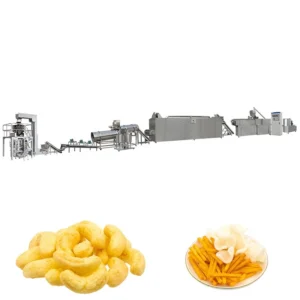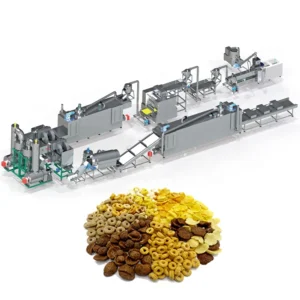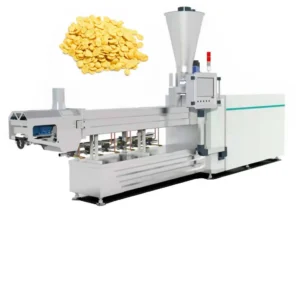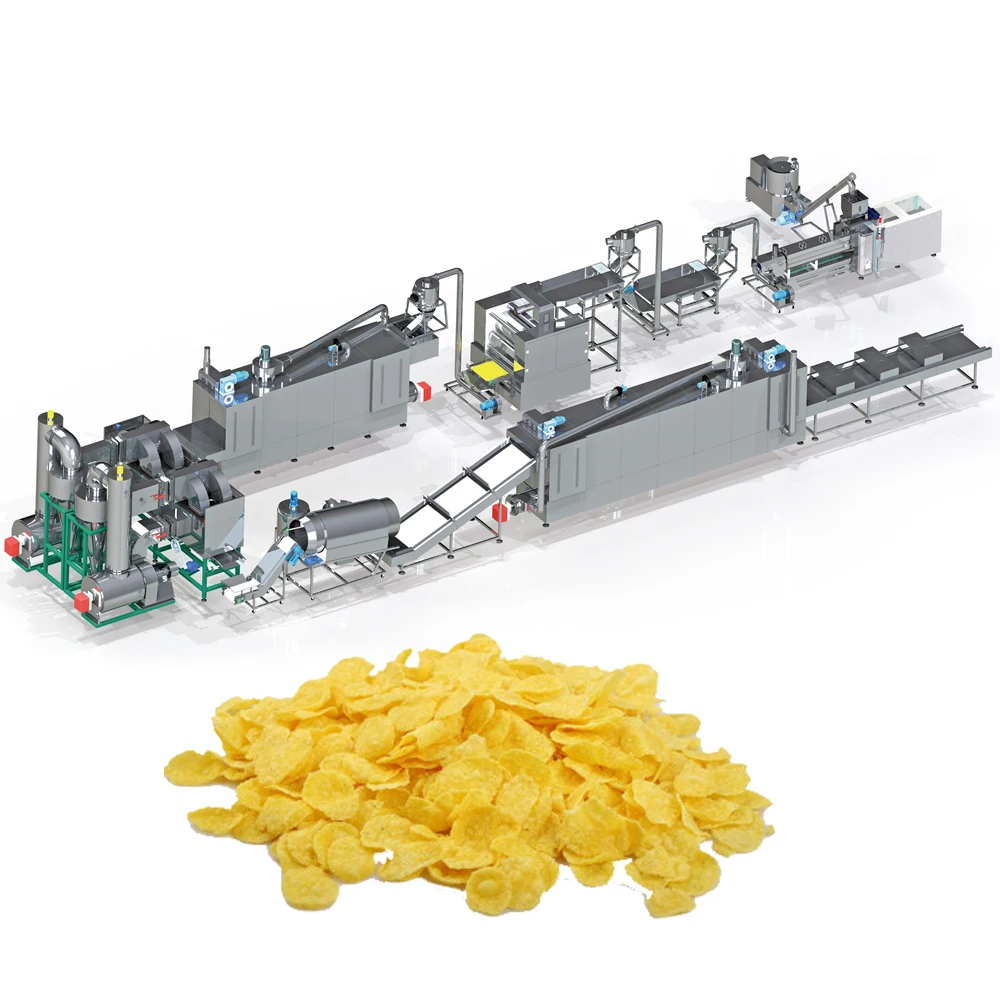
Precision screw and die specification — Every MT-65 corn flakes extrusion production line configuration is validated against the buyer’s actual raw material in our testing workshop before shipment, ensuring starch gelatinisation and flake density match market expectations.
Technical Specifications
| Parameter | Value |
|---|---|
| Model | MT-65 |
| Product Type | Corn Flakes Production Line |
| Extruder Type | Co-rotating twin screw with sectional modules |
| Installed Power | 84 kW |
| Real Power Consumption | 59 kW |
| Output Capacity | 120–150 kg/h (basis not stated in source — confirm raw material, moisture, flake thickness) |
| Overall Line Dimensions | 12000 × 1200 × 2200 mm |
| Mixer Tank Size | Φ600 × 500 mm |
| Mixer Power | 4 kW |
| Screw Conveyor Power | 0.75 kW |
| Corn Flakes Press Machine Power | 16.12 kW |
| Press Roller Size | 510 × 310 × 1050 mm |
| High-Temperature Oven Dimensions | 4500 × 1400 × 1800 mm |
| Oven Heating Method | Gas fired, both-side baking |
| Sugar Spraying System Power | 28.75 kW |
| Sugar Spraying Roller Size | Φ600 × 2700 mm |
| Control System | Separate controller box for flake press; automated PLC/MCC available for full line |
| Gearbox Lubrication | Oil forced automatic lubrication system |
| Contact Materials | Stainless steel for all product contact parts |
| Self-Cleaning Function | Yes |
| Warranty | 1 year complete warranty with life-time maintenance service |
Application Suitability
| Application | Material or Output |
|---|---|
| Traditional corn flakes breakfast cereal | Corn grits, corn flour |
| Multi-grain breakfast flakes | Oat, wheat flour, rice flour blends |
| Puffed extruded snack pellets | Corn flour, rice flour, soya bean |
| Core-filled snack formats | Corn and wheat base with chocolate or sugar fillings |
| Fortified nutritional flakes | Blended grain and vitamin premix formulations |
What "120–150 kg/h" Leaves Out About Corn Flakes Extrusion Production Line Specifications
Nominal capacity means nothing if the screw configuration does not match your raw material formulation.
I once commissioned a corn flakes line in the Middle East where the factory trial ran perfectly on standard corn grits, but the buyer’s actual formulation was an oat-heavy blend. On-site, the expansion rate collapsed and the flakes turned out dense and misshapen. It took two weeks of parameter adjustment to reach acceptable product quality. That experience is why we now require raw material samples for in-house trial runs before any extruder ships [NEED_CITE: importance of raw material trial runs in food extrusion]. A corn flakes extrusion production line specification sheet that omits the test material basis leaves the buyer carrying all the process risk.
How Screw Configuration Controls Starch Gelatinisation
The co-rotating twin screw extruder in this line uses sectional modules that create distinct transport, mixing, de-gassing, cooking, and forming zones along the barrel. Each zone’s screw element pitch and kneading block arrangement determines how long the material stays under heat and shear. For corn flakes, achieving complete starch gelatinisation without over-expansion requires a specific balance of residence time and moisture injection. The corn flakes extrusion production line specifications must document which screw elements are installed at which positions, because swapping even two modules changes the gelatinisation profile and final flake texture.
Barrel Temperature Profile and Expansion Behaviour
Barrel sections are independently heated and monitored, allowing a gradient from initial hydration through peak cooking temperature down to the die face. If the temperature drops too early, the starch matrix sets before the flake press can flatten it properly. If it stays too high, the dough flashes steam at the die and produces porous, fragile half-products that shatter under the press rollers [NEED_CITE: twin screw extrusion temperature profiling for breakfast cereals]. Moisture content at the die typically sits within a narrow window, and the twin screw design allows steam injection or venting at specific barrel sections to maintain that window across different raw material blends.
Reading the Specifications That Actually Matter
The 84 kW installed power versus 59 kW real power draw tells you the motor is sized with adequate headroom for viscous doughs without running at thermal limit. The oil forced automatic lubrication system on the gearbox prevents bearing starvation during continuous shifts, which is a common failure point on lines that rely on splash lubrication. The self-cleaning twin screw function allows the barrel to purge residual dough between product changeovers by running the screws at high speed empty, reducing downtime when switching from corn flakes to a wheat or oat formulation. The dedicated flake press with 510 mm roller width and adjustable gap sets final flake thickness, and its integrated cooling circuit prevents the dough sheet from sticking to the roller surface during high-throughput runs.
The Hidden Cost of Generic Line Configurations
When an extruder is quoted on nominal throughput without matching the downstream dryer, press, and coating stations, the bottleneck shifts to whichever component was undersized. A flake press that cannot handle the extruder’s full output forces the operator to throttle back, wasting installed capacity. An oven with insufficient belt length or wrong heating method leaves flakes under-toasted or scorched at the edges. These mismatches surface only during commissioning, when re-engineering the line layout is expensive and delays market launch [NEED_CITE: throughput matching in food processing line design]. Buyers who skip the line layout and capacity calculation document carry this risk entirely on their own.
Why Process Engineers Source This Line From MT
Screw configuration and die design are specified to the buyer’s raw material and target product, not copied from a generic build library. The in-house machine testing workshop runs actual customer formulations before shipment, producing a trial run report that documents expansion rate, flake density, and texture on the buyer’s own blend. Complete lines from batching through extrusion, pressing, baking, and sugar coating come under one supplier, so throughput is matched at every station rather than assembled from mismatched vendors. Pre-sales consultation covers line layout engineering, utility planning, and electrical schematic confirmation including voltage and frequency for the target market. CE documentation and ISO-certified manufacturing processes support import compliance in regulated markets.
Documentation & Verification
- Screw and die configuration record specifying element positions matched to your grain formulation
- Trial run report on your raw material documenting expansion, density, and flake integrity before dispatch
- Line layout drawing with throughput calculation across mixer, extruder, press, oven, and coating stations
- Electrical schematic confirming voltage, frequency, and control language for your facility
- CE declaration of conformity supporting customs clearance and local machinery registration
Installation, Commissioning & Support
- Foundation plan accounts for the 12-metre line length and 2.2-metre height clearance requirement
- Dedicated electrical circuit sized for the 84 kW installed load with voltage confirmed to local grid standards
- Separate controller box for the flake press arrives pre-wired and requires only field connection to the main PLC panel
- First-run commissioning includes barrel temperature profiling and press roller gap calibration on your raw material
- Operator training covers screw module reconfiguration for product changeovers and self-cleaning cycle initiation
- Wear parts list identifies press roller sleeves, screw tips, and die inserts with recommended replacement intervals
Preparing Your Inquiry
To specify the right corn flakes extrusion production line, share your primary raw material formulation, target flake thickness, and expected daily output volume. Provide your facility’s available floor space, ceiling height, and local voltage and frequency so the electrical design matches your grid from day one. If you run multiple grain blends or plan to introduce oat or multi-grain formats, indicate this upfront so the screw configuration accounts for the full product range rather than a single baseline material.
Frequently Asked Questions
Q: How is output capacity verified on my specific raw material formulation?
A: We run your actual raw material blend through the extruder in our in-house testing workshop before shipment. The trial run report documents real output rate, expansion behaviour, and flake density achieved on your formulation, so the capacity figure you receive carries a specific material basis rather than a generic nominal value.
Q: What screw configuration is used for corn flakes versus oat flakes?
A: Corn grits and oat blends have different starch gelatinisation temperatures and moisture absorption rates. The screw module arrangement, kneading block positions, and die geometry are each specified to the target material. We document the exact configuration in the screw and die configuration record provided with every line.
Q: How does barrel temperature affect starch gelatinisation and flake expansion?
A: Each barrel section is independently controlled to create a temperature gradient that manages hydration, cooking, and forming stages. If the profile does not match the raw material’s gelatinisation window, the dough either under-cooks and produces brittle flakes or over-expands and collapses during pressing. The trial run validates this profile on your blend.
Q: Is a trial run on my raw material conducted before shipment?
A: Yes. The in-house testing workshop runs your formulation through the configured extruder and downstream equipment. The resulting trial report covers output rate, flake dimensions, density, and texture, giving you verified process data before the line leaves the factory.