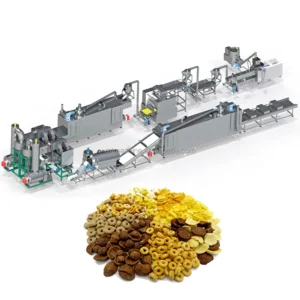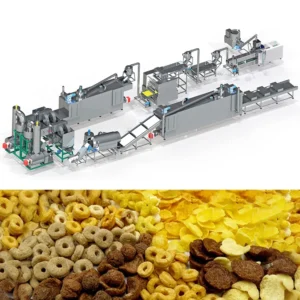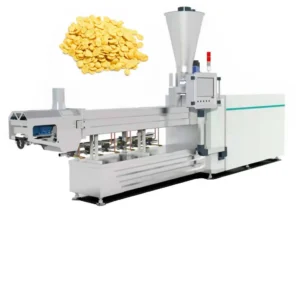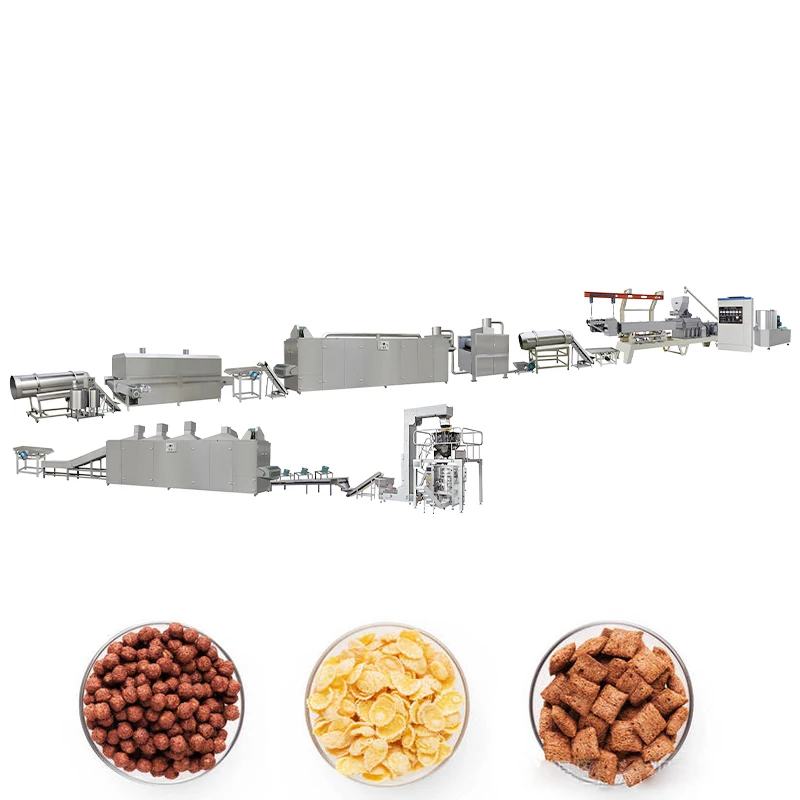
Matched Extrusion Parameters — We design the screw element sequence and die aperture around your specific corn formulation, validated through in-house trial runs before any shipment leaves our Jinan workshop.
Technical Specifications
| Parameter | Value |
|---|---|
| Model | MT-65 / MT-70 / MT-85 / MT-75 |
| Product Type | Corn Flakes Breakfast Cereal Production Line |
| Screw Type | Twin-screw extruder |
| Installed Power | MT-65: 84 kW / MT-70: 132 kW / MT-85: 239 kW / MT-75: 186 kW |
| Real Power Consumption | MT-65: 59 kW / MT-70: 92 kW / MT-85: 167 kW / MT-75: 140 kW |
| Output Capacity | MT-65: 120–150 kg/h (basis not stated in source) / MT-70: 200–250 kg/h (basis not stated in source) / MT-85: 300–400 kg/h (basis not stated in source) / MT-75: 400–500 kg/h (basis not stated in source) |
| Overall Dimensions (L×W×H) | MT-65: 21000×1200×2200 mm / MT-70: 23000×1500×2200 mm / MT-85: 28000×3500×4300 mm / MT-75: 24000×1500×2800 mm |
| Control System | PLC with real-time monitoring, data storage, alarm and reminder functions; MCC available |
| Barrel & Screw Design | 3D software design, analogue simulation, computer-tested for precision |
| Flaking Machine Roller | Cast iron rollers, 45# steel shaft, carbon steel frame, water cooling |
| Flaking Gap | Adjustable to control final flake thickness |
| Hot Air Roaster | Up to 400 °C, electric or gas heating |
| Dryer Configuration | Three, five, or seven layers; adjustable mesh belt speed; electric or gas |
| Sugar Spraying System | 28.75 kW total power; Ø600 × 2700 mm roller; 4000×1900×1880 mm |
| Packing Options | 420, 520, 620, 720 vertical packing machine |
| Certifications | CE (declared since 2014), ISO certified |
Application Suitability
| Application | Material or Output |
|---|---|
| Traditional corn flakes production | Corn flour or corn grits, plain or sugar-coated |
| Multigrain breakfast cereal | Blends of rice, millets, wheat, oat, and barley |
| Fortified breakfast cereal lines | Cereal bases with added vitamin and mineral premixes |
| Vegan cereal manufacturing | Plant-based grain formulations without dairy or animal derivatives |
| Maize flakes for food service | Coarse and fine corn grits for bulk institutional supply |
Why Generic Screw Setups Produce the Wrong Flake Density
A twin-screw corn flakes extruder screw configuration must be matched to the buyer’s actual grain blend, not copied from a standard template.
Process engineers often receive an extruder that runs perfectly on the supplier’s test material but fails on the production floor. When the raw material switches from standard corn flour to a high-amylose grits blend, the degree of starch gelatinisation shifts. The flakes emerge too dense or too brittle, and the downstream roaster cannot correct what the barrel already got wrong [NEED_CITE: starch gelatinisation behaviour in high-amylose corn during twin-screw extrusion]. The twin-screw corn flakes extruder screw configuration has to account for amylose content, particle size distribution, and incoming moisture before the first barrel zone is even set.
Barrel Temperature Profiling Across Gelatinisation Stages
The barrel is divided into independently controlled heating zones, each managing a different phase of the extrusion process. Early zones handle preconditioning and initial moisture absorption, while middle zones drive the bulk of starch gelatinisation through controlled shear and thermal input. The final zones near the die manage melt viscosity and pressure buildup. For corn flakes, the twin-screw corn flakes extruder screw configuration must maintain a temperature gradient that fully gelatinises the starch without over-expanding the extrudate, since the flake precursor needs a dense, cohesive structure before it reaches the flaking rolls.
Die Geometry and Its Role in Flake Precursor Formation
Die aperture shape and land length directly control the pressure at which the cooked dough exits the barrel. A round die with a short land produces a puffed pellet that is difficult to flatten into a coherent flake. A slot or elongated die with a longer land yields a denser, more uniform extrudate that passes through the cast iron flaking rollers without cracking. Die design is not a standalone decision; it is the final expression of everything the screw elements and barrel zones have done to the material upstream [NEED_CITE: die land length effect on extrudate density in cereal processing]. Getting this right is the core of reliable corn flakes extrusion technology.
Reading the Specs: What the Numbers Actually Mean for Your Line
The installed versus real power figures across the MT-65 through MT-75 range reveal how much energy the extruder actually draws during steady-state operation, which is what matters for your utility planning and transformer sizing. The L:D ratio implicit in the barrel design determines residence time — longer barrels allow more gradual gelatinisation at lower shear rates, reducing the risk of scorching heat-sensitive fortified premixes. The PLC control system with real-time data storage captures temperature, screw speed, and moisture readings for every batch, enabling your process engineers to reproduce exact extrusion conditions when switching between corn grits and multigrain blends. Flaking machine rollers made from cast iron with water cooling maintain a consistent surface temperature, preventing the extrudate from sticking or tearing during the critical thickness-reduction step. The adjustable flaking gap gives operators direct control over final flake thickness, which determines how the product behaves in the hot air roaster and ultimately how it performs in the bowl.
The Hidden Cost of Skipping Material-Specific Trials
When an extruder ships without a trial run on the buyer’s actual raw material, the first production run becomes the experiment. Corn grits from different harvests and milling processes vary in particle size, moisture content, and starch damage [NEED_CITE: variability in milled corn grits affecting extrusion performance]. Without baseline extrusion data, operators spend days adjusting barrel temperatures and screw speeds, burning through raw material and producing off-spec product. Flakes that are too dense sink in milk; flakes that are too fragile shatter during conveying and sugar coating. The downstream roaster and dryer then have to compensate for problems that originated in the barrel, creating bottlenecks that reduce the entire line’s effective throughput.
Why Sourcing the Extrusion Technology Here Makes Sense
Every screw element arrangement we build is specified against the buyer’s formulation, not pulled from a catalogue of generic builds. Our testing workshop runs your actual corn flour or grits through the extruder before shipment, generating a documented temperature profile and extrudate sample that your team can evaluate. The PLC system stores all trial parameters, so commissioning on your floor starts from a known baseline rather than a blank screen. We supply the complete line from batching through packing under one configuration, meaning the extruder output is matched to the flaking rolls, roaster, and dryer capacity — no station chokes the others. Every build carries CE and ISO documentation, and the electrical schematic confirms voltage and frequency before the control cabinet is wired.
Documentation & Verification
- Screw and die configuration record matched to your grain formulation and target flake density
- Trial run report on your specific corn flour or grits with extrudate samples before dispatch
- Barrel temperature profile map recorded zone-by-zone during the in-house test run
- Line layout and capacity calculation showing throughput balance across every station
- CE declaration of conformity and ISO certificate included with shipping documentation
Installation, Commissioning & Support
- Foundation requirements mapped to the MT-85 footprint of 28000×3500×4300 mm and total line weight
- Dedicated electrical circuit sized to the extruder’s real power draw, up to 167 kW for the MT-85
- PLC interface language and voltage confirmed before the control cabinet leaves the workshop
- First-run parameter transfer from trial data to your production line during on-site commissioning
- Cast iron flaking roller gap calibration and water cooling circuit setup included in installation
- Wear parts list covering screw elements, die inserts, and mesh belt sections for planned maintenance
What We Need to Scope Your Extrusion Parameters
To configure the twin-screw corn flakes extruder screw configuration for your production targets, we need the specific corn variety, particle size distribution, and any multigrain blend ratios you plan to run. Provide your target flake thickness, the local voltage and frequency at your facility, and the control interface language your operators require. If you have existing upstream milling or downstream packing equipment, share those specifications so we can match throughput across the full line.
Frequently Asked Questions
Q: How does screw configuration affect starch gelatinisation and final corn flake crispness?
A: Screw element arrangement determines shear intensity and residence time inside the barrel. Higher shear in the melting zone accelerates gelatinisation but can degrade starch chains if overdone. We configure the screw sequence to achieve full gelatinisation at controlled shear levels, producing an extrudate that flakes cleanly and roasts to a consistent crispness without internal voids or surface blistering.
Q: What barrel temperature profile is needed for corn grits versus corn flour?
A: Corn grits require a more gradual temperature ramp because their larger particle size slows moisture penetration. Corn flour gelatinises faster and needs tighter thermal control to prevent overcooking. During the trial run, we map the optimal zone-by-zone profile for your specific material and document it for your production team to reference.
Q: How is die aperture sized to produce the right extrudate for downstream flaking?
A: The die must produce an extrudate dense enough to hold together through the flaking rollers but not so dense that it resists compression. We size the die aperture and land length based on your target flake thickness and the gap setting on the cast iron rollers, ensuring a smooth transition from extrusion to flaking.
Q: Can the extrusion parameters be adjusted on-site for different cereal blends?
A: Yes. The PLC system stores multiple recipe profiles, each with its own screw speed, barrel temperature map, and feeder rate. When you switch from corn to a wheat-oat blend, operators load the corresponding profile and make fine adjustments based on the first extrudate samples.
Q: What trial run data is provided before shipment to confirm extrusion performance?
A: We run your actual raw material through the extruder in our testing workshop and provide a full report including barrel temperature logs, screw speed settings, moisture readings, extrudate density measurements, and physical samples so you can verify flake quality before the line ships.