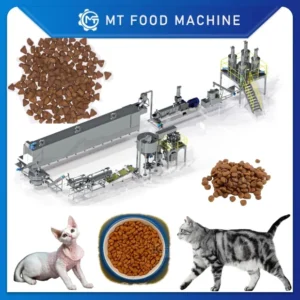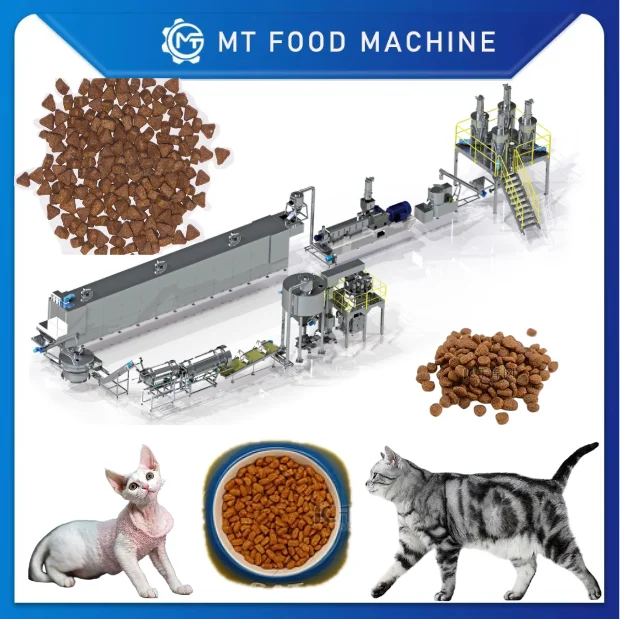
Matched Screw Profiling — extruder geometry configured to your specific meat meal ratio and moisture content before the machine leaves our Shandong workshop, not adjusted for the first time on your floor.
Technical Specifications
| Parameter | Value |
|---|---|
| Model | MT100 |
| Product Type | Multi-Species Pet Food Processing Line |
| Screw Configuration | Twin-screw |
| Control System | PLC Controlled with MCC integration |
| Output Capacity | 1.5-2.0 t/h (basis not stated in source — confirm raw material formulation, moisture content, and kibble size) |
| Alternative Capacity Claim | up to 550 kg/h (basis not stated in source — confirm raw material formulation, moisture content, and kibble size) |
| Suitable Species | Cat, Dog, Fish, Bird, Cattle |
| Line Scope | Complete processing from batching through extrusion to packing |
| Standards | CE, ISO |
| After-Sales Support | Video technical support, online service |
Application Suitability
| Application | Material or Output |
|---|---|
| Premium dry dog kibble | Corn, meat meal, and poultry by-product formulations requiring low-density, high-expansion texture |
| Cat food pellets | High-protein, high-fat recipes demanding tight density control and palatability coating compatibility |
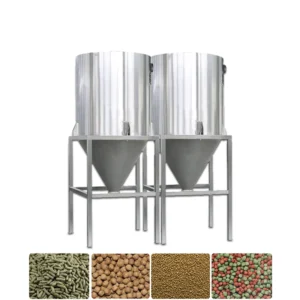
| Floating aquatic feed | Fish meal and starch blends engineered for controlled buoyancy in catfish and tilapia ponds |
| Sinking aquatic feed | Dense shrimp and bottom-feeder pellets requiring minimal expansion and high nutritional retention |
| Bird and cattle feed | Mixed grain and protein mash processed into uniform, nutritionally fortified pellets |
What "1.5 Tons per Hour" Actually Means on Your Raw Material
Nominal capacity figures printed on a brochure mean nothing if the screw profile was never tested against your specific meat meal percentage and moisture target.
A pet food line rated at a certain throughput can easily lose a significant portion of that output when the formulation shifts from standard corn-heavy recipes to high-protein, high-fat blends. I have seen lines stall or produce dense, unexpanded kibble because the screw elements were copied from a generic template rather than matched to the buyer’s actual raw material [NEED_CITE: twin-screw extrusion behavior on high-protein formulations]. When you evaluate twin-screw pet food extrusion line specifications, the number on the nameplate is only the starting point. The real question is whether the manufacturer has run your recipe through a testing workshop before quoting the throughput. Without that validation step, you are buying a machine on paper, not a production solution. The MT100 twin-screw platform addresses this by requiring a raw material trial before the configuration is locked.
Barrel Temperature Zoning and Starch Gelatinisation
The MT100 barrel is divided into multiple independent heating and cooling zones, each managed through the PLC interface. This zoning lets the operator control exactly where and how starch gelatinisation occurs along the screw length. For a high-meat dog kibble recipe, the early zones need lower temperatures to prevent protein denaturation before the starch matrix forms, while later zones require precise heat input to achieve the expansion ratio the market expects. Getting this profile wrong means kibble that is either too dense for dog palatability or too fragile to survive packaging and transport.
Screw Element Arrangement for Density Control
The twin-screw configuration on the MT100 uses interchangeable screw elements — kneading blocks, forward conveying elements, and reverse screw sections — arranged in a sequence specific to the target product. Floating fish feed requires a high-shear kneading section to fully gelatinise starch and trap air cells for buoyancy, while dense dog kibble uses a shorter residence time with less aggressive mixing. The die geometry further refines the output: a multi-hole die with a specific land length controls the pressure drop at exit, which directly governs the expansion ratio. This is where twin-screw pet food extrusion line specifications move from catalogue numbers to process engineering [NEED_CITE: screw configuration impact on extrudate density].
Reading the Specs That Actually Govern Output
The PLC-controlled system on the MT100 integrates motor load monitoring, barrel temperature feedback, and feeder speed synchronisation — parameters that collectively determine whether the line holds its rated throughput on your recipe. The twin-screw design provides self-wiping action, which matters when switching between high-fat cat food recipes and leaner dog formulations; residual material in a single-screw barrel causes cross-contamination and inconsistent expansion between batches. The MCC panel coordinates the upstream batching mixer and downstream dryer speed with the extruder output, so a bottleneck at the dryer does not force the extruder to idle. Capacity claims only hold when every station in the line is matched, which is why the MT100 line layout calculation documents throughput at each stage rather than just at the extruder throat.
The Hidden Cost of a Generic Screw Build
When the screw configuration is not matched to your formulation, the problems do not show up until commissioning — and they are expensive to fix on-site. Kibble that sinks when it should float, pellets that crumble in the coating drum, or an extruder that cannot reach nameplate capacity without excessive motor load all trace back to the same root cause [NEED_CITE: extrusion commissioning failures linked to generic screw builds]. I once spent two weeks on-site in the Middle East reconfiguring screw elements and swapping die plates because the original build was based on a standard corn recipe, not the high meat meal formulation the customer actually used. That kind of field rework costs far more in lost production time and travel expense than getting the configuration right in the testing workshop before the crate is sealed.
Why Source This Line from Shandong
The MT100 platform is built around a testing workshop where your raw material runs through trial extrusion before the final screw and die configuration is locked — not a generic build shipped and adjusted later. The PLC and MCC integration covers every station from batching to packing, so throughput is balanced across the line rather than leaving the dryer or coater as a bottleneck. Screw element records and die configuration documents ship with the machine, meaning your maintenance team knows the exact build when replacement parts are needed. Voltage, frequency, and HMI language are confirmed to your facility standards before production begins, eliminating the commissioning delays that come from mismatched electrical specifications. The CE and ISO certified production process ensures documentation meets export market requirements for customs and regulatory inspection [NEED_CITE: CE declaration requirements for food processing machinery].
Documentation & Verification
- Line layout and capacity calculation showing throughput balance across batching, extrusion, drying, coating, and packing stations
- Screw and die configuration record documenting the exact element sequence matched to your formulation
- Trial run report generated from your raw material processed in the testing workshop before dispatch
- Electrical schematic with voltage, frequency, and control language confirmed to destination country standards
- CE declaration of conformity and ISO certificate for customs clearance and regulatory compliance
Installation, Commissioning & Support
- Foundation plan and utility connection schedule matched to the MT100 PLC cabinet and MCC panel power draw
- Twin-screw barrel alignment verification and screw element sequence confirmation during on-site assembly
- PLC parameter loading with your recipe profiles and HMI language set before operator training begins
- Dryer and coating drum throughput balancing against extruder output to eliminate line bottlenecks
- Wear parts list covering screw elements, die plates, and barrel liners with recommended replacement intervals
What We Need to Configure Your Line
To move from a general specification to a line layout matched to your production target, we need your raw material formulation including meat meal percentage and moisture content, your target kibble size and density range, and the species market you are supplying. Your facility voltage and frequency, available floor space, and preferred PLC interface language should also be confirmed early so the electrical build is correct before production starts. If you have an existing upstream mixer or downstream packing system that must integrate with the MT100, share those equipment details so the throughput calculation accounts for the full line.
Frequently Asked Questions
Q: How is the stated output capacity verified against my raw material?
A: We run your actual formulation through the MT100 in our testing workshop, measuring throughput, expansion ratio, and kibble density under controlled conditions. The trial run report documents the verified output on your specific recipe, including moisture content and screw configuration used. This replaces guesswork with measured data before the line ships.
Q: How does the screw configuration change between cat kibble and floating aquatic feed?
A: Cat kibble requires a screw profile that manages high fat content while maintaining a dense, crunchy texture, using specific kneading block placement. Floating aquatic feed needs aggressive shear and longer residence time to fully gelatinise starch and trap air cells. The MT100 screw elements are rearranged and the die geometry is swapped to match each product’s density target.
Q: What barrel temperature options are available for expansion control?
A: The MT100 barrel features multiple independently controlled heating and cooling zones managed through the PLC. This allows precise temperature staging along the screw length, giving the operator direct control over starch gelatinisation timing and expansion ratio. Moisture injection points can also be configured to fine-tune the extrudate texture before it reaches the die.
Q: Can the PLC interface language be set to our local standard before delivery?
A: Yes, the HMI language, alarm messages, and parameter labels on the MT100 PLC are configured to the operator’s preferred language during production. This is confirmed during the specification review stage along with voltage and frequency, so the control system is ready for immediate operation at commissioning without on-site translation work.
Q: What does the pre-shipment trial run process involve?
A: Your raw material is processed through the MT100 in our testing workshop using the proposed screw and die configuration. We measure output rate, kibble density, expansion ratio, and product appearance, then adjust the screw profile if results fall outside your specification. A full trial run report with the final configuration settings ships with the machine documentation.