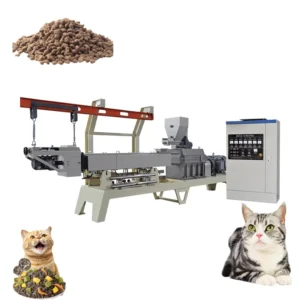
Precision screw and die configuration — every barrel zone and die orifice is matched to your raw material formulation and pellet density target, verified through in-house trial runs before dispatch.
Technical Specifications
| Parameter | Value |
|---|---|
| Product Type | Twin-Screw Fish Feed Extrusion Line |
| Output Capacity | 1.0–1.5 t/h (basis not stated in source — confirm raw material formulation, moisture content, pellet size and sinking/floating specification) |
| Extruder Type | Twin-screw |
| Construction Material | 304 stainless steel (food-contact parts) |
| Control System | PLC & MCC (configurable to buyer’s site requirements) |
| Line Stations | Batching & mixing → extrusion → drying → coating/seasoning → cooling → packing |
| Screw Configuration | Matched to raw material and target product texture |
| Die Configuration | Matched to pellet diameter and density target |
| Voltage & Frequency | To be confirmed against buyer’s site |
| Certification | CE, ISO |
Application Suitability
| Application | Material or Output |
|---|---|
| Floating aquafeed for trout and salmon | Fish meal, starch binders, vitamin premix; low-density pellets requiring high expansion |
| Sinking aquafeed for catfish and carp | Higher protein formulations with controlled gelatinisation for dense pellet output |
| Multi-species feed plants | Changeover between pellet diameters and density targets on a single line |
| Marine species feed | Salt-tolerant formulations with 304 stainless steel contact surfaces |
Why Generic Screw Builds Fail at Your Target Density
A twin-screw extruder configured from a template rather than your actual formula will produce pellets that miss the floating or sinking specification your market demands.
I spent years on assembly floors watching lines ship out with screw profiles copied from a standard build. The extruder looks right on paper, but when a buyer runs a high fish-meal formulation through it, the shear energy drops and the pellets either sink when they should float or crumble during drying. The fish feed extrusion line specifications you receive must document a screw and die configuration that was calculated for your specific raw material blend, not pulled from a catalogue default [NEED_CITE: twin-screw extrusion screw profile selection for aquafeed formulations].
Barrel Temperature Zones and Starch Gelatinisation Control
Proper starch gelatinisation in aquafeed depends on maintaining a precise temperature gradient across multiple barrel zones. Too much heat too early causes premature expansion inside the barrel, while insufficient heat leaves raw starch that reduces digestibility and pellet water stability. The barrel profile on this fish feed extrusion line specifications sheet is engineered so that each zone contributes to a controlled gelatinisation curve matched to your starch source and moisture input.
Moisture, Shear and Expansion Rate
The relationship between preconditioning moisture and mechanical shear inside the barrel determines the final pellet density. Floating feed requires high expansion, which means the dough must retain enough steam pressure at the die face to puff outward the moment it exits. Sinking feed demands the opposite — a denser matrix with minimal expansion. Getting this balance right is the central challenge in any how to choose twin-screw aquafeed line decision, and it is why screw element sequencing must be tied to your exact formulation [NEED_CITE: moisture and shear interaction in twin-screw extrusion for aquafeed].
Reading the Specs That Matter for Pellet Quality
The L:D ratio of the screws determines residence time inside the barrel — a longer ratio gives more time for starch conversion but increases energy input per kilogram of output. Die orifice diameter and land length together control the pressure drop at exit, which directly governs expansion ratio and therefore pellet buoyancy. The PLC system logs barrel temperature, screw speed and feeder rate for every batch, giving operators a repeatable baseline so that a trout feed run on Monday matches the same specification on Friday. Food-grade 304 stainless steel on all contact surfaces resists the corrosive salts and amino acids common in marine feed formulations, reducing pitting and extending intervals between barrel liner replacements.
The Cost of Skipping a Trial Run
When a line ships without a documented trial on your raw material, the first weeks of production become an expensive experiment. Pellet density drifts outside specification, dryer throughput cannot keep pace because the extruder is running slower to compensate, and coating adhesion fails because the pellet surface porosity is wrong. These issues compound through every downstream station, and the root cause is almost always a screw or die configuration that was never validated against the buyer’s actual formula [NEED_CITE: aquafeed extrusion trial run validation before shipment].
What This Build Brings to Your Plant
Screw configuration and die design are specified to your raw material and target pellet density rather than selected from a generic matrix. An in-house testing workshop runs your actual formulation before the line ships, producing a documented trial report with pellet density, expansion ratio and surface texture data. Throughput is matched across every station — batching, extrusion, drying, coating and packing — so no single unit bottlenecks the others. PLC and MCC control gives your operators a repeatable parameter set for batch-to-batch consistency. CE and ISO documentation is prepared to the standards required for your destination market.
Documentation & Verification
- Screw and die configuration record documenting the build matched to your raw material formulation
- Trial run report on your actual aquafeed formula covering pellet density, expansion and surface finish
- Line layout and capacity calculation showing throughput balance across every station
- Electrical schematic with voltage and frequency confirmed for your facility
- CE declaration of conformity and ISO certificate for export compliance
- Operation and maintenance manual with wear parts list specific to your screw and die set
Installation, Commissioning & Support
- Foundation plan based on line footprint and extruder vibration load for your workshop floor
- Dedicated power circuit sized to PLC and main drive motor requirements at your local voltage
- Barrel and screw assembly verified on-site against the factory test record
- First-run parameter tuning with your raw material to match target pellet density
- Operator training covering PLC batch recall, screw changeover and die cleaning procedures
- Wear parts list with lead times for replacement screws, dies and barrel liners
Before You Request a Quote
Send your raw material formulation including protein source, starch type and target moisture content. Specify which species you are producing for, whether the pellets must float or sink, and the pellet diameter range your market requires. Confirm your site voltage, frequency and preferred control language so the electrical package is built correctly from the start.
Frequently Asked Questions
Q: How is the output capacity verified against my raw material?
A: Capacity figures are confirmed only after a trial run using your specific formulation in the testing workshop. The report documents actual throughput at your target pellet size and moisture content, so the number you receive reflects your process conditions rather than a generic benchmark.
Q: How are screw and die configurations chosen for floating versus sinking feed?
A: Screw element sequencing and die land length are calculated based on the expansion ratio your pellet requires. Floating feed needs high expansion with short die land, while sinking feed uses longer land and a screw profile that limits gas retention for a denser matrix.
Q: What barrel profile and moisture range support proper gelatinisation?
A: Barrel zones are set to create a temperature gradient that converts starch progressively along the screw length. Moisture is typically preconditioned to a range suited to your starch source, with each zone logged by the PLC to maintain batch-to-batch consistency.
Q: How is extruder throughput matched to the dryer and coater?
A: Every station in the line is sized during the layout phase so that dryer residence time and coating drum capacity align with extruder output. This prevents wet pellets queuing before the dryer or coating bottlenecks forcing the extruder to idle.
Q: Can I see a trial run before the line ships?
A: Yes. Your raw material is run through the extruder in the testing workshop, and the resulting pellets are measured for density, expansion and durability. A full report is provided so you can confirm product quality before the equipment leaves the factory.