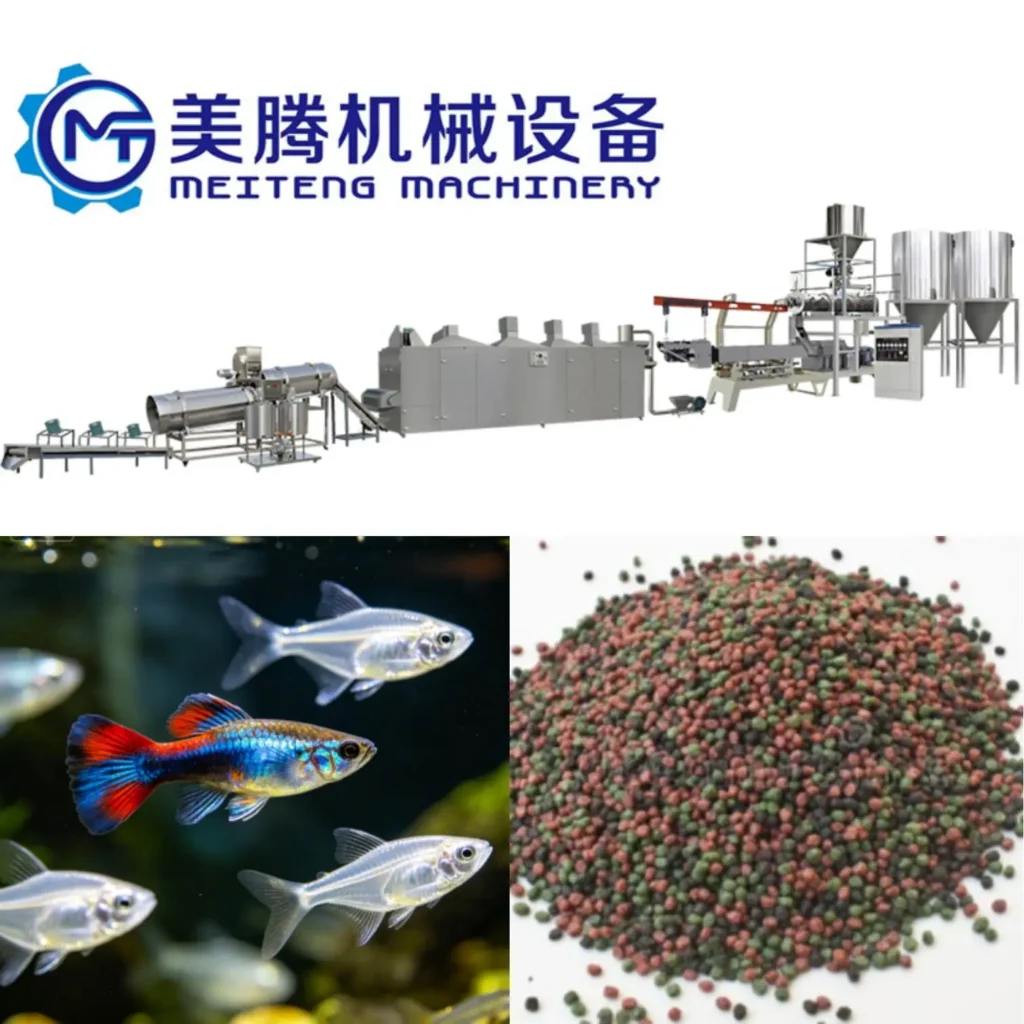
Twin-Screw Configuration Matched to Raw Material — every screw element and die opening is selected after reviewing your fish meal, starch and protein ratios, not copied from a generic aquatic feed build.
Technical Specifications
| Parameter | Value |
|---|---|
| Product Type | Multi-Species Fish Feed Processing Line |
| Extruder Type | Twin-screw extruder |
| Output Capacity | 200–300 kg/h (basis not stated in source — confirm raw material formulation, moisture content and pellet diameter) |
| Construction Material | 304 stainless steel (food-contact parts) |
| Control System | PLC / MCC (options to confirm) |
| Voltage & Frequency | Configurable per target market (to confirm) |
| Certification | CE, ISO |
Application Suitability
| Application | Material or Output |
|---|---|
| Floating trout and salmon pellets | High-protein fish meal blends with controlled starch gelatinisation |
| Sinking catfish feed | Dense carbohydrate and protein mixes requiring low expansion |
| Aquaculture hatchery micro-pellets | Fine-grind raw materials with tight diameter tolerances |
| Multi-species grow-out feed | Variable formulations processed through interchangeable die plates |
What Generic Screw Builds Do to Fish Feed Density
Screw configuration must follow the formulation, never the other way around.
I have watched a twin-screw line ship with a standard aquatic feed screw profile, only for the buyer to discover during commissioning that their high-proponent formulation produced sinking pellets where floating ones were specified. The extruder was fine; the screw elements and die geometry simply did not match the material. Correcting that on-site cost weeks of downtime and a full set of replacement screws flown in from the factory [NEED_CITE: twin-screw element configuration and starch gelatinisation behaviour]. When fish feed extrusion technology twin-screw setups are specified without reviewing the buyer’s actual formulation, density drift is almost guaranteed once production begins.
Barrel Temperature Profiling for Predictable Expansion
Each barrel zone on this twin-screw extruder can be independently heated and monitored, allowing the temperature profile to follow the gelatinisation curve of the specific starch source in your formulation. Whether the binder is corn, wheat or cassava, the barrel zones are staged so that starch reaches full gelatinisation before the material arrives at the die. This level of zone control is what separates consistent pellet expansion from batch-to-batch density variation on the fish feed extrusion technology twin-screw platform.
Moisture, Shear and the Floating-Sinking Boundary
Floating pellets require a precise combination of moisture injection, screw shear and die pressure to trap enough gas inside the pellet matrix for buoyancy. Sinking pellets demand the opposite: higher compression, lower expansion at the die face. The twin-screw configuration allows operators to adjust screw element spacing and rotational speed to shift between these two regimes without a full mechanical rebuild. Getting this balance right during the trial phase prevents the common complaint of floating feed that slowly sinks after a few hours in the water [NEED_CITE: pellet buoyancy and water stability testing standards in aquaculture].
Reading the Spec Sheet Against Your Formulation
The rated output of 200–300 kg/h applies to a specific raw material mix and moisture level that must be confirmed before the line is finalised. The L:D ratio of the barrel determines residence time, which directly affects how completely starch gelatinises in high-protein or high-fat blends. Die format must be chosen based on whether the target pellet is floating or sinking, and the die opening diameter sets the pellet size range. Control system options include PLC with recipe storage or MCC with manual adjustment, and the choice depends on how frequently formulations change between production runs. All food-contact surfaces use 304 stainless steel, meeting CE machinery directive requirements for equipment destined for regulated markets [NEED_CITE: CE machinery directive requirements for industrial equipment].
The Hidden Cost of Skipping a Trial Run
Lines that ship without a trial run on the buyer’s actual raw material almost always require process adjustments during commissioning. That means burning raw material on-site, paying for extended engineer visits and delaying the first commercial shipment. In aquatic feed, a pellet that sinks when it should float is not a minor defect — it is a product rejection from the farm [NEED_CITE: aquaculture feed pellet specification and rejection criteria]. The twin-screw extruder and its supporting dryer and coater must be validated together, because throughput mismatches between stations create bottlenecks that no single-machine test can reveal.
Why This Line Is Engineered Around Your Material
Every screw configuration and die design is specified after reviewing the buyer’s raw material formulation, not selected from a catalogue of standard builds. The in-house testing workshop runs trial production on the customer’s own ingredients before shipment, generating a trial report that documents pellet density, expansion ratio and moisture at the die. Complete line throughput is calculated station by station, so the dryer capacity, coating drum volume and cooler length match the extruder output rather than limiting it. Electrical schematics and control language are confirmed to the target market before production begins, avoiding commissioning delays caused by incorrect voltage or unreadable HMI text. The 304 stainless steel construction across all food-contact parts meets the hygiene expectations of regulated aquaculture feed markets.
Documentation & Verification
- Screw and die configuration record matched to your raw material formulation and target pellet type
- Trial run report from the testing workshop documenting pellet density, expansion and moisture data
- Line layout and capacity calculation confirming throughput balance across all stations
- Electrical schematic with voltage, frequency and control language confirmed for your market
- CE declaration of conformity and ISO certificate included with shipping documentation
Installation, Commissioning & Support
- Foundation plan provided based on twin-screw extruder weight and vibration characteristics
- Dedicated power circuit specification matched to confirmed voltage and total connected load
- Assembly sequence documented for barrel, screw shaft and die installation on site
- Commissioning includes first-run parameter logging for barrel zones, screw speed and feed rate
- Operator training covers formulation changeover procedures on the PLC or MCC control system
- Wear parts list with screw elements, die plates and seals itemised for first reorder cycle
Before You Request a Quote
Share your raw material formulation including protein source, starch type and fat content, along with the target pellet diameter and whether you need floating, sinking or both formats. Specify your local voltage and frequency so the electrical design matches your facility from day one. If you already operate upstream mixing or downstream packing equipment, provide the interface details so the line layout accounts for existing conveyors and silos.
Frequently Asked Questions
Q: How is the output capacity verified, and what formulation is it based on?
A: The 200–300 kg/h range is a reference figure that must be confirmed against your specific raw material blend, moisture content and pellet diameter. We run your formulation in our testing workshop before finalising the line, and the trial report documents the actual throughput achieved under production conditions.
Q: How are screw and die selected for floating versus sinking pellets?
A: Floating pellets need screw elements that generate controlled expansion and a die that maintains internal gas pressure, while sinking pellets require higher compression elements and a die that limits expansion. We specify both the screw profile and die geometry based on your formulation and target buoyancy.
Q: What moisture range and barrel profile are needed for my starch source?
A: Different starch sources gelatinise at different temperatures and moisture levels. Corn, wheat and cassava each require a distinct barrel zone temperature profile and moisture injection rate. These parameters are established during the trial run on your actual raw material and documented in the commissioning record.
Q: Can you run a trial on my raw material before the machine ships?
A: Yes. Our in-house testing workshop processes your raw material through the configured twin-screw extruder and records pellet density, expansion ratio, moisture content and throughput. The trial report is shared with you before shipment so you know the line will perform on your formulation.