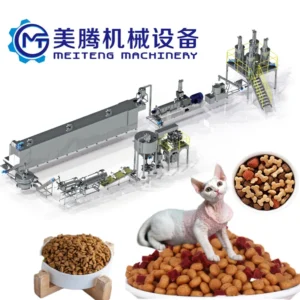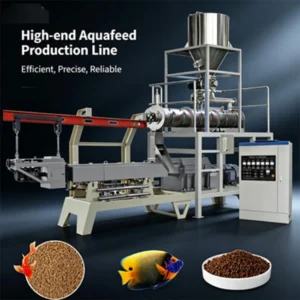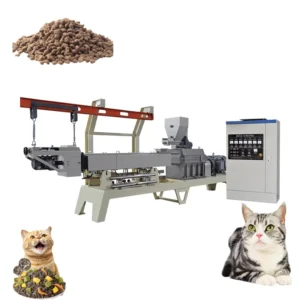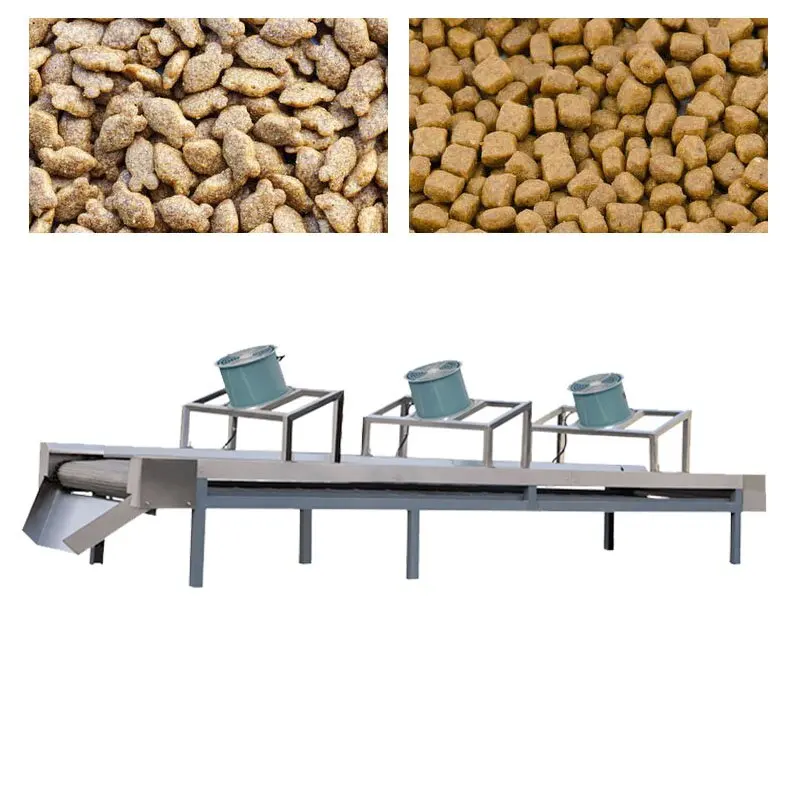
Material-Specific Screw Configuration — Every screw element sequence and die plate is specified to the buyer’s actual formulation, not copied from a generic build, ensuring target density and expansion from day one.
Technical Specifications
| Parameter | Value |
|---|---|
| Product Type | Twin Screw Pet Food Extrusion Production Line |
| Output Capacity | Up to 3 tons per hour (basis not stated in source — confirm raw material formulation, moisture content and target kibble size) |
| Screw Type | Twin screw |
| Line Automation Level | Full automatic |
| Supported Applications | Fish, dog, and cat food production |
| Control System | PLC / MCC configuration (to be confirmed per site requirements) |
| Voltage & Frequency | Configurable to target market (to be confirmed) |
| Process Documentation | Fish feed process drawing included |
| Warranty | 1 year |
| Screw Diameter | To be confirmed based on capacity selection |
| L:D Ratio | To be confirmed based on formulation requirements |
| Barrel Zones | To be confirmed based on thermal profile needs |
| Die Configuration | Matched to target kibble shape and density |
| Line Stations | Batching, extrusion, drying, coating, cooling, packing scope to be confirmed |
Application Suitability
| Application | Material or Output |
|---|---|
| Dry kibble for dogs and cats | Corn, wheat, rice, meat meal, bone meal, fish meal, vitamin premix blends |
| Floating aquatic feed | Soybean meal, fish meal, starch binders for catfish and tilapia |
| Sinking aquatic feed | High-density protein formulations for shrimp and bottom-feeding species |
| Grain-based extruded treats | Corn grits, rice flour, oat blends with flavor and nutrient inclusions |
What Generic Screw Profiles Cost You in Actual Production
A twin-screw extruder configured for a reference recipe will behave differently — often losing significant output — when it meets your real raw material.
I have watched lines that performed perfectly during factory acceptance on a standard corn-starch blend struggle the moment a buyer switched to their own high-protein, high-fat pet food formulation. The extruder barrel fills unevenly, the die pressure drifts, and the kibble density falls outside what the market expects [NEED_CITE: starch gelatinisation behaviour across varying protein and fat ratios in extrusion]. The twin screw pet food extrusion line extrusion technology only delivers when every screw element, barrel zone, and die opening is matched to the recipe that will actually run through it eight hours a day.
How Screw Element Sequencing Shapes Kibble Texture
The arrangement of conveying, kneading, and reverse elements inside the barrel determines how much mechanical energy the dough absorbs before it reaches the die. A formulation heavy in meat meal needs a different shear profile than one built primarily on corn and wheat flour. Adjusting the kneading block positions changes the degree of starch gelatinisation, which directly controls whether the final kibble fractures cleanly or crumbles during packaging and transport. Selecting the correct twin screw pet food extrusion line extrusion technology parameters at the design stage prevents texture defects that no downstream dryer or coating drum can fix.
Barrel Temperature Zones and Gelatinisation Control
Each heating and cooling zone along the barrel manages a specific stage of the dough’s transformation. Early zones pre-condition the mix and begin hydration, while middle zones push starch past its gelatinisation threshold. Late zones stabilise melt temperature before the die. If a recipe contains heat-sensitive additives such as vitamin premixes or enzymes, the thermal profile must account for their degradation points [NEED_CITE: thermal degradation thresholds for common vitamin premixes in food extrusion]. Getting this wrong means either under-cooked kibble with poor shelf stability or nutrient loss that forces expensive over-dosing of supplements.
Reading the Specs That Actually Matter
The L:D ratio — the relationship between screw length and diameter — governs how long the material stays inside the barrel and therefore how completely starch converts. A short L:D works for simple puffed shapes but may leave complex, high-protein formulations under-processed. The number of independently controlled barrel zones determines how finely the thermal profile can be tuned; fewer zones mean broader, less precise temperature bands. Die geometry — the number of openings, their diameter, and the land length — sets the expansion ratio and final kibble density, which in turn decides whether aquatic feed floats or sinks. Full automatic control across these variables keeps batch-to-batch variation within tight limits once the correct baseline is established.
The Downtime Cost of Overlooked Configuration Details
When screw elements are selected without reference to the buyer’s actual formulation, wear concentrates on specific flight edges, shortening service intervals and raising spare parts consumption. A die plate designed for a different expansion ratio produces kibble that either over-expands and becomes fragile or under-expands and sinks when it should float [NEED_CITE: relationship between die land length and expansion ratio in twin-screw extrusion]. These issues rarely surface during a short factory test on generic material; they appear weeks into production, when a warehouse of finished goods sits outside specification and the line is shut down waiting for replacement tooling.
Why Sourcing This Line Here Makes Sense
Screw configuration and die design are specified against the buyer’s raw material data sheet, not pulled from a standard library. An in-house testing workshop runs trial extrusion on the customer’s actual formulation before the line ships, generating a documented process baseline. Throughput calculations cover every station — from batching through extrusion to drying, coating, and packing — so no single unit bottlenecks the rest. PLC and MCC panels are built and labelled in the control language and voltage standard of the destination facility. Pre-sales engineering continues through on-site installation, commissioning, and operator training, with wear parts lists matched to the specific screw and die set supplied.
Documentation & Verification
- Line layout drawing showing throughput matching across every station for your target capacity
- Screw and die configuration record matched to your raw material formulation
- Trial run report on your actual recipe conducted in the testing workshop before shipment
- Electrical schematic with confirmed voltage, frequency, and control language for your site
- Machine specification sheet detailing barrel zone count, L:D ratio, and motor power
- CE declaration of conformity and ISO certificate for the supplied equipment
Installation, Commissioning & Support
- Foundation and floor loading plan based on the confirmed line dimensions and operating weight
- Dedicated power circuit sizing matched to the extruder main drive and dryer thermal load
- Modular station delivery allowing phased installation in facilities with limited access
- First-run parameter logging covering barrel temperatures, screw speed, and feed rate for your formulation
- Operator training on die changes, screw element replacement, and daily cleaning procedures
- Wear parts kit including matched screw flights and die plates shipped with the line
What We Need to Configure Your Line
Share your target formulation — including primary protein sources, starch carriers, and moisture content — along with the kibble size range and density specification your market requires. Confirm the voltage and frequency at your facility, the control language your operators read, and whether you need floating, sinking, or both aquatic feed types. If you can provide a sample of your raw material blend, a trial run in the testing workshop will establish the screw and die baseline before the line enters production.
Frequently Asked Questions
Q: How is screw configuration selected for different pet food and aquatic feed formulations?
A: Conveying, kneading, and reverse screw elements are sequenced based on the protein, fat, and starch ratios in your recipe. High meat-meal blends need different shear profiles than grain-dominant mixes. The configuration is documented and tested on your actual material in the workshop before shipment, so the line produces correct texture and density from the first production run.
Q: What barrel temperature profile is needed for proper starch gelatinisation?
A: Each barrel zone is set to manage a specific stage — hydration, gelatinisation, and melt stabilisation. The target temperatures depend on your starch source and the presence of heat-sensitive additives. During the trial run, zone-by-zone readings are recorded and saved as the baseline recipe for your formulation, giving operators a verified starting point.
Q: How does die geometry affect kibble expansion and aquatic feed behaviour?
A: The number of die openings, their diameter, and land length together control the pressure drop at exit, which governs expansion ratio and final density. Floating aquatic feed requires a lower density than sinking feed, achieved through specific die selection matched to the formulation. Die plates are specified and tested against your target product before the line ships.
Q: Can a trial run be performed on my actual raw material before shipping?
A: Yes. The in-house testing workshop runs your supplied raw material through the configured extruder, documenting screw speed, barrel temperatures, moisture injection rate, and the resulting kibble density and expansion. The trial run report ships with the line, giving your team a verified process baseline instead of starting development after installation.
Q: How are moisture and shear controlled to maintain consistent density?
A: Liquid injection ports along the barrel introduce precise moisture quantities at defined stages, while screw element sequencing manages shear intensity. The full automatic control system monitors and adjusts these variables in real time, reducing batch-to-batch density variation. Parameters established during the pre-shipment trial run are loaded into the PLC as the reference recipe.