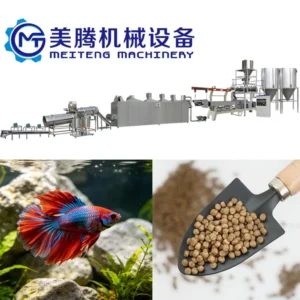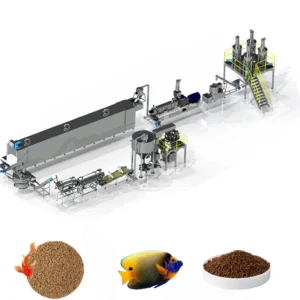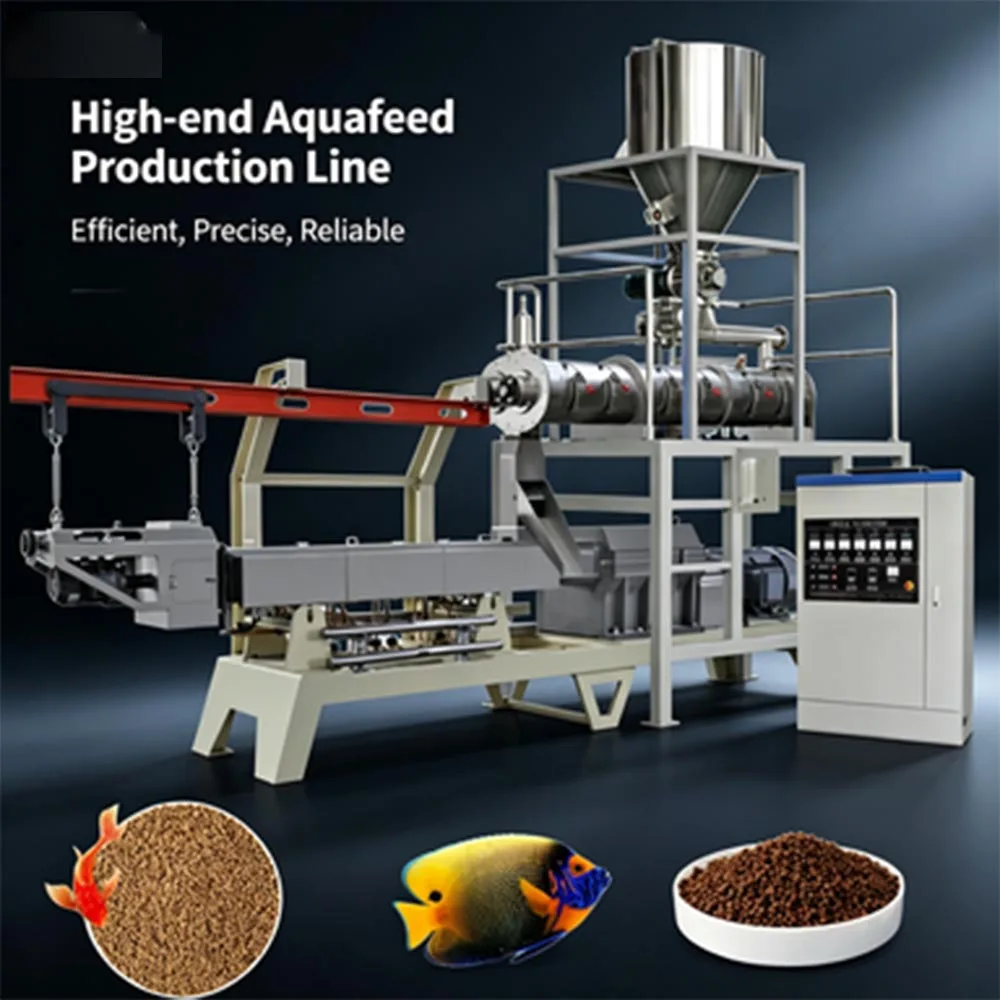
In-house trial runs on your raw material — we verify screw configuration and coating adhesion using your actual fish meal and soybean meal blend before the line ships, preventing density and buoyancy surprises on your factory floor.
Technical Specifications
| Parameter | Value |
|---|---|
| Product Type | Fish Feed Flavoring Coating Machine |
| Control System | PLC automatic control system |
| Contact Material | Food-grade 304 stainless steel |
| Line Stations | Raw material mixer, extruder, dryer, seasoning coating machine, vibrating sieve, conveyor equipment |
| Operation Interface | Humanized operation interface |
| Assembly State | Complete matched production line configuration |
| Output Capacity | Large stable processing capacity for medium to large scale industrial commercial fish feed mass production (basis to be confirmed) |
| Operating Mode | Full continuous automatic production from raw material mixing to finished product discharging |
| Energy Design | Optimized energy saving transmission structure and heating system |
| Maintenance Design | Convenient daily cleaning, regular maintenance, quick replacement of vulnerable parts |
| Standards | CE certified, ISO certified |
Application Suitability
| Application | Material or Output |
|---|---|
| Floating fish feed pellets for koi and goldfish | Fish meal, soybean meal, corn powder with buoyancy-targeted screw configuration |
| Sinking aquatic feed for freshwater species | Compound additives and starch blends compressed through high-shear die design |
| Tropical fish feed with precise density control | Multi-ingredient formulations requiring matched barrel temperature profiles |
| Surface-coated pellets with flavoring adhesion | Oil and seasoning sprayed on extruded pellets via dedicated coating drum |
Why Screw Configuration Decides If Your Fish Feed Floats or Sinks
The extruder is not the bottleneck — it is the relationship between screw geometry, barrel heat zones, and die restriction that sets pellet density.
When a feed producer complains that floating pellets sink within minutes, or sinking feed drifts to the surface too fast, the investigation almost never points to the motor or throughput. It points to how starch gelatinisation was managed inside the barrel and what the die forced the melt through. I have seen lines where the fish feed flavoring coating machine extrusion technology was perfectly adequate, but the screw elements were pulled from a generic catalogue build that never accounted for the buyer’s high-fat fish meal ratio [NEED_CITE: twin-screw element selection for high-lipid aquatic formulations]. The pellets looked correct on the conveyor, but density was outside what the pond or tank environment demanded.
Barrel Temperature Zones and Starch Gelatinisation
Fish meal and soybean meal blends behave differently from pure corn or rice grits under shear. The protein fraction denatures at lower barrel temperatures than starch gelatinises, so the heating profile must be staged. A flat temperature curve across all zones will either under-cook the starch — leaving pellets that disintegrate in water — or scorch the protein, reducing palatability. This is where the fish feed flavoring coating machine extrusion technology earns its value: precise zone control lets the operator hold the first two barrel sections cooler for protein conditioning, then ramp the middle zones for starch conversion, and finally drop the temperature before the die to control expansion.
Die Geometry and Pellet Expansion Rate
The die plate determines the final shape, but more importantly, it sets the pressure drop that governs how much steam flashes off when the melt exits the barrel. A thicker die with longer land length restricts flow and increases back-pressure, producing denser sinking pellets. A thinner die with shorter land length allows rapid expansion, creating the air pockets that keep floating feed at the surface. Matching die design to target species — koi that feed at the surface versus catfish that feed at mid-water — is not a luxury, it is the baseline expectation from any aquaculture operation [NEED_CITE: die land length and pellet buoyancy in aquatic feed production]. The seasoning and coating station downstream cannot correct a density error introduced here.
What the PLC Actually Controls Beyond On and Off
The PLC automatic control system on this line does more than sequence the stations. It records and holds the barrel temperature profile, screw speed, feeder rate, and cutter timing as a named recipe, so that when the operator switches from a floating koi formula to a sinking catfish formula, the changeover is repeatable. This matters because the fish feed flavoring coating machine extrusion technology relies on consistent pellet geometry entering the coating drum. If extruder output varies in size or moisture from one batch to the next, the oil spray pattern will be uneven — some pellets over-coated, others barely touched. The humanized operation interface displays real-time deviation from the saved recipe, letting the operator correct drift before an entire batch goes off-spec.
Reading the Spec Sheet Beyond Motor Power
Buyers often fixate on motor kilowatts as a proxy for capability, but motor power alone tells you nothing about what happens inside the barrel. The screw configuration — how many conveying elements, kneading blocks, and reverse-screw sections are assembled on the shaft — determines residence time and shear intensity. A long residence time with moderate shear fully ripens a fish meal blend, while short residence time with high shear is better suited for pure starch applications. The food-grade 304 stainless steel contact surfaces ensure that no metallic contamination enters the feed during this high-shear phase, which matters for export markets with strict traceability requirements. The optimized energy saving transmission structure reduces heat loss between the motor and the barrel, meaning the thermal energy you pay for actually reaches the material instead of dissipating into the workshop air.
What Happens When the Extruder and Coating Drum Are Mismatched
An extruder running at full throughput pushes pellets into a dryer, and that dryer delivers them to the coating drum. If the coating drum was sized for a lower throughput, pellets pile up inside, the spray nozzles cannot cover the tumbling mass evenly, and you get a mix of over-oiled clumps and under-coated dust. I have watched this exact failure happen on a line where the extruder vendor and the coating equipment vendor were separate suppliers who never compared their throughput numbers. The result was a seasoning drum that could only handle about two-thirds of what the extruder actually produced, with the surplus overflowing onto the floor. This is why line layout and capacity calculation must show every station matched — not quoted in isolation.
Why Buy This Line From One Source
The screw configuration and die design are specified to your raw material formulation and target pellet density, not copied from a previous customer’s build. An in-house machine testing workshop runs trial production on your actual fish meal, soybean meal, and compound additives before the line ships, generating a trial run report that documents density, buoyancy, and coating adhesion. The complete matched production line configuration means throughput between the extruder, dryer, and seasoning coating machine is calculated as a system, eliminating the bottleneck risk that arises when stations come from separate vendors. Electrical schematics include voltage and frequency confirmation for your target market, preventing the commissioning delays that occur when a machine arrives wired for a grid it cannot connect to [NEED_CITE: voltage and frequency standards by export market]. Food-grade 304 stainless steel contact materials throughout every station satisfy hygiene audits in regulated markets without requiring aftermarket surface treatment.
Documentation & Verification
- Line layout showing throughput-matched extruder, dryer, and coating stations
- Screw and die configuration record tied to your raw material formulation
- Trial run report on your fish meal blend conducted before dispatch
- Electrical schematic with voltage and frequency matched to your facility
- CE declaration of conformity and ISO certificate for the complete line
- Operation and maintenance manual covering every station from mixer to sieve
Installation, Commissioning & Support
- Foundation plan accounts for the full line footprint including conveyor transfer points
- Dedicated electrical circuits specified per station to match PLC power requirements
- Equipment ships in modular sections for site assembly aligned to your workshop access
- First-run parameter setting covers barrel zones, screw speed, and coating spray rate
- Operator training addresses recipe changeover on the humanized operation interface
- Wear parts list includes screw elements, die plates, and coating nozzle assemblies
What We Need From You to Quote Accurately
To size the extruder barrel, select the correct screw elements, and match the coating drum capacity, we need your raw material formulation including the percentage of fish meal, fat content, and starch source. Share your target pellet diameter, whether you need floating or sinking output, and the daily production volume your market requires. Provide your facility voltage and frequency so the electrical schematic matches your grid on arrival.
Frequently Asked Questions
Q: How do screw configuration and barrel temperature profile determine whether fish feed pellets float or sink?
A: Screw elements control residence time and shear intensity inside the barrel, which governs how completely starch gelatinises. Barrel temperature zones are staged to condition protein first, then convert starch, and finally control expansion before the die. Together, these variables set the air pocket structure inside each pellet, which directly determines whether it floats at the surface or sinks to a specific depth in the water column.
Q: What die design parameters control pellet density and expansion rate for different aquatic species?
A: Die land length and orifice diameter set the pressure drop as the melt exits the barrel. Longer land length increases back-pressure, producing denser sinking pellets for bottom-feeding species like catfish. Shorter land length allows rapid steam flash-off, creating the internal voids that keep feed floating for surface feeders like koi and goldfish. The die plate is matched to your target species during the pre-shipment trial run.
Q: How is starch gelatinisation managed during twin-screw extrusion of fish meal and soybean meal blends?
A: High-protein ingredients like fish meal denature at lower temperatures than the starch fraction requires for full conversion. The barrel temperature profile is staged in zones — cooler at the feed end to condition protein, hotter in the middle to gelatinise starch, and cooler again near the die to control final expansion. The PLC holds this profile as a named recipe so every batch repeats the same thermal history.
Q: What moisture range and shear conditions are required for consistent coating adhesion on extruded pellets?
A: Pellets must exit the dryer at a moisture level low enough that surface oil absorbs rather than beads off, but not so dry that the surface cracks and flakes. The coating drum tumble speed and spray nozzle pressure are calibrated to the pellet size and surface texture produced by your specific die configuration. This calibration is verified during the in-house trial run on your raw material before shipment.