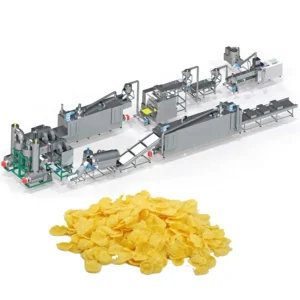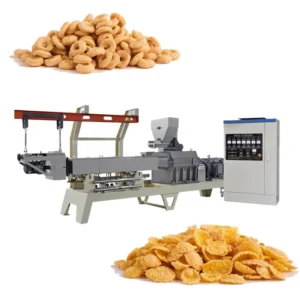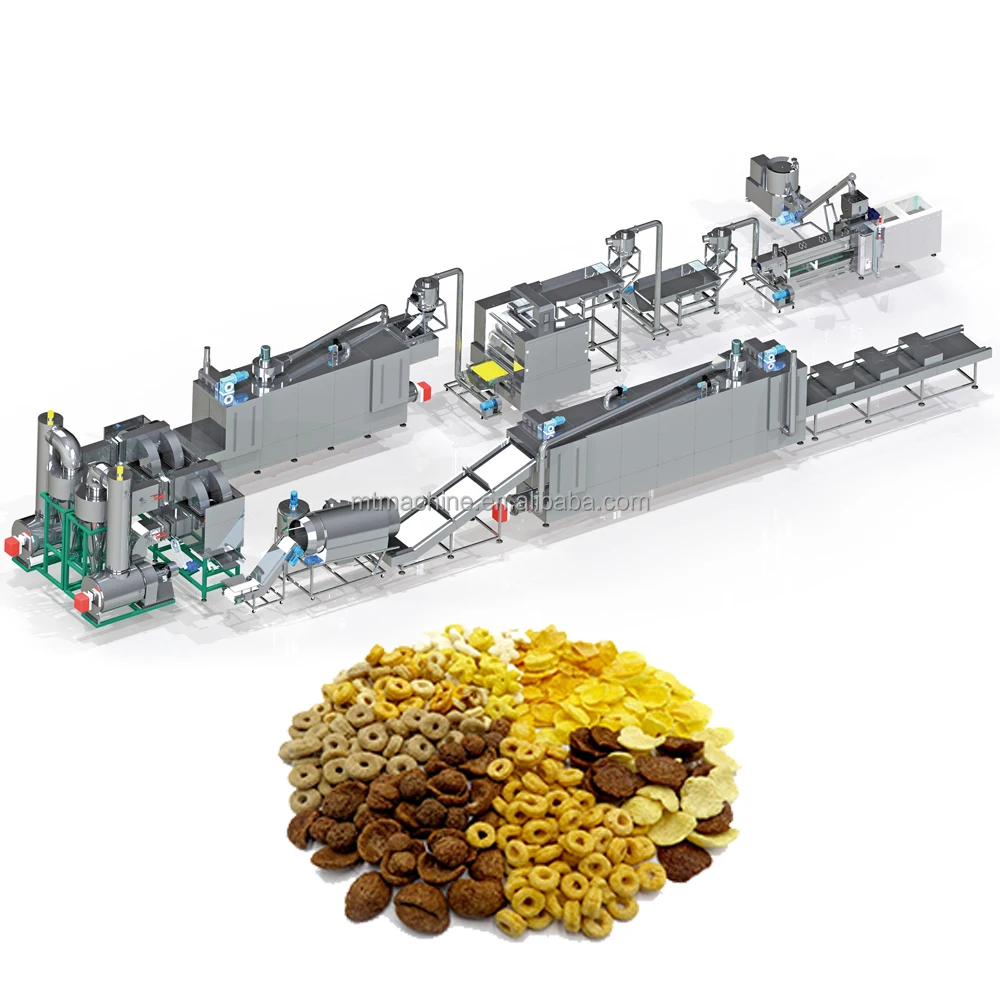
Thermodynamic profiling — screw geometry and barrel zones mapped to your grain blend before the first kilogram leaves the factory floor.
Technical Specifications
| Parameter | Value |
|---|---|
| Model | MT-75 |
| Product Type | Corn Flakes Breakfast Cereal Extrusion Production Line |
| Screw Configuration | Twin-screw, material-specific element arrangement |
| Output Capacity | 200-300 kg/h (basis not stated in source — confirm raw material / moisture content) |
| Voltage & Frequency | 220V / 380V (frequency configurable to facility standard) |
| Control System | PLC control with configurable HMI language |
| Heating Source | Gas or electric (buyer specified) |
| Flaking Machinery | Hydraulic double-roller system, infrared sensor temperature control |
| Roasting Oven | Conciliation burner combustion chamber, two circulating fans, cyclone dust removal |
| Coating System | Double tumble sugar melting, elevator, coating drum, spraying nozzle |
| Core Component | Gearbox (1-year warranty on core components) |
| Assembly State | Complete production line from mixing through packing |
Application Suitability
| Application | Material or Output |
|---|---|
| Sugar-coated corn flakes for retail packaging | Corn grits, sugar syrup, malt extract |
| Plain toasted breakfast cereal flakes | Corn, wheat, rice flour blends |
| Multigrain flake cereal with oat or barley | Corn blended with oat, barley, rice |
| Fortified breakfast cereal for nutrition programmes | Grain base with added vitamin and mineral premix |
| Puffed snack shapes on the same extrusion platform | Corn, rice, wheat starch-based formulations |
What Grain Blend Shifts Do to Your Extrusion Curve
The corn flakes extrusion production line must be configured around the exact starch profile and moisture content of the grain blend you will actually run, not a generic corn-only baseline.
I spent years in a testing workshop outside Jinan watching lines that ran perfectly on pure corn grits collapse when the buyer introduced oat or barley into the mix. The screw shear profile that gelatinises pure corn starch cleanly will under-process a high-fibre oat blend, leaving hard centres in the pellet and killing the blistering effect that defines a quality flake. Buyers often specify capacity based on a single-material trial and then discover throughput drops significantly when production starts on their real formulation [NEED_CITE: starch gelatinisation temperature differences across common cereal grains]. The corn flakes extrusion production line you evaluate must be validated on the material you intend to run.
Shear, Moisture and the Gelatinisation Window
Twin-screw extrusion gives you independent control over shear intensity and residence time across multiple barrel zones. For corn flakes, the objective is complete starch gelatinisation without excessive expansion — you want a dense, glassy pellet that will flatten cleanly under the flaking rolls and then blister uniformly in the roasting oven. The screw element sequence and barrel temperature profile are tuned together so that moisture and mechanical energy bring the starch through its gelatinisation transition at precisely the right point in the barrel.
Die Design and Pellet Geometry
The die at the extruder discharge determines pellet cross-section and wall thickness, both of which govern how the pellet behaves during flaking and roasting. A pellet that is too thick will retain a hard core after toasting; one that is too thin will shatter under the hydraulic rollers. Die geometry is specified alongside the screw configuration so that the corn flakes extrusion production line produces a pellet matched to the target flake thickness and the surface blister pattern the market expects [NEED_CITE: relationship between extrudate die geometry and final flake texture in breakfast cereal processing].
Reading the Specification Sheet Like a Process Engineer
The MT-75 designation covers the twin-screw extruder at the centre of the line, but the engineering that determines final product quality lives in the configuration details. The PLC control system manages barrel zone temperatures and screw speed, which together set the thermal and mechanical energy input per kilogram of material. The hydraulic flaking station uses independent dual-motor roller drives and infrared temperature sensing to hold consistent flake gauge across the full production run. The roasting oven runs two separate circulating fans with cyclone dust removal, which matters because uneven air distribution causes patchy blistering — some flakes toast fully while others remain pale and soft. Output figures are meaningful only when tied to a specific grain blend and moisture level; the 200-300 kg/h range applies under defined material conditions that should be confirmed during your trial run.
When Configuration Guesses Become Production Losses
I once set up a line for a buyer who switched from pure corn to a corn-oat blend after installation. The original screw combination could not generate enough shear to fully gelatinise the oat starch, so the pellets came out with uncooked cores. The flakes tore instead of blistering in the oven, and the bowl-life collapsed — milk penetrated within seconds instead of minutes. The line had to be shut down while we reconfigured the screw elements and adjusted barrel temperatures zone by zone. This is the cost of skipping a material-specific trial: not just wasted raw material, but lost shelf space when retailers reject inconsistent product [NEED_CITE: common causes of texture and density variation in extruded breakfast cereals].
Why Procurement Starts With a Trial, Not a Brochure
Every station on the corn flakes extrusion production line is throughput-matched under one supplier, so the extruder, flaking rolls, dryer, roasting oven and coating drum are balanced to each other rather than assembled from disconnected vendors. Screw configuration and die design are specified to your raw material formulation and target flake density — not copied from a generic template. The in-house testing workshop runs your actual grain blend through the line before shipment, generating a trial report that documents expansion behaviour, pellet integrity and flake blister pattern. Electrical schematics and voltage specifications are confirmed against your facility supply before production begins, avoiding commissioning delays caused by mismatched frequency or control language. Documentation covers the full chain: line layout, screw and die configuration records, factory test records and operation manuals.
Documentation & Verification
- Screw and die configuration record matched to your grain blend and target flake density
- Trial run report on your raw material from the in-house testing workshop before shipment
- Line layout drawing with capacity calculation across every station
- Electrical schematic with voltage, frequency and PLC language confirmed to your facility
- Factory test record and CE declaration of conformity included with dispatch
Installation, Commissioning & Support
- Foundation plan provided based on the full line footprint including roasting oven and coating stations
- Power supply specification confirmed for 220V or 380V with frequency matched to your grid standard
- PLC control system commissioned on-site with HMI language set to your operator requirement
- First production run supervised with screw speed, barrel temperature and flaking pressure tuned to your material
- Wear parts list provided covering screws, dies and flaking roller surfaces with recommended replacement intervals
What to Share With Your Enquiry
To configure a corn flakes extrusion production line that matches your actual production conditions, we need your grain blend formulation with moisture percentages, your target flake dimensions and density range, and the voltage and frequency standard at your facility. If you plan to run multiple recipes — for example, plain corn and a multigrain oat blend — let us know both so the screw configuration can accommodate the full range.
Frequently Asked Questions
Q: How do you match screw configuration to different grain blends and moisture levels?
A: We adjust the screw element sequence — mixing blocks, kneading discs and conveying elements — along with barrel zone temperatures to control shear intensity and residence time. A high-fibre oat blend needs different energy input than pure corn grits. The configuration is finalised during a trial run on your specific material in our testing workshop before shipment.
Q: What controls the surface blistering effect during roasting?
A: Blistering depends on pellet density and residual moisture entering the roasting oven. The die design and extrusion parameters set the pellet structure, while the drying stage controls moisture before roasting. The oven’s dual circulating fans and temperature profile then determine how uniformly blisters form across the flake surface.
Q: How is throughput balanced between the extruder, flaking rolls and roasting oven?
A: Each station is sized so that material flow matches without accumulation or starvation. The hydraulic flaking rolls, dryer capacity and roasting oven air volume are all calculated against the extruder output for your specific formulation, preventing bottlenecks that occur when stations are sourced from separate vendors.
Q: Can you trial our exact raw material before the line ships?
A: Yes. We run your grain blend through the configured line in our testing workshop and produce a trial report documenting pellet expansion, flake thickness consistency and roasting behaviour. This validates the screw and die configuration before the equipment leaves the factory.
Q: What electrical and control options are confirmed before commissioning?
A: We confirm voltage, frequency and PLC control language against your facility power supply before production. The electrical schematic is included in the documentation package, and the control system is set to your preferred language before the line ships.