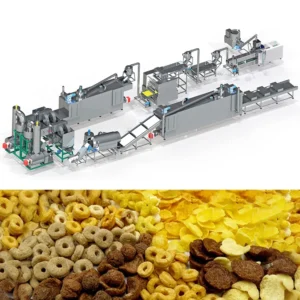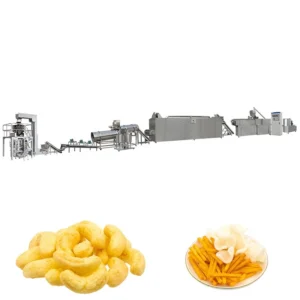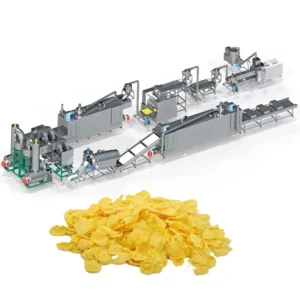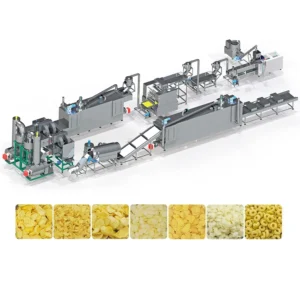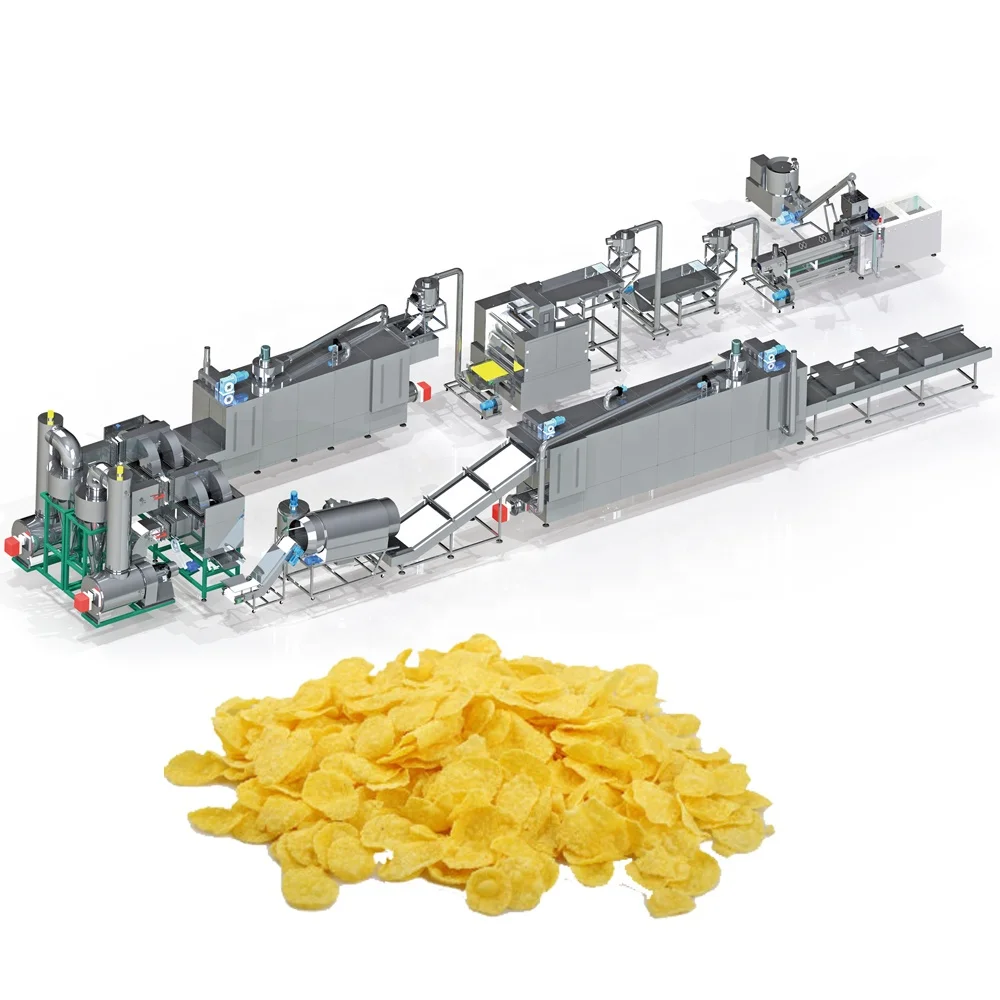
Extrusion Process Engineering — Every screw configuration, barrel temperature zone, and die geometry is specified against the buyer’s actual corn variety and target flake density, validated through in-house trial runs before the line ships.
Technical Specifications
| Parameter | Value |
|---|---|
| Product Type | Corn Flakes Production Line |
| Output Capacity | Up to 750 kg/hr (basis not stated in source — confirm raw material, moisture content, flake thickness) |
| Product Range | Natural corn flakes, sugar-coated flakes, shaped breakfast cereals |
| Control System | PLC / MCC (to be specified per project) |
| Screw Type | Twin-screw (to be configured per raw material) |
| Die Configuration | Customized to target flake geometry and expansion ratio |
| Layout | Engineered drawings tailored to factory dimensions |
| Certification | CE, ISO (company-level) |
Application Suitability
| Application | Material or Output |
|---|---|
| Natural corn flake production | Degerminated corn grits, whole corn meal |
| Sugar-coated and frosted flakes | Base flakes with sugar, honey, or chocolate coating |
| Shaped breakfast cereal formats | Multi-grain blends, fortified corn-based formulations |
| High-fibre or wholegrain cereal lines | Bran-enriched corn blends requiring adjusted gelatinisation |
What Extrusion Parameters Actually Determine About Your Corn Flake
Flake bowl life is decided inside the barrel, not at the packaging station.
When a producer switches from standard degerminated corn grits to a higher-fibre blend without adjusting the screw profile or barrel temperature zones, the degree of starch gelatinisation drops. The flakes may look correct on the conveyor, but they absorb milk faster and lose crunch within minutes. I once spent two weeks on-site re-tuning a breakfast cereal line in the Middle East because the original configuration was built around a standard corn formulation while the buyer was running a high-fibre recipe — throughput fell sharply and product texture never matched the market sample. That corn flakes extrusion technology production line taught me that every parameter must follow the raw material, not the other way around. [NEED_CITE: starch gelatinisation degree and its effect on cereal bowl life]
Screw Configuration and Starch Gelatinisation Control
The screw profile governs how much mechanical shear the corn meal receives as it moves through the barrel. A configuration with aggressive kneading blocks generates higher shear, which raises dough temperature internally and promotes gelatinisation — essential when processing harder corn varieties or high-amylose blends. For standard degerminated grits, a moderate shear arrangement prevents over-working the dough, which can cause excessive expansion at the die and produce flakes that shatter during pressing. Each corn flakes extrusion technology production line we configure starts with the buyer’s specific corn source and target gelatinisation window.
Barrel Temperature Zones and Moisture Management
Modern extrusion barrels divide into multiple independently controlled heating and cooling zones. The feed zone typically runs cooler to prevent premature gelatinisation that would cause bridging or surging. The compression and metering zones ramp temperature progressively so that starch granules hydrate and swell in a controlled sequence. If a zone overheats, moisture flashes to steam too early, creating voids in the extrudate that collapse during flaking. [NEED_CITE: barrel temperature profiling in twin-screw food extrusion] Proper zone management is what separates a corn flake that holds its structure in the bowl from one that turns to mush.
Die Geometry, Flake Thickness, and Expansion Ratio
The die opening determines the cross-section of the extrudate rope before it reaches the flaking rolls. A wider die produces a thicker rope that, when pressed, yields a denser flake with longer bowl life. A narrower die creates a thinner rope, leading to lighter, more delicate flakes that may suit sugar-coated formats but sacrifice structural integrity. Die geometry also affects surface texture — a smooth die land produces clean-cut edges, while a shorter die land can leave a rougher surface that holds coating syrups better. Selecting the correct die is a core step in any corn flakes extrusion technology production line.
How Key Specifications Translate to Production Reality
Output capacity figures only become meaningful when tied to a specific raw material, moisture level, and flake thickness target. A line rated at 750 kg/hr on standard corn grits may deliver considerably less when running whole-grain or fibre-enriched blends because the dough requires longer residence time and lower screw speed to achieve full gelatinisation. The control system — whether PLC or MCC — affects how consistently operators can reproduce the correct barrel temperature profile and screw speed across shifts and batches. Layout engineering ensures that the extruder, flaking rolls, toaster oven, and coating drum are throughput-matched; a bottleneck at any station idles the entire line. These are the specification details that determine whether a corn flakes extrusion technology production line meets its projected output in practice.
The Hidden Cost of Skipping Raw Material Trials
When an extrusion line ships without a trial run on the buyer’s actual corn supply, all parameter tuning happens during commissioning — on the factory floor, with production deadlines looming. Screw profiles may need replacement, barrel zone setpoints require extensive re-testing, and die geometry might not suit the real expansion behaviour of the local corn variety. I have watched installations stall for weeks because the corn source had higher protein content than the generic test material, altering dough viscosity and die pressure entirely. [NEED_CITE: impact of raw material variability on extrusion process stability] These delays cost far more than a pre-shipment trial ever would.
Why Buyers Choose This Approach to Line Configuration
Every station from batching through extrusion, flaking, drying, coating, and packing is sourced under one supplier, so throughput is calculated end-to-end rather than assembled from mismatched vendors. Screw configuration and die design are specified against the buyer’s documented raw material profile and target flake density, not copied from a generic template. The in-house testing workshop allows trial runs on customer-supplied corn before the line is cleared for shipment, catching formulation mismatches early. Electrical schematics, voltage, frequency, and control language are confirmed before production begins, preventing commissioning delays. Pre-sales consultation continues through on-site installation, operator training, and ongoing maintenance support.
Documentation & Verification
- Line layout and capacity calculation matched to your corn variety and target output
- Screw and die configuration record documented against your raw material data sheet
- Trial run report generated from in-house testing on your supplied corn sample
- Electrical schematic with confirmed voltage, frequency, and control interface language
- CE declaration of conformity and ISO certificate for the complete production line
- Operation and maintenance manual with wear parts list for extruder screws and dies
Installation, Commissioning & Support
- Foundation and floor-space plan engineered to your factory dimensions and extruder footprint
- Dedicated power circuit sized to the extruder motor and all downstream heating loads
- Assembly sequence planned so the extruder, flaking rolls, and dryer align before utility hookup
- First-run parameter tuning on your actual corn supply with on-site engineer supervision
- Operator training covering barrel temperature zones, screw speed, and die change procedures
- Wear parts inventory list for screws, dies, and flaking roll surfaces with reorder guidance
What We Need to Specify Your Line Accurately
To build a correct corn flakes extrusion technology production line configuration, share your corn source and its typical moisture and protein content, the target flake thickness and bowl-life expectation, and whether you plan to run sugar-coated or shaped formats alongside natural flakes. Your factory’s available floor space and ceiling height determine the layout, and your local voltage and frequency standards must be confirmed before electrical design begins. If you have existing upstream mixing or downstream packing equipment, provide their throughput rates so the new line integrates without bottlenecks.
Frequently Asked Questions
Q: How is output capacity verified for a corn flakes line?
A: Output capacity depends on the specific corn variety, moisture content at the extruder inlet, and target flake thickness. We verify throughput during an in-house trial run using your raw material, documenting actual output under production-representative conditions rather than quoting a generic figure that may not hold on your formulation.
Q: How are screw and die choices made for a particular corn type?
A: We analyse your corn’s amylose-to-amylopectin ratio, protein content, and particle size distribution. The screw profile is then selected to deliver the correct shear and residence time for full gelatinisation, while the die opening is sized to produce the extrudate rope dimensions needed for your target flake geometry.
Q: What barrel temperature profile is needed for proper gelatinisation?
A: The feed zone runs cooler to prevent premature starch activation. Compression and metering zones increase progressively so moisture distributes evenly before the die. Exact setpoints vary by corn variety and moisture level — they are established during the trial run and documented in your commissioning report.
Q: How is flake density controlled for acceptable bowl life?
A: Density is governed by extrudate expansion at the die, flaking roll gap, and toasting temperature. We adjust screw speed and die geometry to set expansion, then tune the roll gap and dryer profile. The result is measured by bulk density tests and milk-soak trials during the pre-shipment validation.
Q: Can the line be tested on our own corn supply before delivery?
A: Yes. We require a sample of your actual raw material — typically several hundred kilograms — to conduct a full trial run in our testing workshop. The trial covers extrusion, flaking, toasting, and coating, and we provide a documented report with all process parameters before the line is approved for shipment.