Precision Extrusion Engineering — Screw configuration, die geometry, and barrel profiling calibrated to the buyer’s specific grain blend and target flake density, verified through in-house trial runs before shipment.
Technical Specifications
| Parameter | Value |
|---|---|
| Model | MT75 |
| Product Type | Twin Screw Extruder for Corn Flakes & Breakfast Cereal Production Line |
| Screw Type | Twin-screw |
| Installed Power | 210 kW |
| Power Consumption | 150 kW |
| Output Capacity | 300–500 kg/h (basis not stated in source — confirm raw material, moisture content, and product format) |
| Overall Dimensions (Line) | 45 × 1.5 × 3.5 m |
| Control System | PLC and MCC control |
| Basic Raw Materials | Corn, rice, wheat, oat, barley powder |
| Flaking Machinery | Hydraulic double-roller system with separate motor drives and infrared sensor temperature control |
| Dryer Heating Source | Gas or Electric (configurable) |
| Hot Air Roasting Oven | Vibrating pan, high-temperature spraying tubes, conciliation burner, dual circulating fans, cyclone dust removal |
| Coating System | Double tumble sugar melting, elevator, coating drum, spraying nozzle |
| Final Products | Natural corn flakes, sugar-coated corn flakes, shaped cereals (ball, tube, ring, star, wheel, flower, heart) |
| Certifications | CE, ISO |
Application Suitability
| Application | Material or Output |
|---|---|
| Natural corn flakes production | Degermed corn grits or whole corn flour |
| Sugar-coated breakfast cereals | Corn, rice, or wheat-based extrudate with syrup coating |
| Shaped cereal formats | Corn, oat, barley, or multi-grain blends through adjustable die plates |
| Fortified breakfast cereals | Grain flour blends with vitamin premix or high-fiber additives |
| Multi-grain extruded snacks | Rice, wheat, oat, and barley powder combinations |
What the Corn Flakes Extrusion Machine Specifications Don’t Tell You About Flake Density
The screw and die configuration must be matched to your grain formulation, not copied from a generic build.
A twin screw extruder for breakfast cereal that ships with a default screw profile will produce extrudate at the wrong density. Too dense, and the flakes won’t crisp properly after hot air roasting. Too expanded, and they shatter under the flaking rollers. I once watched a line trial where standard maize flour ran perfectly, then the customer switched to their local coarse degermed grits — the starch content was completely different, and the whole batch broke apart at the roller stage. The barrel temperature profile and screw pitch had to be reworked on the floor. [NEED_CITE: starch gelatinisation requirements across grain varieties]
Barrel Temperature Profiling Across Heating Zones
The MT75 uses multi-zone barrel heating to govern the starch gelatinisation curve. Each zone is independently controlled, allowing the process engineer to set a temperature gradient that matches the specific gelatinisation window of corn, rice, wheat, or oat-based formulations. Corn flour typically requires a different thermal profile than barley or oat blends, and the ability to adjust zone-by-zone prevents under-cooked or degraded extrudate.
Screw Configuration and L:D Ratio Selection
The twin-screw arrangement and screw element sequence are specified to the buyer’s raw material and moisture target. The L:D ratio and individual screw element placement control shear intensity and residence time inside the barrel. For high-fiber or fortified formulations, the screw profile must be recalibrated — additives change melt rheology, and a corn flakes extrusion machine specification sheet that lists a single default configuration cannot account for these variations. [NEED_CITE: twin-screw element arrangement and shear rate effects on starch-based dough]
Die Geometry and Expansion Control
The adjustable die plate at the extruder discharge determines extrudate cross-section and density. For flake production, a consistent extrudate strand is essential — irregular expansion produces uneven thickness after the hydraulic flaking rollers. When switching to shaped cereal formats like rings, balls, or stars, the die plate is changed and the screw profile may need adjustment to maintain the correct expansion ratio for each geometry.
Interpreting the Installed Power and Line Throughput
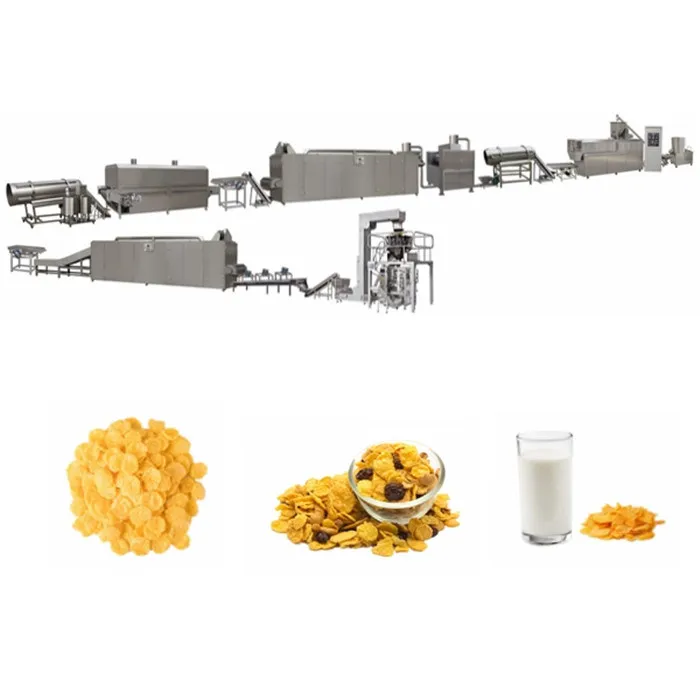
The 210 kW installed power and 150 kW running consumption reflect the full extruder drive and barrel heating load. The hydraulic flaking machinery with separate motor drives is throughput-matched to the extruder output, preventing bottlenecks between the extrusion and flaking stages. The hot air roasting oven uses dual circulating fans and a conciliation burner with a cyclone dust removal device, designed to handle the moisture load leaving the dryer stage. The 45-meter line footprint encompasses all stations from mixing through packing, and the PLC and MCC control architecture allows centralized parameter management across every stage.
The Hidden Cost of Skipping a Raw Material Trial
When a corn flakes line ships without a trial run on the buyer’s actual grain formulation, the first production run becomes the experiment. I have seen entire batches scrapped because the screw configuration was set for a reference material that didn’t match the local supply. The flaking rollers crush over-expanded extrudate, the roasting oven can’t correct under-gelatinised starch, and the sugar coating drum produces inconsistent coverage on irregular surfaces. Commissioning delays stretch into weeks while engineers reprofile barrel temperatures and swap screw elements on site. [NEED_CITE: extrusion line commissioning failure rates without pre-shipment testing]
Why Procurement Through an Extrusion-Focused Supplier Matters
The screw configuration and die design are specified to the buyer’s raw material, not pulled from a standard catalog. An in-house machine testing workshop allows trial runs on the customer’s grain blend before the line ships, generating a documented configuration record. The complete line from mixing through packing is engineered under one supplier, so throughput is balanced across every station rather than assembled from mismatched vendors. Technical support extends from pre-sales line layout through on-site commissioning and operator training. Spare wear parts including screws and dies are documented in the wear parts list provided at delivery.
Documentation & Verification
- Line layout drawing with throughput calculation for your corn or multi-grain formulation
- Screw and die configuration record matched to your raw material trial data
- Electrical schematic with voltage and frequency confirmation for your local grid
- Factory trial run report on your grain blend before shipment
- CE declaration of conformity and ISO certificate for the complete line
- Operation and maintenance manual covering all stations from mixing to packing
Installation, Commissioning & Support
- Foundation and utility planning based on the 45 m × 1.5 m × 3.5 m line footprint and 210 kW installed power requirement
- Voltage and frequency configured to local grid specification with MCC panel wiring verified before dispatch
- PLC control system programmed with your product parameters and operator language preference before arrival
- On-site barrel temperature profiling and screw element adjustment during initial production runs
- Wear parts list with screw elements, die plates, and flaking roller specifications for reorder planning
- Scheduled maintenance intervals documented for hydraulic flaking system seals and roasting oven burner assemblies
Preparing Your Inquiry
To configure the MT75 for your application, we need your target product format — natural flakes, sugar-coated, or shaped cereal — along with the specific grain blend and moisture content of your raw material. Provide your local voltage and frequency, available workshop floor space, and whether you require the sugar coating and double tumble system. If you can send a sample of your grain formulation, a trial run in the testing workshop will establish the correct screw configuration and barrel temperature profile before the quotation is finalized.
Frequently Asked Questions
Q: How is the screw configuration determined for my specific grain blend?
A: The screw element arrangement and L:D ratio are selected based on your grain formulation ratios, moisture content, and target extrudate density. A trial run in the testing workshop on your actual raw material generates the configuration record before the extruder ships.
Q: What extrusion parameters control flake density and crispness after roasting?
A: Barrel temperature profile, screw speed, die pressure, and exit moisture all influence the final flake texture. These are set during the trial run and documented so your process engineer can reproduce them on site during commissioning.
Q: Can I switch between natural flakes and shaped cereal on the same extruder?
A: Yes. The adjustable die plate allows format changes, but the screw profile and process parameters may need reconfiguration for each shape. Technical support covers die changeover procedures and parameter adjustment for different geometries.
Q: Can the line handle fortified formulations with vitamin premixes?
A: Additives change melt rheology, so the screw configuration and barrel temperature settings must be recalibrated. A trial run on your fortified blend verifies that the extruder produces the correct extrudate density before the line ships.
Q: Is a trial run performed on my raw material before shipment?
A: The in-house testing workshop runs your grain formulation through the MT75 before dispatch. The trial generates a configuration record, process parameter sheet, and product samples, reducing commissioning time and production risk on site.