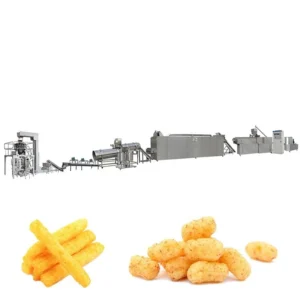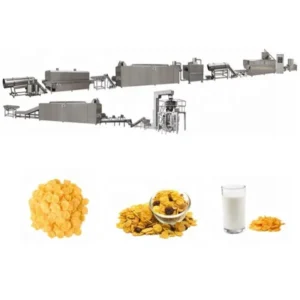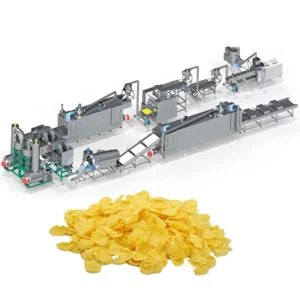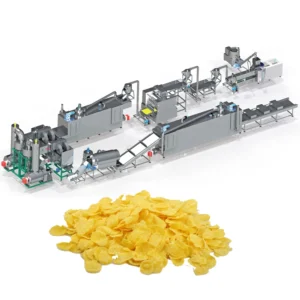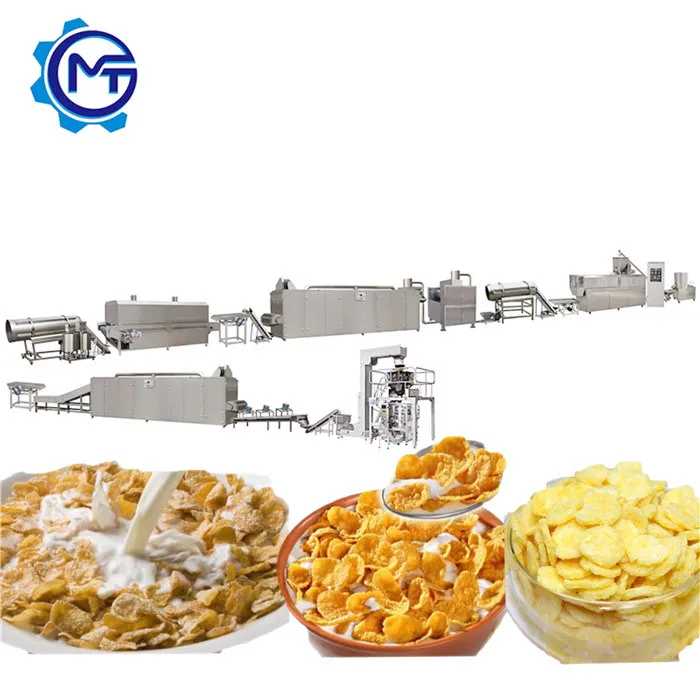
Matched Screw Geometry — Every MT70, MT85, and MT75 barrel profile is validated against your grain blend in our testing workshop before the line ships.
Technical Specifications
| Parameter | Value |
|---|---|
| Product Type | Corn Flakes Production Line |
| Model Options | MT70, MT85, MT75 |
| Extruder Type | Twin Screw |
| MT70 Installed Power | 160 kW |
| MT70 Power Consumption | 120 kW |
| MT70 Capacity | 150–200 kg/hr (basis not stated in source — confirm raw material formulation, moisture content and product format) |
| MT70 Overall Dimensions | 41 × 1.5 × 2.2 m |
| MT85 Installed Power | 190 kW |
| MT85 Power Consumption | 140 kW |
| MT85 Capacity | 300–400 kg/hr (basis not stated in source — confirm raw material formulation, moisture content and product format) |
| MT85 Overall Dimensions | 43 × 1.5 × 3.2 m |
| MT75 Installed Power | 210 kW |
| MT75 Power Consumption | 150 kW |
| MT75 Capacity | 300–500 kg/hr (basis not stated in source — confirm raw material formulation, moisture content and product format) |
| MT75 Overall Dimensions | 45 × 1.5 × 3.5 m |
| Control System | PLC control with full line automation |
| Flaking Machinery | Hydraulic double-roller system, independent motor drives, infrared-sensor temperature control |
| Dryer Heating Source | Gas or Electric |
| Roasting Oven | Hot air roasting, vibrating pan, dual circulating fans, cyclone dust removal |
| Coating System | Double tumble sugar melting, elevator, coating drum, spraying nozzle |
| Basic Raw Materials | Corn, rice, wheat, oat, barley powder |
Application Suitability
| Application | Material or Output |
|---|---|
| Natural corn flakes production | Corn grits, corn flour blends |
| Sugar-coated breakfast cereal | Corn, rice, wheat base with sugar spray coating |
| Multi-grain flaked cereal | Oat, barley, wheat powder blends |
| Shaped cereal formats | Ball, tube, stick, ring, fruit loop, star, wheel, flower, heart via extruder die changes |
| Fortified breakfast cereal | Grain blends with added vitamin and mineral premix |
Why "Rated Capacity" Means Nothing Without Your Grain Blend
A corn flakes extrusion production line specification is only as honest as the raw material it was tested on.
I learned this the hard way on a workshop floor in Shandong. A buyer ordered a line based on our published throughput numbers, but his corn flour had a coarser particle size than our standard test material. The extrudate came out uneven in thickness, shattered after roasting, and his actual output fell well below half the brochure figure. That failure had nothing to do with motor power or barrel length — it was a mismatch between screw configuration and a specific grain blend that nobody had bothered to verify before shipment [NEED_CITE: raw material variability effects on twin-screw extrusion output]. When you evaluate corn flakes extrusion production line specifications, the first question should always be whether those numbers hold up on your exact formulation.
How Screw Configuration Governs Flake Density and Bowl Life
The twin-screw extruder is where starch gelatinisation actually happens, and the degree of gelatinisation determines whether your corn flakes stay crisp in milk or turn to mush within minutes. Screw element arrangement — the ratio of conveying segments to kneading blocks — controls shear intensity and residence time inside the barrel. A corn flakes extrusion production line built for high-amylose corn needs a different screw profile than one running a wheat-and-oat blend with lower gelatinisation temperatures. Getting this wrong means the flake either puffs too much and collapses during roasting, or stays dense and chewy in the bowl.
Barrel Temperature Profiling and Moisture Management
Each heating zone along the barrel must be set independently because the material undergoes distinct phase transitions — hydration, gelatinisation, and partial expansion — as it moves from feed to die. The PLC control system on these lines manages barrel zone temperatures in coordination with moisture injection points, keeping the process repeatable across production runs [NEED_CITE: starch gelatinisation temperature profiles in food extrusion]. Inconsistent moisture at the die face produces flakes with variable thickness after the rolling mill, which then roast unevenly. The infrared-sensor temperature control on the flaking machinery catches some of this variation, but it cannot compensate for fundamental extrusion instability upstream.
Reading the Power and Dimension Data Correctly
The installed power figures across the MT70, MT85, and MT75 models reflect the total connected load of every motor, heater, and control cabinet on the line — not just the extruder drive. Actual power consumption runs lower, as shown in the consumption row, because heaters cycle and conveying motors draw intermittently. The overall dimension lengths of 41 to 45 metres span the full station sequence from mixing through packing, which means your facility needs clear linear floor space plus access clearance on both sides. The flaking station uses a hydraulic double-roller system with separate motors driving each roller, so roll gap and differential speed can be adjusted independently to control flake thickness without relying on a single shared drive that forces both rollers to the same speed.
What Happens When the Die and Dryer Are Specified Separately
A common failure mode on breakfast cereal lines is an extruder that runs fine in isolation but feeds a dryer that cannot keep up. The hot air roasting oven on these lines uses a vibrating pan with dual circulating fans and cyclone dust removal to manage moisture extraction and surface blistering, but its throughput must be matched to whatever the extruder actually delivers on your recipe. If the extruder pushes material faster than the roasting oven can remove moisture, the flakes exit with residual internal humidity and go soft within hours of packing [NEED_CITE: moisture equilibrium requirements for shelf-stable breakfast cereals]. The sugar coating stage adds another constraint — the double tumble system with spraying nozzle must apply syrup evenly before the final drying pass, and any bottleneck there backs up the entire line.
Why Buyers Source This Equipment Here
Every line undergoes a trial run using your actual raw material in the testing workshop before it ships, so screw configuration, die geometry, and barrel temperature profiles are locked in based on real extrudate samples rather than generic defaults. The complete production sequence — mixing, extruding, flaking, drying, roasting, cooling, and packing — is supplied as one matched system where throughput at each station is calculated against the others, eliminating the mismatch that happens when stations are assembled from separate vendors. Screw and die configuration records are documented and delivered with the machine so your process team has a baseline for future recipe adjustments. Electrical schematics include voltage and frequency confirmation completed before production starts, preventing commissioning delays caused by unconfirmed local power standards.
Documentation & Verification
- Line layout and capacity calculation balanced across all stations for your target product
- Screw and die configuration record specific to your grain blend and flake density target
- Trial run report generated on your raw material before dispatch
- Electrical schematic with voltage, frequency, and control language confirmed pre-production
- CE declaration of conformity and ISO certificate included with shipment documentation
- Operation and maintenance manual with wear parts list for scheduled replacement planning
Installation, Commissioning & Support
- Foundation planning based on the MT75 overall length of 45 metres plus utility corridor clearance
- Dedicated power circuit sized for the MT85 installed load of 190 kW with local voltage confirmation
- Extruder barrel sections and flaking roller assembly arrive modular for on-site alignment
- First-run commissioning includes barrel temperature profiling and flaking roller gap calibration on your material
- Operator training covers PLC parameter adjustment for recipe changes between corn, oat, and wheat blends
- Wear parts list identifies screw elements, die plates, and flaking roller surfaces with replacement intervals
What We Need From Your Side
To configure the right screw profile and line capacity, we need your raw material specification including grain type, particle size distribution, and target moisture content at the die. Tell us your intended daily output and whether you plan to run natural flakes, sugar-coated flakes, or both formats. Confirm your facility voltage and frequency, preferred PLC language, and available floor space so we can propose a station layout that fits without compromising maintenance access.
Frequently Asked Questions
Q: How is screw configuration and die design matched to my specific grain blend and target flake density?
A: We run your actual raw material through the extruder in our testing workshop before finalising the build. The screw element arrangement, kneading block ratio, and die aperture are adjusted iteratively until the extrudate meets your target expansion and density. The resulting configuration record ships with the line so your team has a documented baseline for future production runs.
Q: What is the actual verified capacity on my raw material, and what trial run is performed before shipment?
A: Published capacity ranges are reference values that depend on formulation, moisture, and product format. We conduct a full trial run using your grain blend in our testing workshop, measuring actual throughput, flake thickness uniformity, and roasting behaviour. The trial run report documents verified output under your specific conditions and is shared with you before the line ships.
Q: How do barrel zone temperature profiles and moisture levels affect starch gelatinisation and final flake crispness?
A: Each barrel zone is independently controlled because the material passes through hydration, gelatinisation, and expansion phases sequentially. The PLC system coordinates zone temperatures with moisture injection to maintain consistent gelatinisation degree. Incomplete gelatinisation produces a chewy flake; excessive shear degrades starch and reduces bowl life. The correct profile is established during the pre-shipment trial run.
Q: How does the flaking roller system maintain uniform thickness, and what wear parts need scheduled replacement?
A: The flaking station uses a hydraulic double-roller system with independent motor drives for each roller, allowing separate adjustment of roll gap and differential speed. Infrared sensors monitor roller surface temperature to prevent thermal distortion. Roller surfaces, screw elements, and die plates are the primary wear items, and the delivered wear parts list specifies replacement intervals based on your production volume.