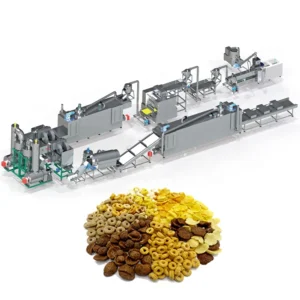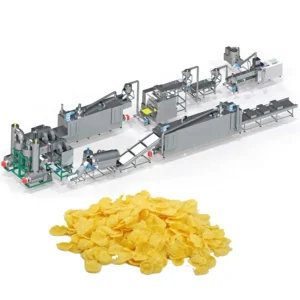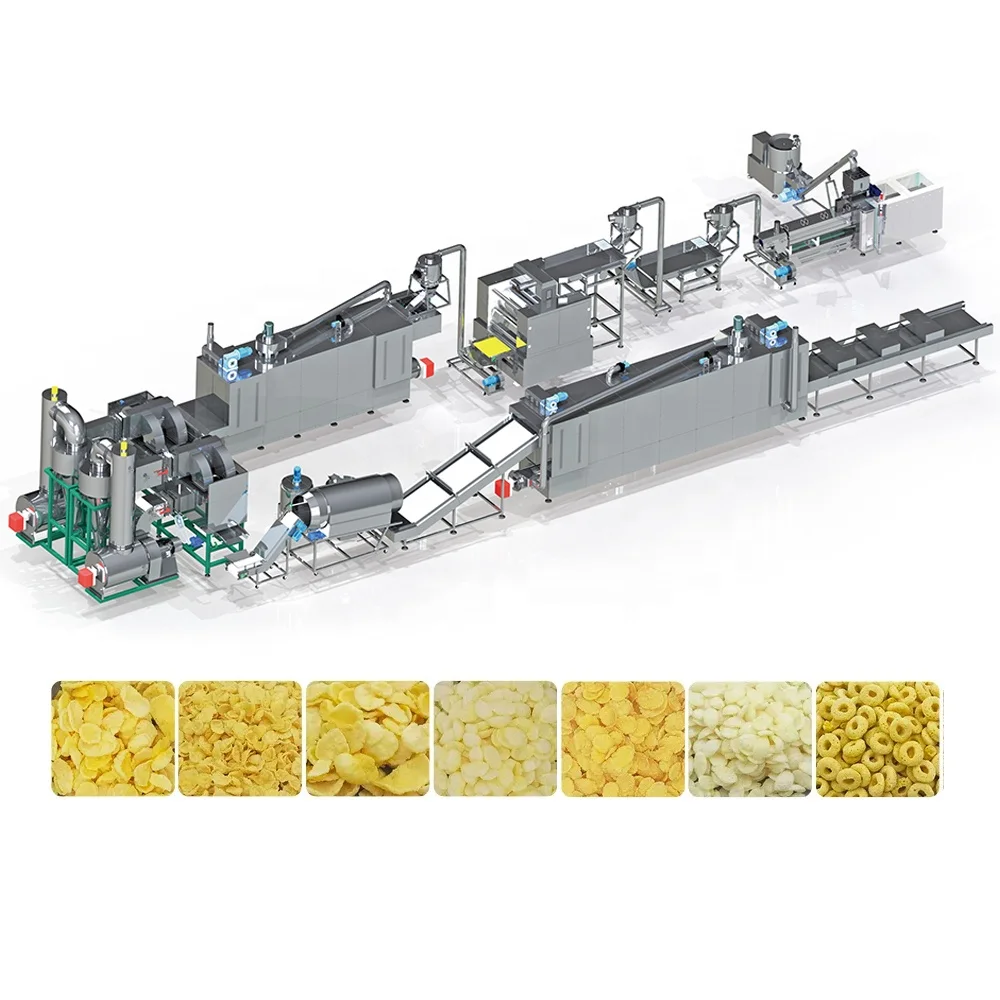
Throughput Matching Across Every Station — Line configuration for corn flakes extrusion ensures flaking, drying, and roasting capacities are balanced with extruder output, preventing bottlenecks from separate vendor mismatches.
Technical Specifications
| Parameter | Value |
|---|---|
| Product Type | Corn Flakes Breakfast Cereal Production Line |
| Model Options | MT70 / MT85 / MT75 |
| Extruder Type | Twin Screw |
| Installed Power (MT70) | 160 kW |
| Installed Power (MT85) | 190 kW |
| Installed Power (MT75) | 210 kW |
| Power Consumption (MT70) | 120 kW |
| Power Consumption (MT85) | 140 kW |
| Power Consumption (MT75) | 150 kW |
| Output Capacity (MT70) | 150–200 kg/hr (basis not stated in source — confirm raw material and moisture) |
| Output Capacity (MT85) | 300–400 kg/hr (basis not stated in source — confirm raw material and moisture) |
| Output Capacity (MT75) | 300–500 kg/hr (basis not stated in source — confirm raw material and moisture) |
| Dimensions (MT70) | 41 × 1.5 × 2.2 m |
| Dimensions (MT85) | 43 × 1.5 × 3.2 m |
| Dimensions (MT75) | 45 × 1.5 × 3.5 m |
| Control System | PLC and MCC |
| Flaking Machinery | Hydraulic double-roller system, infrared sensor temperature control |
| Dryer Heating Source | Gas or Electric |
| Roasting Oven | Vibrating pan, reconciliation burner, cyclone dust removal |
| Raw Materials | Corn, rice, wheat, oat, barley powder |
| Voltage & Frequency | Customized to local requirement |
Application Suitability
| Application | Material or Output |
|---|---|
| Natural Corn Flakes | Milled corn grits or powder |
| Sugar-Coated Flakes | Corn, wheat, or multi-grain base with sugar syrup coating |
| Multi-Grain Cereals | Blends of rice, oat, barley, and wheat powder |
| Shaped Cereal Formats | Rings, balls, stars, and loops from corn or rice base |
Why "Rated Capacity" Means Nothing Without the Material Baseline
A corn flakes extrusion production line specification is incomplete unless the throughput figure is tied to a specific grain blend, particle size, and moisture content.
When a buyer receives a capacity quote for corn flakes extrusion production line specifications without those qualifiers, the number is essentially a guess. I have watched lines stall at half their promised output because the factory switched from coarse corn grits to a locally milled flour that absorbed water differently, collapsing the expansion inside the barrel. The extruder is only one link; if the downstream flaker, dryer, and roaster were sized against an inflated throughput, every station downstream chokes [NEED_CITE: extrusion throughput verification on grain moisture and particle size].
Barrel Temperature Zones and Starch Gelatinisation
The twin-screw extruder on the MT70, MT85, and MT75 uses multiple independently heated barrel zones managed through the PLC. Each zone governs a different stage of starch gelatinisation — from initial hydration and mixing through high-shear cooking to pressure build-up before the die. Precise temperature profiling is what separates a flake that stays crisp in milk from one that turns to mush within seconds.
Screw Configuration Matched to Formulation
A generic screw build copied from a standard pet food or snack setup will not produce the correct half-product density for corn flakes. The screw elements, kneading blocks, and die aperture must be specified against the buyer’s actual raw material blend. Rice-heavy formulations behave differently under shear than pure corn, and the screw pitch and compression ratio must reflect that [NEED_CITE: twin-screw element configuration for cereal starch processing].
Decoding Power, Dimensions, and Flaking Mechanics
Looking at the corn flakes extrusion production line specifications across the three models, installed power ranges from 160 kW to 210 kW, with consumption figures running roughly 70–75 percent of that. The MT70 at 41 meters in line length suits a compact facility, while the MT75 at 45 meters demands a longer production hall with adequate ceiling clearance for the dryer and roaster exhaust routing. The flaking station uses a hydraulic double-roller system with separate motors driving each roller, which maintains even nip pressure across the full roller width — a critical factor when flake thickness variation directly affects roasting uniformity and final bowl crispness. Infrared sensors on the flaker monitor surface temperature in real time, preventing the half-product from sticking or tearing during compression.
The Cost of Ignoring Voltage and Frequency Before Production
Shipping an extruder configured for the wrong voltage or frequency is not a minor inconvenience — it delays commissioning by weeks while replacement motors, VFDs, and control transformers are sourced locally. I have seen a cereal line sit idle in a North African plant because the control panel was wired for 50 Hz and the local grid runs at 60 Hz, which pushed every motor past its rated speed and tripped the MCC within minutes [NEED_CITE: industrial motor frequency mismatch consequences]. The PLC interface language is another detail that gets overlooked until an operator on the floor cannot read the alarm messages during a barrel blockage.
Why Source the Line From One Supplier
The MT70, MT85, and MT75 are designed as complete systems, not assembled from mismatched single-vendor machines. Extruder output is calculated against the actual capacity of the flaking rollers, the dryer belt speed, and the roaster residence time, so no station becomes a bottleneck. Screw configuration and die design are specified against the buyer’s raw material before production begins, not pulled from a generic catalogue. The in-house testing workshop runs the buyer’s own grain blend through the extruder before shipment, catching formulation surprises at the factory rather than on the installation floor. Every station from the batching mixer to the coating drum operates under a unified PLC and MCC architecture, simplifying troubleshooting and spare parts sourcing. CE and ISO documentation is issued against the full line, not individual components.
Documentation & Verification
- Line layout drawing with throughput calculation for your chosen corn or multi-grain formulation
- Screw and die configuration record matched to your raw material sample
- Trial run report produced on your grain blend in the testing workshop before dispatch
- Electrical schematic confirming voltage, frequency, and PLC language for your facility
- CE declaration of conformity covering the complete production line
Installation, Commissioning & Support
- Foundation plan specifying floor loading for the 41–45 meter line footprint and roaster vibration isolation
- Dedicated power circuit sizing for 160–210 kW installed load with MCC panel placement guidance
- On-site mechanical assembly and belt alignment for dryer and vibrating roaster pan
- First-run parameter tuning including barrel zone temperatures, screw speed, and flaker roller gap
- Operator training on PLC alarm response, die changes, and screw element replacement
- Wear parts inventory list covering screw segments, die plates, and flaker roller surfaces
What to Prepare Before Requesting a Quote
To configure the correct corn flakes extrusion production line specifications for your facility, share your primary grain type and whether you plan to run multi-grain blends. Specify your target daily output, available floor space, and ceiling height. Confirm your local voltage, frequency, and preferred control interface language. If you can ship a sample of your actual raw material, a trial run in the testing workshop will validate the screw configuration and throughput before the quotation is finalized.
Frequently Asked Questions
Q: How is output capacity verified before the line ships?
A: Capacity figures for the MT70, MT85, and MT75 are confirmed through a trial run using the buyer’s own raw material in the testing workshop. The resulting report documents throughput, moisture content, and flake density against your target specification, ensuring the quoted output reflects your actual formulation rather than a generic baseline.
Q: How is the screw configuration matched to my cereal formulation?
A: The screw elements, kneading blocks, and die aperture are selected based on the grain type, particle size, and starch content of your raw material. A configuration record is generated and shared before production, so you know exactly which elements are installed and why.
Q: Will the downstream stations keep pace with the extruder?
A: Each line is configured as a single system. The flaker roller width, dryer belt length, and roaster pan area are all sized against the extruder’s verified throughput, preventing any station from becoming a bottleneck during continuous production runs.
Q: Can I run a trial on my raw material before the line ships?
A: Yes. The in-house testing workshop accepts samples of your grain blend and runs them through the extruder at production-relevant parameters. The trial run report, including flake expansion and density data, is provided before shipment confirmation.
Q: What voltage and PLC language will the control system use?
A: Voltage, frequency, and control interface language are confirmed during the specification stage before production begins. The electrical schematic documents these settings, and the MCC and PLC are configured accordingly so the line is ready for commissioning on arrival.