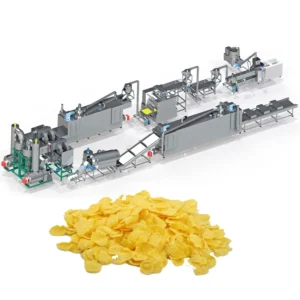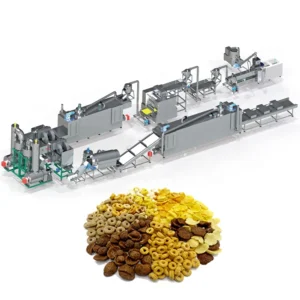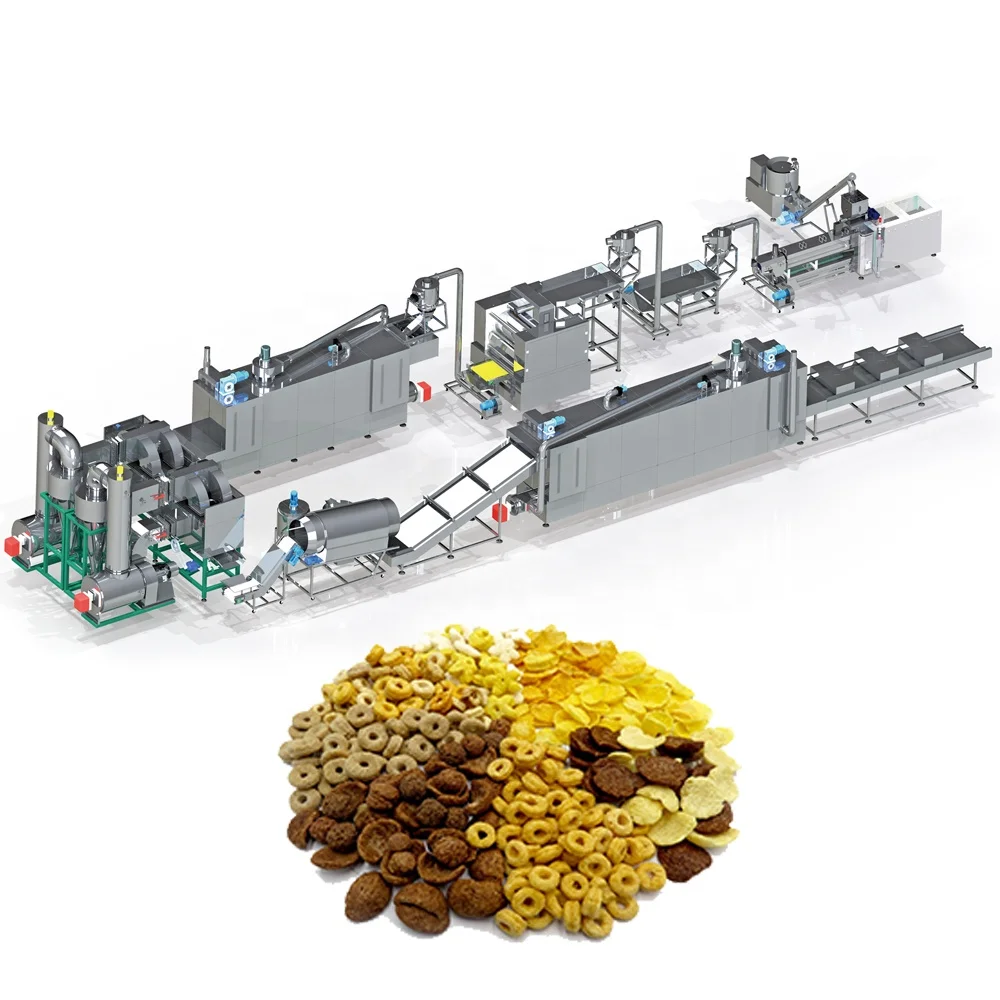
Screw Configuration Matched to Material — The MT-65 twin-screw extruder is configured after reviewing your specific corn grit particle size, moisture content, and starch behaviour, not assembled from a standard element set.
Technical Specifications
| Parameter | Value |
|---|---|
| Model | MT-65 |
| Product Type | Corn Flakes Production Line |
| Extruder Type | Twin Screw (Co-rotating) |
| Installed Power (Extruder) | 84 kW |
| Real Power (Extruder) | 59 kW |
| Output Capacity | 120–150 kg/h (basis not stated in source — confirm raw material formulation / moisture content / flake thickness) |
| Overall Dimensions (L×W×H) | 12000 × 1200 × 2200 mm |
| Gear Box Lubrication | Forced automatic oil lubrication system |
| Extruder Self-Cleaning | Yes |
| Cutting System | Non-stop cutting system |
| Raw Materials | Corn grits, corn flour, rice flour, wheat flour, soya bean, peanut, walnut, sugar |
| Mixer Tank Size | φ600 × 500 mm |
| Mixer Power | 4 kW |
| Screw Conveyor Power | 0.75 kW |
| Corn Flakes Press Machine Power | 16.12 kW |
| Press Roller Size | 510 × 310 × 1050 mm |
| Press Roller Feature | Big roller with cooling system, adjustable roller distance |
| High-Temperature Oven Size | 4.5 × 1.4 × 1.8 m |
| Oven Heating Source | Gas (both-side baking system) |
| Sugar Spraying System Power | 28.75 kW |
| Sugar Spraying Roller Size | Approx. Ø600 × 2700 mm |
| Certification | CE |
| Warranty | 1 year complete warranty, life-time maintenance service |
Application Suitability
| Application | Material or Output |
|---|---|
| Traditional corn flakes breakfast cereal | De-germed corn grits, corn flour |
| Multi-grain breakfast flakes | Wheat flour, rice flour, soya bean blends |
| Sweetened or coated cereal flakes | Corn base with sugar spraying and flavouring |
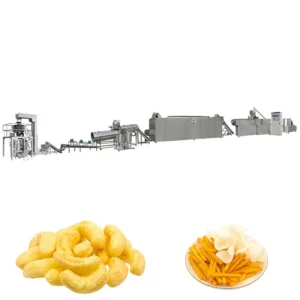
| Extruded corn snacks (puffed formats) | Corn grits, corn flour, peanut, walnut |
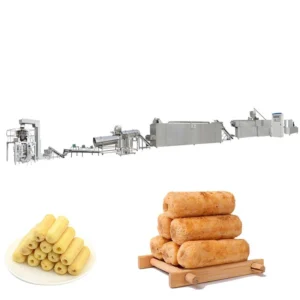
| Core-filled snack variants | Corn or rice flour with chocolate or sugar filling |
Why the Corn Flakes Extrusion Production Line Specifications Dictate Final Bowl-Life
Flake crispness and milk absorption are decided inside the barrel, long before the product reaches the oven.
Many buyers evaluate a line on its nameplate capacity and assume the corn flakes extrusion production line specifications will deliver the same result on their local corn supply. In practice, degermed grits from different milling sources vary in fat residue and particle distribution, which shifts the gelatinisation window. A screw profile set for one grit type will over-shear another, producing fines and broken flakes instead of the whole, crunchy pieces your market expects [NEED_CITE: starch gelatinisation behaviour in cereal extrusion]. The configuration must be matched before the machine is built.
Barrel Zones and Starch Gelatinisation Control
The MT-65 twin-screw extruder runs a sectional barrel with independent temperature zones. Moisture injection and barrel heat work together to push corn starch through its gelatinisation range. The degree of gelatinisation set here determines how the pellet expands later during flaking and toasting. If the starch is under-cooked in the barrel, the resulting flakes will be hard and dense; over-cooked material produces a sticky mass that tears on the press roller. Corn flakes extrusion production line specifications that ignore this variable leave the buyer to troubleshoot on their own floor.
Die Geometry and Pellet Formation
The die plate at the extruder discharge shapes the cooked mass into small, uniform pellets before they enter the press machine. Die hole diameter and land length control the back-pressure inside the barrel, which in turn affects residence time and shear history [NEED_CITE: extrusion die design principles for cereal pellets]. A die specified for a high-moisture corn flour blend will not perform the same way on coarse, low-moisture grits. The die must be selected alongside the screw configuration, not as an afterthought.
Reading the Line Parameters for Production Reality
The 84 kW installed and 59 kW real power figures tell you the extruder has headroom for viscous cereal doughs without running the motor at its thermal limit. The forced automatic oil lubrication system on the gear box protects the drive train during the high-torque start-up phase when cold, stiff material first enters the barrel. The non-stop cutting system keeps pellets uniform without operator intervention, which matters when the downstream press machine requires a steady feed to maintain roller gap consistency. The 12 m line footprint is compact for a complete cereal line, but buyers should confirm ceiling height against the 2200 mm machine height plus clearance for maintenance access. The adjustable press roller gap lets the operator dial in flake thickness, and the integrated cooling system prevents the roller surface from reaching the temperature where starch adhesives cause wrapping.
The Cost of an Unmatched Line Configuration
When a corn flakes line is assembled from generic screw sets and standard dies, the output looks acceptable during a short factory run on reference flour. Once the machine reaches the buyer’s site and runs on local grits, the flake density drifts, the bowl-life shortens, and the sugar coating adheres unevenly. Correcting this on-site means pulling the extruder apart, ordering new screw elements and dies, and losing weeks of production [NEED_CITE: extruder screw element replacement lead time and production loss]. The cost of the unplanned downtime dwarfs any savings from accepting a standard build.
Sourcing From a Line Builder, Not a Machine Assembler
The MT-65 line is supplied as a matched sequence from mixer through sugar spraying, meaning throughput at each station is calculated against the others. The twin-screw extrusion expertise covers cereal applications specifically, so the screw configuration is built around corn starch behaviour rather than borrowed from snack or pet food builds. An in-house testing workshop runs the line on the buyer’s own raw material before shipment, generating a trial run report that documents the actual process parameters. Pre-sales consultation includes line layout and capacity calculation so that utility connections, floor loading, and material flow are resolved before installation day.
Documentation & Verification
- Line layout drawing with station-by-station throughput calculation for your corn grit formulation
- Screw element sequence and die geometry record matched to your raw material
- Trial run report on your raw material with process parameters and output sample
- Electrical schematic with confirmed voltage and frequency for your site
- CE declaration of conformity for the complete line
- Operation and maintenance manual covering each station
Installation, Commissioning & Support
- Confirm 12 m × 1.2 m floor space plus operator clearance against the 12000 × 1200 × 2200 mm line envelope
- Provide dedicated 3-phase power circuits matching confirmed voltage for the 84 kW extruder and 28.75 kW sugar system
- Verify gas supply pressure and flow rate for the 4.5 m high-temperature oven before oven commissioning
- Commissioning includes press roller gap calibration and oven temperature profiling for your target flake thickness
- Operator training covers screw configuration logic, barrel zone temperature settings, and press roller adjustment
- Wear parts list includes screw elements, die plates, and press roller bearings with recommended replacement intervals
Before You Request a Quotation
Share your corn grit or flour specification sheet, including particle size distribution, moisture content, and fat percentage. Provide the target flake thickness and the bowl-life profile your market requires, along with your local voltage, frequency, and preferred control language. If you plan to run multi-grain or fortified formulations on the same line, list those recipes as well so the screw configuration can accommodate the full range from day one.
Frequently Asked Questions
Q: How is the screw configuration matched to my specific corn grit formulation?
A: We review your raw material specification — particle size, moisture, fat content — and build the screw element sequence to achieve the correct gelatinisation degree and shear history for your target flake density. The configuration is documented before production begins.
Q: What happens during the trial run before shipment?
A: Your raw material is run through the complete line in our testing workshop. We document barrel temperatures, screw speed, moisture addition, and press roller gap, then ship the output sample and trial report with the machine.
Q: How is flake density and crispness controlled on this line?
A: Density is primarily set by the degree of starch gelatinisation in the extruder barrel and the press roller gap. Crispness is finalised in the gas-fired oven through controlled moisture removal across the flake bed.
Q: What electrical and control details are confirmed before production?
A: Voltage, frequency, and control panel language are confirmed in writing before the machine enters production. This prevents rewiring and reprogramming delays when the line arrives at your facility.
Q: How is throughput balanced between the extruder, press, and oven?
A: Each station is sized so the extruder output, press roller feed rate, and oven belt speed handle the same mass flow. This prevents material backlog or starvation at any point in the corn flakes extrusion production line.