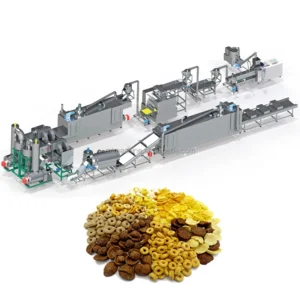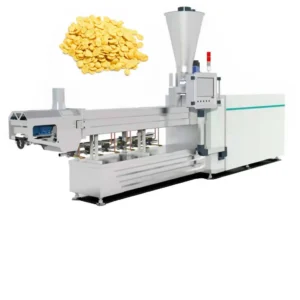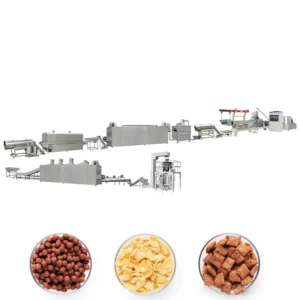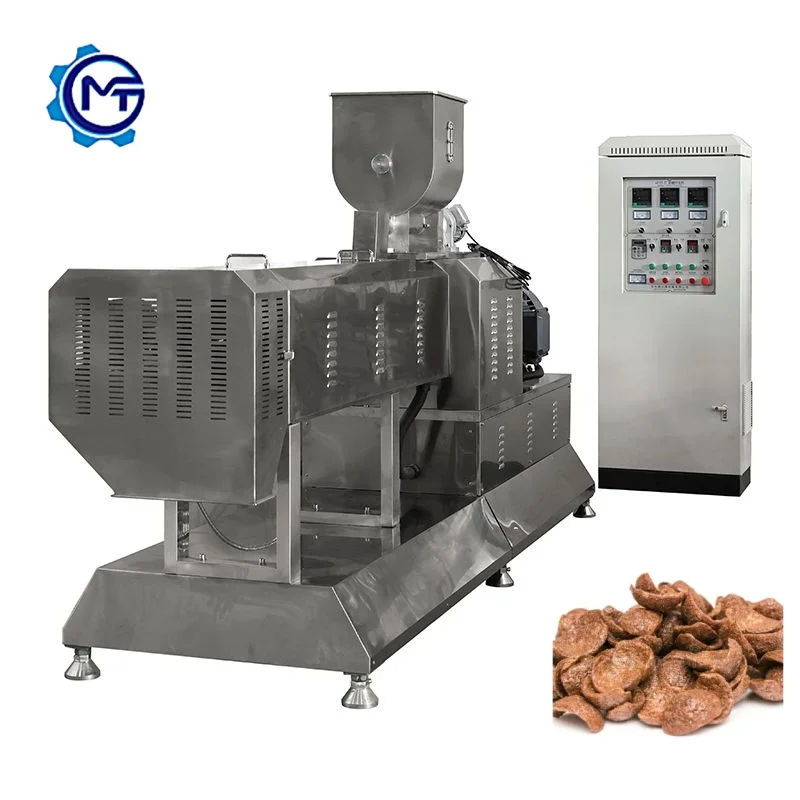
Screw configuration matched to your material — Every twin-screw extrusion build for breakfast cereal starts with your specific raw material blend and target flake density, not a generic template pulled from another product category.
Technical Specifications
| Parameter | Value |
|---|---|
| Product Type | Twin Screw Extrusion Breakfast Cereal Production Line |
| Model Options | MT70 / MT85 / MT75 |
| Installed Power | MT70: 160 kW; MT85: 190 kW; MT75: 210 kW |
| Power Consumption | MT70: 120 kW; MT85: 140 kW; MT75: 150 kW |
| Capacity | MT70: 150–200 kg/h; MT85: 300–400 kg/h; MT75: 300–500 kg/h (basis not stated in source — confirm raw material type and moisture content) |
| Overall Dimensions | MT70: 41 × 1.5 × 2.2 m; MT85: 43 × 1.5 × 3.2 m; MT75: 45 × 1.5 × 3.5 m |
| Screw Type | Twin screw |
| Control System | PLC control system; MCC available for line |
| Flaking Drive | Hydraulic system for double rollers; double motors for separate roller driving |
| Flaking Temperature Control | Infrared sensor-regulated heating pipe |
| Roasting Oven | Vibrating pan with high-temperature spraying tubes, two circulating fans, cyclone dust removal |
| Coating System | Double tumble for sugar melting, elevator, coating drum, spraying nozzle |
| Dryer Heating Source | Gas, electric, or steam (multi-fuel configurable) |
| Supported Raw Materials | Corn, rice, wheat, oat, barley powder |
| Standards | CE certified; ISO certified |
Application Suitability
| Application | Material or Output |
|---|---|
| Natural corn flakes production | Corn grits and corn flour blends |
| Sugar-coated corn flakes | Corn base with sugar syrup coating |
| Cocoa puffed breakfast cereal | Cocoa flour blended with corn or wheat |
| Multi-grain puffed cereal | Rice, oat, and barley powder mixtures |
| Shaped puffed snacks | Ball, tube, stick, ring, fruit loop, star, wheel, flower, heart shapes via die swap |
Why Generic Screw Builds Produce the Wrong Cereal Density
A twin screw extrusion technology breakfast cereal production line only delivers consistent flake density when the screw profile is matched to your exact material and moisture target.
I spent two weeks on a corn flake line in Colombia where the trial used standard corn flour but production switched to a high-fiber whole wheat formula. The extruder ran fine mechanically, but the flakes came out dense, the bowl life was poor, and the local market rejected the product outright. The root cause was a screw configuration copied from a generic build that never accounted for the different starch gelatinisation behaviour of whole wheat. This is a recurring pattern I see across Latin American installations where the extrusion parameters are never revalidated for the buyer’s actual recipe [NEED_CITE: starch gelatinisation behaviour differences between refined and whole grain cereals].
The twin screw extrusion technology breakfast cereal production line must be specified against the raw material you will actually run in production, not the test flour used during a factory demo.
Barrel Temperature Profile and Starch Gelatinisation
The barrel zones on this line allow independent temperature control across the extrusion stages. Corn and wheat starches gelatinise at different thresholds, and the temperature curve must track the specific blend ratio running through the machine. A profile that works for pure corn grits will under-cook a high-oat formulation, leaving raw centres that produce brittle flakes with short bowl life. The twin screw extrusion technology breakfast cereal production line uses PLC control to hold each zone within tight tolerance, so operators can store and recall profiles for different recipes without manual recalibration every shift.
Die Design and Expansion Ratio Control
The die geometry determines how the extrudate expands as it exits the barrel and pressure drops. For corn flakes, you need a flat ribbon profile that the flaking rollers can compress into uniform sheets. For puffed cereal shapes like rings or stars, the die must produce an expansion ratio that holds the shape through drying and roasting without collapsing. The hydraulic flaking system with independent double-motor roller drive applies even pressure across the ribbon width, which matters when you are targeting a specific flake thickness for packaging density and shipping cost.
What the Power and Dimension Numbers Actually Mean
The MT75 at 210 kW installed power and 45 metres of line length represents the highest-throughput configuration, but those numbers only matter relative to your material throughput and floor space. The power consumption figures — 150 kW for the MT75 — reflect the extruder, flaking, roasting, and drying stations running together. The multi-fuel dryer option means you can switch between gas, electric, and steam based on local utility costs, which directly affects your per-kilogram production cost. The flaking machinery uses infrared sensors to maintain even roller temperature, preventing the edge-to-centre thickness variation that causes downstream breakage during roasting and coating [NEED_CITE: infrared temperature regulation in industrial flaking equipment].
The Cost of Unmatched Extruder and Dryer Capacity
When the extruder runs at a throughput the dryer cannot handle, material backs up on the conveyor, moisture content stays too high entering the roasting oven, and the final product ships with inconsistent crispness. I have seen lines where the coating drum was undersized relative to the extruder output, forcing the operator to slow the entire line to match the slowest station. Every station on a twin screw extrusion technology breakfast cereal production line must be throughput-matched during the layout phase, not assembled from independent vendor quotes that each optimise for their own machine [NEED_CITE: throughput matching across extrusion line stations].
Why Buy This Line From This Builder
The complete line from mixing through packing sits under one supplier, so throughput is calculated across every station rather than assembled from separate vendors who each guarantee only their own machine. Screw configuration and die design are specified to your raw material and target cereal texture before production begins. An in-house testing workshop runs your actual material before shipment, so the trial run report reflects your recipe, not a generic flour. The PLC and MCC control systems are configured for your local voltage, frequency, and operator language before the machines leave the factory.
Documentation & Verification
- Line layout and capacity calculation based on your raw material throughput target
- Screw and die configuration record matched to your cereal formulation
- Trial run report on your raw material conducted in the testing workshop before dispatch
- Electrical schematic with voltage and frequency confirmed for your market
- Factory test record with photos and packing documentation for customs clearance
Installation, Commissioning & Support
- Foundation and floor space planning based on the selected model dimensions (up to 45 m line length)
- Dedicated power circuit sizing for the installed power rating of your chosen model
- PLC and MCC control system commissioning with operator language set before first run
- Screw configuration verification against your production material during on-site startup
- Wear parts list covering screws, dies, and flaking roller surfaces with recommended replacement intervals
- Operator training covering barrel temperature profile adjustment and recipe changeover procedures
What to Share With Your Inquiry
Provide the specific raw material blend you intend to run in production — including fiber content, fat percentage, and moisture level — along with your target flake or puff density and daily output requirement. Confirm your facility voltage and frequency, available floor length and ceiling height, and preferred dryer fuel source. If you have an existing mixing or packing station upstream or downstream, share those specifications so the line layout accounts for integration points.
Frequently Asked Questions
Q: How does screw configuration affect cereal expansion and density?
A: The screw profile determines shear intensity and residence time inside the barrel, which directly controls starch gelatinisation. A configuration designed for corn grits will under-process a high-fiber whole wheat blend, resulting in lower expansion and denser flakes. Each build is matched to your material before production.
Q: What barrel temperature settings work for different cereal blends?
A: Corn-based recipes typically require higher barrel temperatures than oat or barley blends due to different gelatinisation thresholds. The PLC control stores separate temperature profiles per recipe, allowing consistent output across shift changes without manual recalibration each time.
Q: How is die design selected for different cereal shapes?
A: Flat dies produce ribbon extrudate for flaking into corn flakes, while shaped dies create rings, stars, or tubes for puffed cereal. The die geometry must match the target expansion ratio so the shape holds through drying and roasting without collapsing or over-expanding.
Q: What does the trial run process involve before shipment?
A: Your raw material is shipped to the testing workshop where the extruder runs your actual recipe. The trial run report documents screw configuration, barrel temperatures, expansion ratio, and final product density so you receive a line already tuned to your production formula.
Q: How does moisture management influence starch gelatinisation?
A: Insufficient moisture leaves uncooked starch cores that produce brittle flakes with poor bowl life. Excess moisture causes over-expansion and irregular shapes. The twin-screw design allows precise water injection and mixing within the barrel to maintain the moisture level your specific recipe requires.