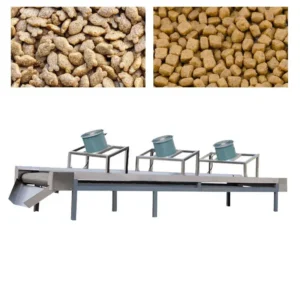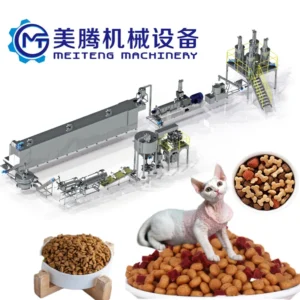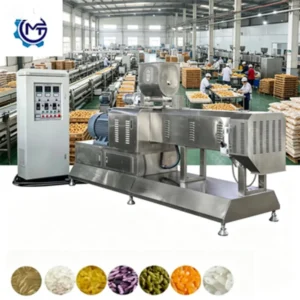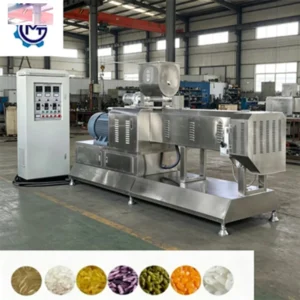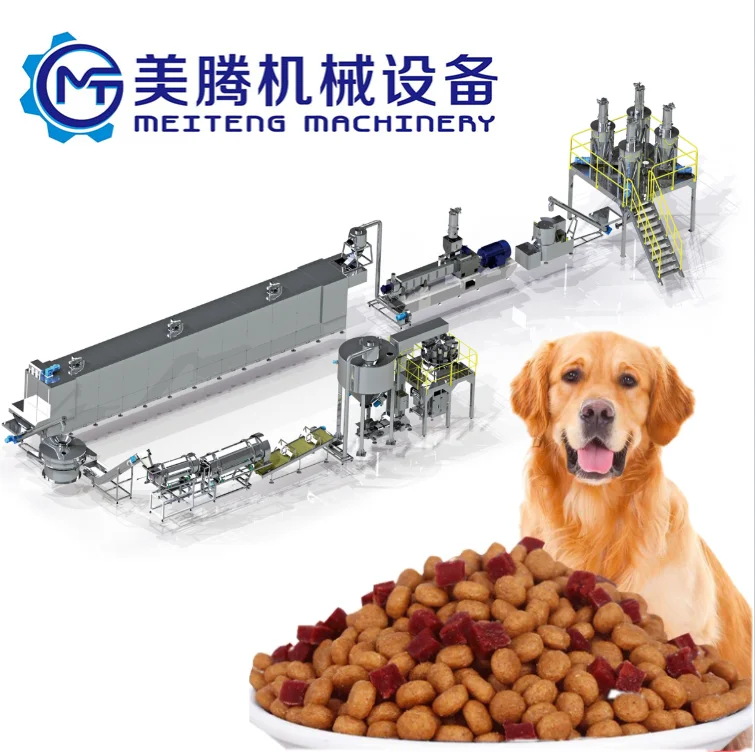
Custom screw geometry — every barrel section and die plate is matched to your exact meat meal protein level and target kibble density, validated in our testing workshop before the line ships.
Technical Specifications
| Parameter | Value |
|---|---|
| Product Type | Pet Food Extrusion Production Line |
| Line Configuration | Batching, mixing, extrusion, drying, packaging |
| Screw Type | Twin-screw |
| Control System | PLC / MCC |
| Automation Level | Fully automated with sensors and precision controls |
| Construction Material | Food-grade contact materials |
| Recipe Adaptability | Dry kibble, semi-moist pet food, treats |
| Output Capacity | High capacity (basis to be confirmed) |
| Assembly State | Complete production line |
| Customization | Flexible layout and capacity configuration options |
| Standards | CE, ISO |
Application Suitability
| Application | Material or Output |
|---|---|
| Dry kibble for dogs and cats | Corn, meat meal, soy protein, vitamin premix |
| Semi-moist pet food formulations | High-moisture protein blends with humectants |
| Bird and small animal feed | Seed-based and grain-based pellet mixes |
| Floating and sinking aquatic feed | Fish meal, starch binders, lipid coatings |
| Cattle supplement pellets | Fiber-rich roughage with mineral additives |
What "Nominal Capacity" Means When Your Formula Changes
A rated throughput figure only holds true on the raw material profile used to establish it.
I once worked with a Middle Eastern pet food producer who ordered a line based on a sample capacity quote. Their actual meat meal had a noticeably higher protein content than the standard test material. The screw combination that worked on paper could not generate enough shear to gelatinise the starch properly at that protein load. Output dropped to roughly six tenths of the quoted figure, and kibble density drifted outside the range their retail customers expected. That experience sits behind every line we configure now: we run your actual formula through the extruder in our testing workshop, adjust the screw arrangement and die geometry, and confirm real throughput before anything leaves the factory [NEED_CITE: twin-screw extrusion behaviour on high-protein pet food formulations].
How Shear and Moisture Shape the Kibble
The twin-screw extrusion process relies on controlled mechanical shear and thermal input to gelatinise starch and expand the dough matrix at the die face. Moisture content entering the barrel, combined with screw speed and barrel temperature profiling, determines whether the kibble exits light and porous or dense and hard. A Pet Food Extrusion Production Line turnkey setup must account for these variables across every recipe the buyer intends to run, not just a single reference formula.
Die Geometry and the Density Target
Die aperture diameter, land length, and cut-off mechanism together define the final kibble shape, size, and bulk density. Floating aquatic feed requires a different expansion ratio than a premium dog kibble aimed at a specific crunch texture. Our die design process starts from the buyer’s target density and works backward through the screw configuration and barrel zone temperatures [NEED_CITE: die land length influence on extrudate expansion ratio]. This is where generic builds fall short — a die copied from a standard catalogue cannot compensate for a formula that departs from the assumed starch-to-protein ratio.
Reading the Specs That Actually Matter
Twin-screw versus single-screw selection dictates how well the line handles high-fat or high-protein recipes that tend to slip in a single-screw barrel. The screw configuration record we supply shows the arrangement of conveying, kneading, and reverse elements matched to your material. PLC and MCC control provides repeatable set-points for barrel zone temperatures and screw speed, which directly influence batch-to-batch consistency. Food-grade contact materials across all wetted surfaces meet hygiene requirements that standard industrial extruders do not address, and this matters when producing nutritionally fortified kibble destined for regulated markets.
The Cost of Skipping the Trial Run
When a line ships without a prior trial on the buyer’s actual raw material, the first weeks of production become an expensive experiment. Screw elements may need re-arranging, the dryer could be undersized for the moisture load exiting the die, and flavouring drum residence time might not achieve the coating pick-up rate the product specification demands [NEED_CITE: post-installation commissioning delays in extrusion plants]. These mismatches are not defects in individual machines — they are integration gaps that a pre-shipment trial run exposes and resolves while corrections still cost days rather than months.
Why This Line Is Configured Differently
Every station from batching through packing is sourced from one supplier, so throughput is matched across the chain instead of assembled from independent vendors with mismatched nominal ratings. Screw configuration and die design are specified to your raw material, not borrowed from a reference build. Our in-house testing workshop runs your formula before shipment, generating a trial report that documents actual output, kibble density, and process set-points. Twin-screw expertise across pet food, aquatic feed, and snack applications means the engineering team has encountered a wide range of material behaviours. Pre-sales consultation through installation and ongoing maintenance keeps the same technical thread alive across the project lifecycle.
Documentation & Verification
- Line layout showing throughput calculation for every station in your Pet Food Extrusion Production Line
- Screw and die configuration record specific to your raw material formula
- Trial run report documenting output, density, and moisture on your actual ingredients
- Electrical schematic with voltage and frequency matched to your facility supply
- CE declaration of conformity and ISO certificate for the complete line
- Wear parts list with part numbers for screws, dies, and barrel liners
Installation, Commissioning & Support
- Foundation plan accounts for the full line footprint and dryer weight distribution
- Dedicated electrical circuit sized to the extruder main drive and dryer heater load
- Barrel and screw assembly verified on-site after transport to confirm alignment
- First-run parameter setting uses your trial report set-points as the baseline
- Operator training covers recipe changeover on the PLC interface and screw swap procedures
- Spare screw elements and die plates stocked against the wear parts list provided
What We Need to Start Your Line Configuration
Send us your target kibble format, the raw material list with protein and fat percentages, and the daily output you need to hit. Include your workshop dimensions, ceiling height, and the local voltage and frequency standard. If you have existing upstream mixers or downstream packing equipment that should integrate with the new line, share those specifications so we can match throughput at the connection points.
Frequently Asked Questions
Q: How is output capacity verified on my specific raw material before shipment?
A: We run a production trial using your actual formula in our testing workshop. The trial report records real throughput, kibble density, moisture content at the die exit, and all process set-points. This report ships with the line and becomes the baseline for commissioning at your facility.
Q: How do you match throughput between the extruder, dryer, and packaging station?
A: Each station is sized during the layout phase so that its rated handling capacity exceeds the extruder output at the confirmed trial run rate. This prevents any single machine from becoming a bottleneck when the line runs continuously.
Q: What screw and die configuration will be designed for my target kibble?
A: The screw element arrangement and die geometry are selected based on your raw material profile and the kibble density, shape, and expansion ratio your market requires. A configuration record documenting every element position is provided with the line documentation.
Q: Can the line layout adapt to my factory dimensions and future expansion?
A: The modular layout is drawn to your workshop footprint, and we can reserve space and utility connections for a future second extruder or additional dryer section when your production volume grows.
Q: What voltage, frequency, and control language options are confirmed before production?
A: We confirm your facility supply specifications and the preferred PLC interface language during the quotation stage. The electrical schematic and control panel labels are produced to match those confirmed parameters before the line enters assembly.