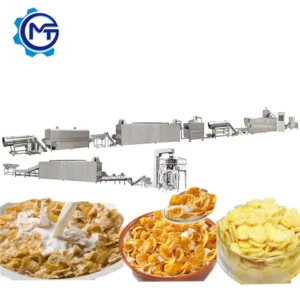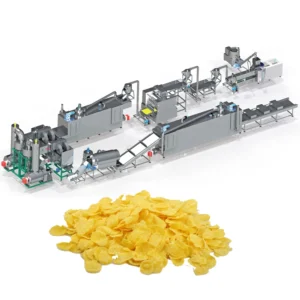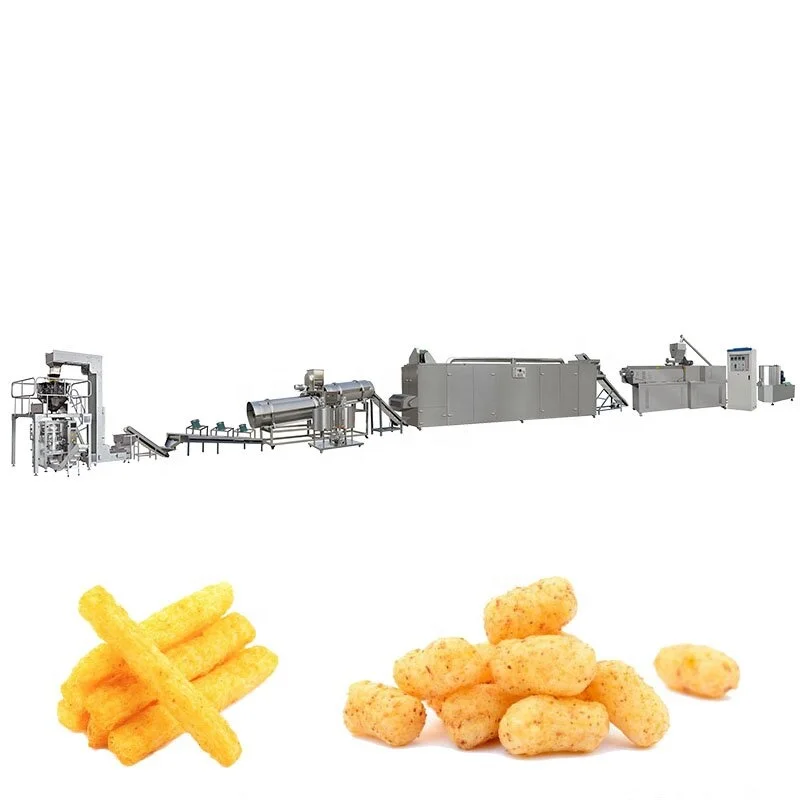
Matched Throughput — every station from mixer to packer is sized against the extruder’s real output on your grain blend, confirmed during a pre-shipment trial run in our testing workshop.
Technical Specifications
| Parameter | Value |
|---|---|
| Product Type | Corn Flakes Extrusion Production Line |
| Model Options | MT70 / MT75 / MT85 |
| Screw Type | Twin-screw |
| Installed Power | MT70 160 kW; MT75 210 kW; MT85 190 kW |
| Power Consumption | MT70 120 kW; MT75 150 kW; MT85 140 kW |
| Output Capacity | MT70 150–200 kg/h (basis not stated in source); MT75 300–500 kg/h (basis not stated in source); MT85 300–400 kg/h (basis not stated in source) |
| Overall Dimensions (L×W×H) | MT70 41 × 1.5 × 2.2 m; MT75 45 × 1.5 × 3.5 m; MT85 43 × 1.5 × 3.2 m |
| Control System | PLC and MCC |
| Flaking System | Hydraulic double-roller, independent dual-motor drive, infrared sensor temperature control |
| Roasting Oven | Vibrating pan, conciliation burner, dual circulating fans, cyclone dust removal |
| Coating System | Double tumble sugar melting, elevator, coating drum, spraying nozzle |
| Dryer Heating Source | Gas or Electric |
| Standards | CE, ISO |
Application Suitability
| Application | Material or Output |
|---|---|
| Natural corn flakes for retail breakfast cereal | Corn grits, corn flour |
| Sugar-coated corn flakes for mass-market cereal | Corn base with sugar syrup coating |
| Multi-grain breakfast flakes | Rice, wheat, oat, and barley powder blends |
| Extruded cereal shapes (rings, balls, stars, tubes) | Corn, rice, and mixed grain formulations |
Why "Rated Capacity" Rarely Matches What You Actually Produce on a Corn Flakes Extrusion Production Line Turnkey
Output numbers on paper mean nothing until the machine runs your specific grain blend at your moisture level.
I remember commissioning a corn flake line where the factory trial used standard-grade corn grits at controlled moisture. When we reached the buyer’s plant, the local corn had higher moisture and a finer grind. The screw speed and die temperature we had dialed in were useless — the first batch came out thick and hard, nothing like a breakfast cereal. That is why every corn flakes extrusion production line turnkey we build goes through a trial run on the customer’s actual raw material before it leaves the workshop. [NEED_CITE: raw material moisture variation in grain processing across regions]
Without that step, throughput claims are guesswork. A line quoted at a certain hourly output may stall at the dryer or produce flakes outside market specification when the real feedstock hits the barrel.
Barrel Temperature Profile and Starch Gelatinisation
The twin-screw extruder controls how thoroughly starch gelatinises before the dough reaches the die. Corn starch requires a specific temperature window to achieve the right degree of cook — too low and the flake will be dense and brittle; too high and the surface will blister unevenly during roasting. The PLC system on this corn flakes extrusion production line turnkey allows zone-by-zone barrel temperature adjustment, giving the operator room to compensate when local corn varieties behave differently from the test material.
Die Design and Flake Expansion Behaviour
The die determines the shape and initial density of the extrudate before it reaches the flaking rolls. For a classic flat corn flake, the die must produce a consistent rope or pellet that the hydraulic double-roller flaker can compress to uniform thickness. Die geometry also affects how the piece will blister during hot air roasting — a factor that directly controls the final crispness consumers expect in a breakfast cereal. [NEED_CITE: die geometry effects on extruded cereal expansion]
Screw Configuration Across Grain Blends
A screw profile optimised for pure corn may not generate the right shear when the formulation shifts toward oat or barley. These grains have different fat and fibre content, altering how the dough flows through the barrel. The screw configuration and die design are specified to the buyer’s declared formulation so that a corn flakes extrusion production line turnkey maintains product consistency across production runs rather than requiring constant manual intervention.
Hydraulic Flaking and Thickness Consistency
The flaking station uses independent dual-motor drive on each roller with infrared sensor temperature control. This setup keeps the gap stable even when dough temperature fluctuates between batches. Consistent flake thickness is essential because uneven flakes roast at different rates — thin pieces burn while thick ones stay chewy. The hydraulic system adjusts roller pressure to accommodate variations in extrudate moisture arriving from the dryer.
The Hidden Cost of Unmatched Station Capacity
A frequent failure in assembled lines is a dryer or roaster that cannot keep pace with the extruder. When the extruder runs at full output but the roaster can only handle a fraction of that volume, operators are forced to throttle back — and the entire line runs below its economic threshold. Mismatched coating drums cause the same problem downstream, leaving sugar-coated flakes waiting in holding bins where they absorb moisture and lose crispness. [NEED_CITE: throughput bottleneck effects in continuous food processing lines]
Why Procurement Here Reduces Commissioning Risk
The screw configuration and die design are documented for each buyer’s raw material, not copied from a generic build. Every station in the corn flakes extrusion production line turnkey — mixer, extruder, flaker, dryer, roaster, coater, and packer — is capacity-calculated together under one supplier. The in-house testing workshop runs your grain blend before shipment so screw speed, barrel temperatures, and die selection are already validated. PLC and MCC control with voltage and frequency confirmed before production avoids electrical surprises at commissioning. Wear parts including screws and dies are listed and available from day one, so the first replacement does not become an unplanned shutdown.
Documentation & Verification
- Line layout showing capacity calculation for each station matched to your target throughput
- Screw and die configuration record specifying the build matched to your grain formulation
- Trial run report from the testing workshop using your actual raw material
- Electrical schematic with confirmed voltage, frequency, and control language
- Factory test record with extruder and flaker performance data before dispatch
- CE declaration of conformity and ISO certificate for customs clearance
Installation, Commissioning & Support
- Foundation plan aligned to the MT75 footprint of 45 × 1.5 × 3.5 m with utility routing
- Dedicated electrical circuit matching confirmed kW draw and local voltage
- Modular station delivery with sequenced assembly from extruder through packing
- First-run parameter setting using trial run report as the commissioning baseline
- Operator training covering PLC interface, screw speed, and barrel zone temperatures
- Wear parts list with screw and die replacement intervals specific to your grain blend
What to Share With Your Inquiry
To size the right configuration, provide the grain type and blend ratio you intend to run, your target daily output, and your local voltage and frequency. If you can send a sample of your raw material, we can schedule a trial run in the testing workshop before finalising the corn flakes extrusion production line turnkey specification.
Frequently Asked Questions
Q: How is output capacity verified and on which raw material?
A: Capacity is confirmed by running the buyer’s actual grain blend in the testing workshop before shipment. The trial run report documents real throughput at specific moisture levels and screw speeds, so the quoted output reflects your material — not a generic benchmark.
Q: Can I send my own grain blend for a trial run before the line ships?
A: Yes. Sending your raw material allows us to test screw configuration, die selection, and barrel temperature profile on the exact corn, rice, wheat, or barley blend you will produce. Results are documented in a trial run report shared before dispatch.
Q: How are the dryer, roaster, and coater sized to avoid bottlenecking the extruder?
A: Every station is capacity-calculated as a single system under one supplier. The dryer, roaster, and coating drum are each specified to handle the extruder’s verified output on your grain, so no downstream station forces you to throttle back production.
Q: What screw configuration and die design will be specified for my target flake density?
A: Screw profile and die geometry are selected based on your grain formulation and the flake thickness and crispness your market expects. The exact configuration is documented and validated during the pre-shipment trial run on your raw material.
Q: How are voltage, frequency, and control language confirmed before production begins?
A: Your local electrical standards and preferred operator language are confirmed during the specification phase. The electrical schematic is reviewed and signed off before manufacturing starts, so the PLC and MCC panels arrive ready for immediate commissioning.
 词汇验证: - Industrial(通用限定词库) - Corn Flakes Production Line(来自【分类】breakfast cereals corn flakes machine + 【产品草稿】.product_type "Corn Flakes Production Line") - Complete Line(站点修饰词池:产线方案类角色→Production Line / Turnkey Solution / Complete Line) 记录ID 10631 数字和=11,11%6=5(结构5),11%3=2(池索引2→Complete Line) 无禁用词/无编造规格/无价格/无禁用符号](https://mtextrusion.com/wp-content/uploads/2026/05/He55b4c1cec294192a848b7f7f2ee8e4dS-300x300.webp)