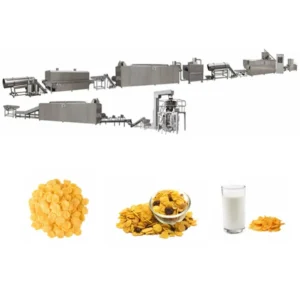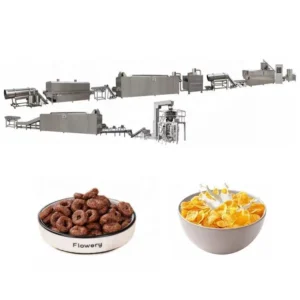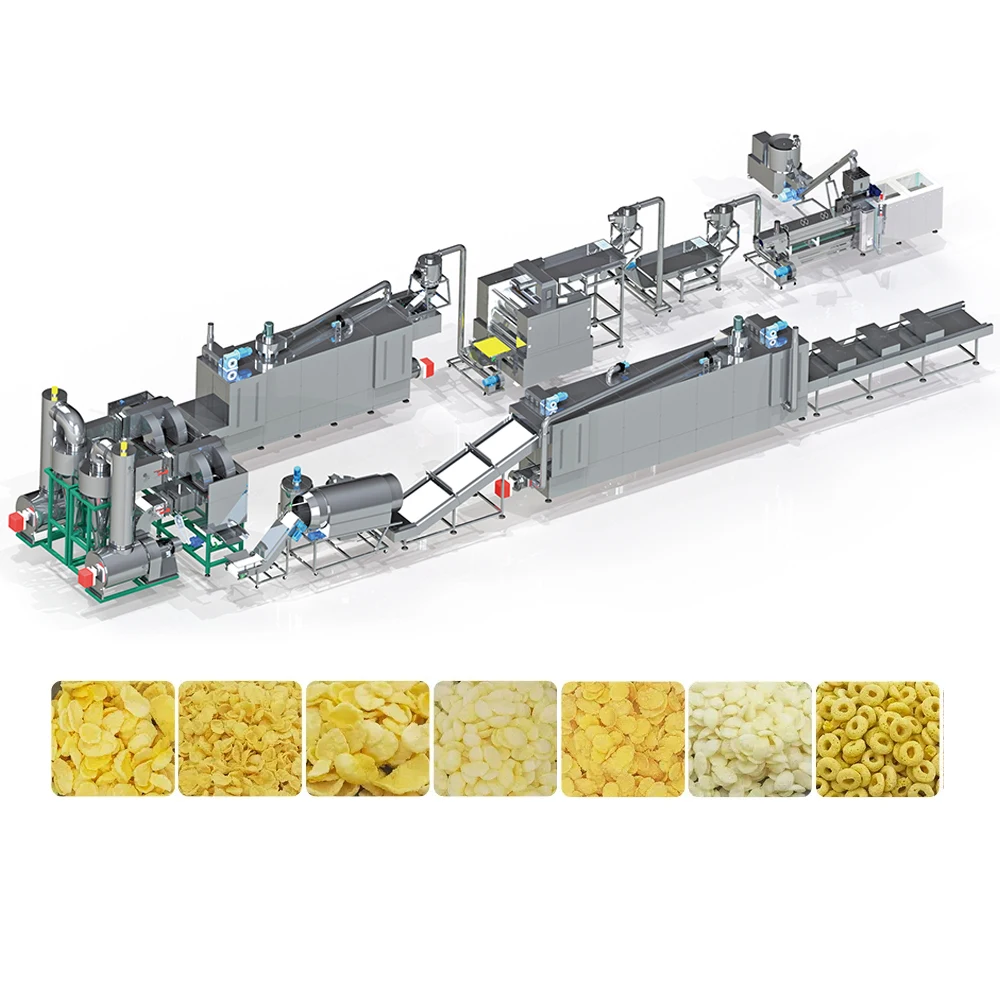
Screw Configuration Matched to Your Grain Blend — Every MT70, MT85, and MT75 extruder ships with screw elements and die geometry specified to the buyer’s actual corn, rice, wheat, oat, or barley formulation, validated through in-house trial runs before dispatch.
Technical Specifications
| Parameter | Value |
|---|---|
| Product Type | Corn Flakes Processing Line (Twin-Screw Extrusion) |
| Models Available | MT70, MT85, MT75 |
| Extruder Type | Twin-Screw |
| Installed Power (MT70) | 160 kW |
| Installed Power (MT85) | 190 kW |
| Installed Power (MT75) | 210 kW |
| Power Consumption (MT70) | 120 kW |
| Power Consumption (MT85) | 140 kW |
| Power Consumption (MT75) | 150 kW |
| Capacity (MT70) | 150–200 kg/h (basis not stated in source — confirm raw material and moisture content) |
| Capacity (MT85) | 300–400 kg/h (basis not stated in source — confirm raw material and moisture content) |
| Capacity (MT75) | 300–500 kg/h (basis not stated in source — confirm raw material and moisture content) |
| Overall Dimensions (MT70) | 41 × 1.5 × 2.2 m |
| Overall Dimensions (MT85) | 43 × 1.5 × 3.2 m |
| Overall Dimensions (MT75) | 45 × 1.5 × 3.5 m |
| Control System | PLC and MCC control |
| Flaking Machinery Drive | Double motors with separate roller driving; hydraulic system for double rollers |
| Flaking Temperature Monitoring | Infrared sensor |
| Dryer Heating Source | Gas or Electric |
| Roasting Oven | Hot air roasting with vibrating pan, high-temperature spraying tubes, dual circulating fans, cyclone dust removal |
| Coating System | Double tumble drum for sugar melting, elevator, coating drum, spraying nozzle |
| Screw Material | Special wear-resistant alloy |
| Lubrication | Automatic lubricating and cooling |
| Raw Materials | Corn, rice, wheat, oat, barley powder |
| Certifications | CE (since 2014), ISO |
Application Suitability
| Application | Material or Output |
|---|---|
| Natural corn flakes production | Maize grits, whole corn flour |
| Sugar-coated corn flakes | Corn grits with sugar syrup coating |
| Multi-grain breakfast cereal | Blends of rice, wheat, oat, and barley with corn |
| Shaped breakfast cereals | Ball, tube, stick, ring, fruit loop, star, wheel, flower, heart shapes via die adjustment |
| Fortified cereal production | Grain blends with added nutritional premix |
Why "Nominal Capacity" Means Nothing Without the Raw Material Story
A corn flakes extrusion line rated at a certain throughput on standard maize grits will behave differently on your local corn supply.
I spent years in after-sales flying out to fix lines that weren’t running right. One corn flakes extruder we shipped ran perfectly on standard maize grits during trial, but the customer’s local corn had higher moisture and a different starch profile. The first batch came out half-puffed with density all wrong, and the entire shift was scrapped. The corn flakes extrusion production line only delivers what it promises when screw configuration, barrel temperature profile, and moisture targets are all set against the grain you will actually feed into the hopper [NEED_CITE: starch gelatinisation behaviour across different maize varieties].
How Barrel Temperature Profiling Controls Flake Texture
The extrusion barrel is divided into multiple heating zones, each independently controlled. Early zones focus on preconditioning and initial starch hydration, while downstream zones manage peak gelatinisation temperature. Getting this profile wrong means the dough either fails to expand properly at the die face or over-expands into a brittle, low-density sheet that shatters during flaking. The corn flakes extrusion production line relies on precise thermal staging so the extrudate exits the die with the correct internal moisture and starch structure for consistent flake formation.
Die Geometry and Its Effect on Expansion Ratio
Die opening diameter and land length directly determine how much the extrudate expands as it exits into atmospheric pressure. A shorter land length allows greater radial expansion, producing a thicker pre-flake pellet, while a longer land restricts expansion for a denser, thinner result. Matching die geometry to the target flake thickness and bowl-life expectation is not a generic exercise — it depends on the amylose-to-amylopectin ratio in the grain blend [NEED_CITE: relationship between die land length and extrudate expansion in cereal processing].
Reading the Specs Beyond the Nameplate
The installed power figures — 160 kW for the MT70, 190 kW for the MT85, and 210 kW for the MT75 — represent total connected load across the extruder drive, barrel heaters, and auxiliary systems. Actual power consumption runs lower at 120 kW, 140 kW, and 150 kW respectively under typical operating conditions. The gap between installed and consumed power reflects the thermal and mechanical headroom needed when processing higher-moisture or harder grain varieties. Twin-screw extrusion generates shear heating internally, so the barrel heater duty cycle varies depending on how much mechanical energy the screw configuration imparts to the dough. The hydraulic flaking rollers with infrared temperature monitoring ensure the extrudate is sheeted at the correct surface temperature, preventing uneven moisture distribution that leads to blistering or cracking during roasting.
The Hidden Cost of Skipping the Raw Material Trial
When a corn flakes extrusion production line ships without a trial run on the buyer’s actual grain, product development starts after installation — on the factory floor, with production schedules waiting. Screw elements that work on one corn variety may produce inadequate gelatinisation on another, leading to flakes that turn soggy in milk within seconds or emerge from the roasting oven with uneven colour [NEED_CITE: impact of raw material variability on extruded cereal quality]. The flaking rollers then compound the problem: inconsistent extrudate density means the sheet thickness varies across the roller face, and the downstream dryer and roasting oven cannot correct what the extruder got wrong.
Why Procurement Should Start With a Grain Sample
Every configuration decision on this corn flakes extrusion production line flows from the raw material. The screw element arrangement — how many conveying sections, kneading blocks, and reverse-flight zones — is selected to achieve the target residence time and shear profile for the specific starch composition. The barrel temperature setpoints are then tuned to that screw configuration. The die plate is drilled and fitted with inserts matched to the desired pellet size. This is not a catalogue selection; it is a process design exercise, and it requires a representative sample of the buyer’s grain blend run through the testing workshop before the machine is locked down for production.
Documentation & Verification
- Screw and die configuration record specifying element arrangement matched to your grain blend
- Trial run report conducted on your raw material sample in our testing workshop
- Line layout with throughput calculation confirming station-to-station capacity alignment
- Electrical schematic with voltage, frequency, and control language confirmed for your market
- CE declaration of conformity and ISO certificate included in shipping documentation
- Operation and maintenance manual with wear parts list and replacement intervals
Installation, Commissioning & Support
- Foundation planning based on overall line dimensions up to 45 m length for the MT75 configuration
- Dedicated power circuit sized for installed load up to 210 kW with voltage and frequency verification
- Extruder barrel segments and screw shafts shipped disassembled for container loading and reassembled on site
- First production run supervised by commissioning engineer with barrel profile and screw speed optimisation
- Operator training covering PLC interface navigation, flaking roller gap adjustment, and roasting oven fan balance
- Wear parts stock including spare screw elements, die inserts, and flaking roller surfaces for initial replacement cycle
What We Need to Configure Your Line
Before we can specify screw elements, die geometry, and barrel temperature profiles, we need a representative sample of the grain or grain blend you plan to process, along with target flake dimensions and any coating requirements. Confirm your facility voltage and frequency, available floor space and ceiling height, and whether the dryer should be gas or electric fired. If you are adding this line alongside existing mixing or packing equipment, share the interface specifications so throughput can be matched across stations.
Frequently Asked Questions
Q: How is screw configuration and die design matched to a specific corn or multi-grain blend?
A: We analyse the starch composition, moisture content, and particle size of your grain sample, then select screw element arrangement and die geometry to achieve the target gelatinisation degree and expansion ratio. A trial run in our testing workshop validates the configuration before the machine ships.
Q: What barrel temperature profile and moisture level produce the target flake expansion and crunch?
A: The profile depends on your grain’s amylose content and initial moisture. Higher amylose blends typically need higher peak barrel temperatures for complete gelatinisation. We establish the setpoints during the raw material trial and document them in the configuration record provided with your line.
Q: How is throughput matched between extruder, flaking rollers, dryer, and roasting oven?
A: Each station is sized so that none becomes a bottleneck. The flaking roller width, dryer belt length, and roasting oven pan area are all calculated against the extruder output for your specific product density, and the capacity calculation document confirms this alignment before production begins.
Q: Can the same extrusion platform produce shaped cereals beyond flakes?
A: Yes. By changing the die plate, the twin-screw extruder produces rings, balls, stars, tubes, and other shapes. The flaking station is bypassed, and the extrudate goes directly to drying and roasting. We specify the die insert set based on the shapes in your product range.
Q: Is a trial run on the buyer’s raw material available before shipment?
A: Yes. We require a raw material sample and run it through the configured extruder in our testing workshop. The trial run report documents screw speed, barrel temperatures, moisture addition, and product density so you know the line will perform on your grain before it leaves our factory.