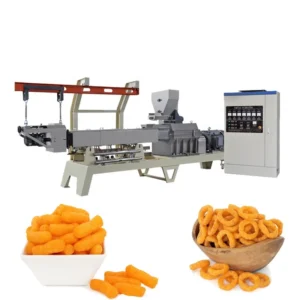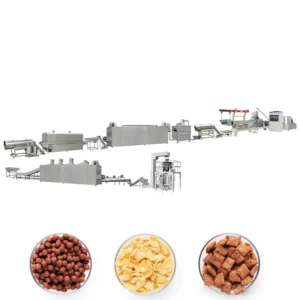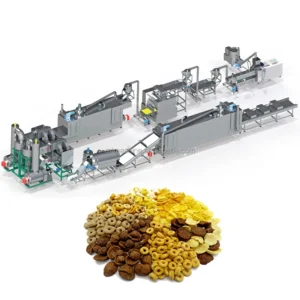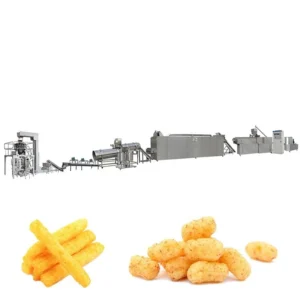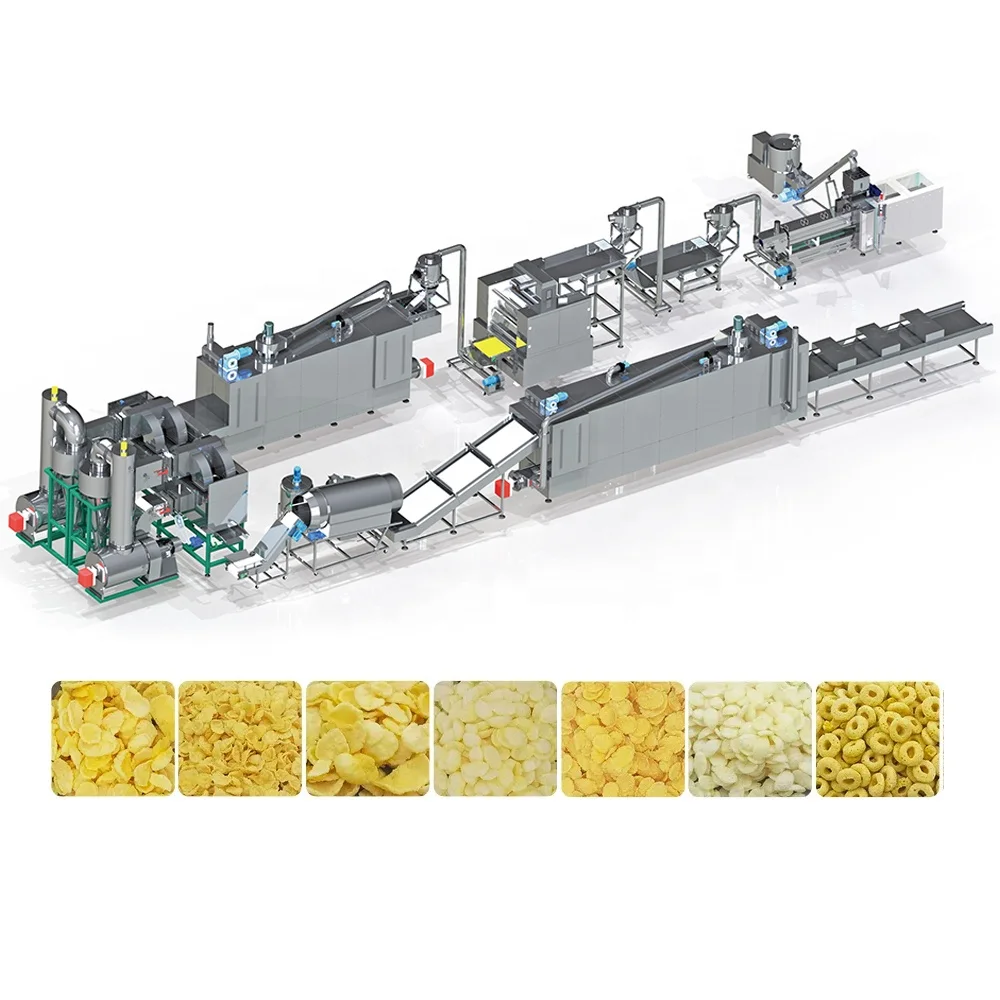
Extrusion Process Mastery — Every screw element and barrel zone on the MT70, MT85, and MT75 twin-screw extruders is configured to your specific corn, wheat, or barley blend to hit the exact flake density and blister pattern your market expects.
Technical Specifications
| Parameter | Value |
|---|---|
| Product Type | Corn Flakes Breakfast Cereal Production Line |
| Model | MT70 / MT85 / MT75 |
| Screw Type | Twin-screw (extruder section) |
| Installed Power | 160 kW (MT70); 190 kW (MT85); 210 kW (MT75) |
| Power Consumption | 120 kW (MT70); 140 kW (MT85); 150 kW (MT75) |
| Output Capacity | 150–200 kg/h (MT70); 300–400 kg/h (MT85); 300–500 kg/h (MT75) (basis to be confirmed on actual raw material, moisture, and flake format) |
| Overall Dimensions | 41 × 1.5 × 2.2 m (MT70); 43 × 1.5 × 3.2 m (MT85); 45 × 1.5 × 3.5 m (MT75) |
| Flaking Machine Capacity | 200–300 kg/h (basis to be confirmed on granule size and moisture) |
| Flaking Roller Control | PLC-controlled hydraulic system, double motors for independent roller drive |
| Flaking Temperature Control | Infrared sensor-regulated heating pipe |
| Dryer Heating Source | Gas or electric (selectable) |
| Hot Air Roasting Oven | Vibrating pan, conciliation burner, dual circulating fans, cyclone dust removal |
| Coating System | Double-tumble sugar melting unit, elevator, coating drum, spray nozzle |
| Control System | PLC (partial stations) |
| Basic Raw Materials | Corn, rice, wheat, oat, barley powder |
| Standards | CE declared; ISO declared |
Application Suitability
| Application | Material or Output |
|---|---|
| Natural corn flakes production | Degermed corn grits blended to target particle size and moisture |
| Sugar-coated corn flakes | Corn or multi-grain base with post-roasting sugar tumble coating |
| Fortified multi-grain breakfast cereal | Blends of corn, rice, oat, and barley powder requiring matched shear profile |
| Shaped cereal formats (loops, stars, rings, wheels) | Extruder die changes on the same twin-screw platform to produce ball, tube, stick, fruit loop, star, and flower shapes |
Why "Rated Capacity" Means Nothing Without the Raw Material Spec
A capacity number only holds value when tied to the exact corn variety, particle size, and moisture content running through the barrel.
I have seen buyers sign off on corn flakes extrusion production line specifications based on a headline output number, then discover during commissioning that their local corn source has a different fat and starch profile. The flakes come off the roaster dense and hard instead of crisp and blistered. The extruder was built for a reference material, not theirs [NEED_CITE: raw material variability in corn starch gelatinisation behaviour]. That mismatch is why every screw configuration and die selection here starts with a trial on the buyer’s actual raw material before the machine ships, not after it arrives.
Shear, Moisture, and Starch Gelatinisation Inside the Barrel
The twin-screw extruder on the MT70, MT85, and MT75 is designed to manage the precise balance of shear force, barrel temperature, and moisture injection required to gelatinise corn starch uniformly. Automatic lubricating and cooling functions keep barrel zones within tolerance during continuous runs. This matters because under-gelatinised starch produces flakes that shatter during roasting, while over-gelatinised material creates a gummy texture that will not crisp.
Flaking Hydraulics and Independent Roller Drive
After extrusion, the cooked mass passes through the flaking station where PLC-controlled hydraulic double rollers press it into sheets of uniform thickness. Each roller is driven by a separate motor, which prevents slip and maintains consistent nip pressure across the full roller face. An infrared sensor monitors and regulates the roller temperature pipe so that the sheet does not stick or tear. Flake thickness directly controls the final bowl-life crispness — a variation of fractions of a millimetre changes how the product behaves in milk [NEED_CITE: flake thickness influence on bowl-life in breakfast cereal engineering].
Roasting, Blister Formation, and Coating Precision
The hot air roasting oven uses a vibrating pan with high-temperature spraying tubes and a conciliation burner to drive the rapid moisture flash-off that creates the characteristic blister pattern on a corn flake. Two separate circulating fans and a cyclone dust removal device maintain even air distribution. For sugar-coated variants, the double-tumble sugar melting and coating drum with spray nozzle distributes syrup evenly before the second drying pass.
Interpreting the Numbers That Matter
The installed power range across the three models reflects the thermal and mechanical energy needed to cook, shear, and push cereal dough through the extruder die at sustained output. Power consumption figures are lower than installed totals because heating zones cycle and motors do not run at peak draw simultaneously. The overall line dimensions indicate the linear footprint required for the full natural or sugar-coated corn flakes process from mixer to packer — useful when planning shop floor layout [NEED_CITE: typical floor space planning for continuous cereal lines]. The flaking machine capacity is listed separately because it must be matched to the extruder output; if the flaker cannot hold pace, the extruder backs up and the dough cools, ruining sheet consistency.
The Cost of a Mismatched Line
Buyers who spec each station independently often find the roaster cannot keep up with the flaker, or the dryer is undersized for the moisture load coming off the extruder. The result is product sitting in buffer hoppers, losing temperature and moisture, arriving at the roaster in a condition that no longer produces the right blister. These bottlenecks are invisible on a quotation that lists machines as separate items without a throughput calculation tying them together [NEED_CITE: throughput matching across cereal production stations].
Why Buyers Spec with Us
Screw and die configurations are selected against the buyer’s raw material blend and target flake density, not copied from a generic template. Every line goes through an in-house testing workshop where the buyer’s actual corn or grain blend is run before shipment, generating a trial report that becomes the baseline for commissioning. Complete lines from batching through extrusion, flaking, drying, roasting, coating, and packing are engineered under one supplier so that each station’s capacity is calculated to hold pace with the others. The flaking station uses PLC-controlled hydraulics and independent dual-motor drive rather than a single shared motor, giving better nip control. Electrical schematics and voltage are confirmed against the target market’s standards before production begins, not discovered during installation.
Documentation & Verification
- Screw and die configuration record matched to your corn or grain blend and target flake specification
- Trial run report generated on your actual raw material in the testing workshop before shipment
- Line layout drawing and throughput capacity calculation across every station from mixer to packer
- Electrical schematic with confirmed voltage, frequency, and control language for your facility
- CE declaration of conformity and ISO certificate documentation
- Operation and maintenance manual with wear parts list and packing photographs for customs
Installation, Commissioning & Support
- Foundation and utility plan based on the MT70/MT85/MT75 footprint and 41–45 metre linear layout
- Dedicated circuit sizing for 160–210 kW installed power depending on model selected
- On-site assembly of roaster vibrating pan, cyclone, and flaking hydraulic system after transport
- First-run parameter setting on PLC-controlled flaking pressure and infrared roller temperature
- Operator training covering die changes for shaped cereal formats and screw element access
- Wear parts list covering screws, dies, and roller surfaces with recommended replacement intervals
Before You Send the Inquiry
To configure the right line and provide corn flakes extrusion production line specifications that match your situation, share the raw material blend and its typical moisture content, the target daily output and shift pattern, and the electrical voltage and frequency at your facility. If you are considering sugar-coated variants or shaped cereal formats, note those as well so the coating drum and die options are included in the layout proposal.
Frequently Asked Questions
Q: How is the output capacity basis determined for each model?
A: The listed output ranges for the MT70, MT85, and MT75 are based on standard reference conditions. Actual capacity depends on your specific corn variety, moisture content, and target flake thickness. We confirm the real throughput by running your raw material in our testing workshop and documenting the result in a trial report before the line ships.
Q: How are screw and die configurations chosen for multi-grain blends?
A: Corn, wheat, oat, and barley each have different starch gelatinisation temperatures and shear requirements. We select the screw element arrangement and die opening based on the exact blend ratio and particle size you provide, then validate the configuration during the in-house trial run on your material.
Q: What PLC parameters are controlled at the flaking and roasting stages?
A: The flaking station uses PLC control for hydraulic roller pressure, with infrared sensing for roller temperature. The roasting oven uses a conciliation burner and dual circulating fans for temperature uniformity. Control language options are confirmed during the pre-production specification review to match your operator team.
Q: How do you ensure the roaster and coater match extruder throughput?
A: Every station is capacity-calculated as a system. The flaker, dryer, roaster, and coating drum are each sized to handle the moisture load and mass flow from the extruder at sustained output, so no station becomes a bottleneck during continuous production.