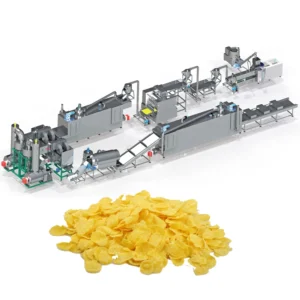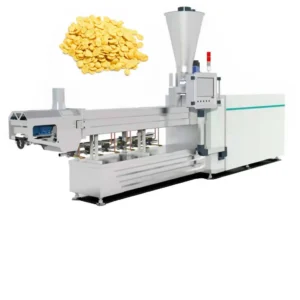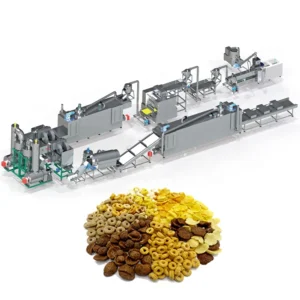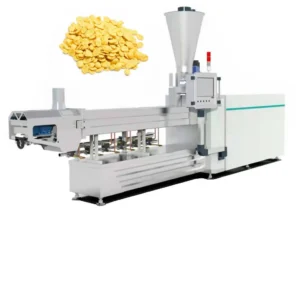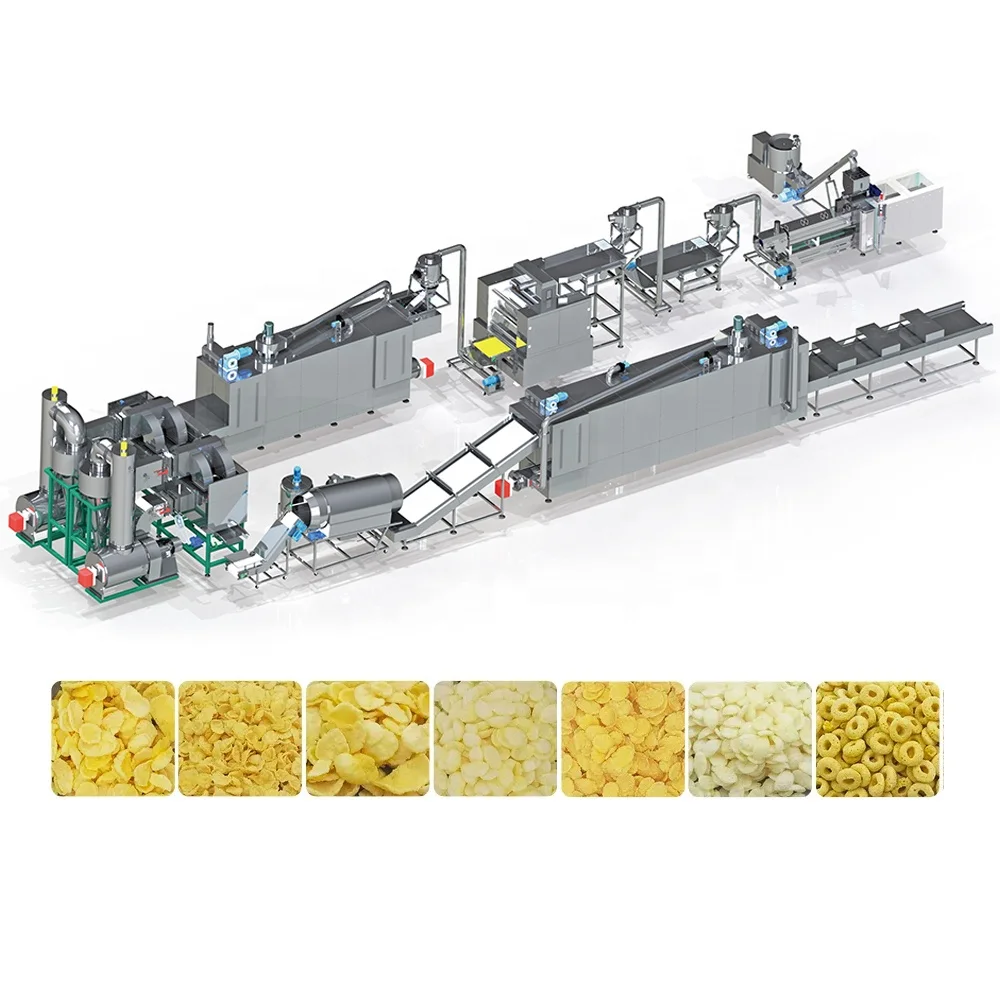
Screw and die geometry matched to recipe — The MT-75 twin screw configuration is specified to your grain blend and target flake density rather than copied from a generic cereal build.
Technical Specifications
| Parameter | Value |
|---|---|
| Model | MT-75 |
| Product Type | Twin Screw Breakfast Cereal Extrusion Line |
| Screw Type | Co-rotating twin screw, sectional modules |
| Mixer Tank Size | φ600 × 500 mm |
| Mixer Output | 10–30 kg per load |
| Mixer Power | 4 kW |
| Screw Conveyor Power | 0.75 kW |
| Corn Flakes Press Roller | 510 × 310 × 1050 mm |
| Corn Flakes Press Power | 16.12 kW |
| Press Features | Adjustable roller gap, integrated cooling system |
| High-Temperature Oven Dimensions | 4.5 × 1.4 × 1.8 m |
| Oven Heating Method | Gas-fired, dual-side baking |
| Oven Power | 3.75 kW |
| Sugar Spraying System Power | 28.75 kW |
| Sugar Spraying Roller | Ø600 × 2700 mm |
| Die Options | Interchangeable moulds for ring, ball, star, stick and custom shapes |
| Control System | Separate controller box for press machine (PLC/MCC scope basis to be confirmed) |
| Voltage Options | 3ph 380V 50Hz / 3ph 380V 60Hz / 3ph 415V 60Hz / 3ph 220V 60Hz |
| Standards | CE |
Application Suitability
| Application | Material or Output |
|---|---|
| Corn flakes production | Corn grits and maize flour with sugar or salt malting |
| Choco hoops and crunchy rings | Wheat flour, oat flour, cocoa powder blends |
| Fortified breakfast cereals | Multi-grain premix with vitamin and mineral additions |
| Puffed grain snack variants | Rice flour, oat, and blended cereal powders |
| Honey or sugar-coated leisure snacks | Extruded grain pellets passed through coating drum |
Why Screw Configuration Matters More Than Nameplate Capacity
A twin screw breakfast cereal extrusion line rated by nameplate alone will underperform the moment your raw material diverges from the test grain.
Many buyers receive a quote based on a standard maize flour trial, then discover on commissioning that their whole grain wheat blend with higher bran content produces dense, under-expanded flakes. The die geometry and screw element sequence that work for pure corn grits fail to generate sufficient shear and gelatinisation when fibre content rises [NEED_CITE: starch gelatinisation behaviour across grain types]. This mismatch does not show up on a spec sheet — it only appears once material is running through the barrel.
How Barrel Temperature and Screw Pitch Shape Flake Expansion
The MT-75 uses sectional screw modules arranged along the barrel to control forward transport, mixing, de-gassing, cooking, and forming in sequence. Each module’s pitch and flight depth determines residence time and shear intensity at that zone. For corn flake production, the cooking section requires a temperature profile that drives starch gelatinisation without premature moisture loss, ensuring the dough reaches the die with enough plasticity to expand uniformly under the press roller.
Die Geometry and Flake Thickness Control
The interchangeable die system produces pellet shapes — ring, ball, star, stick — before the material passes to the press roller unit. The press roller’s adjustable gap directly governs final flake thickness, while its integrated cooling system prevents the sheeted dough from sticking or tearing. Gas-fired dual-side baking in the high-temperature oven then sets the crispness uniformly across the flake surface, which is critical when buyers target a specific crunch density expected by retail markets [NEED_CITE: cereal flake density specifications in retail packaging standards].
Reading the Specs That Actually Determine Output Quality
The co-rotating twin screw design generates higher shear than single-screw alternatives, which matters when processing oat or wheat blends that resist gelatinisation at lower energy inputs. The mixer output of 10–30 kg per load sets the batching rhythm feeding the extruder — if the upstream batching cycle is slower than extruder consumption, the barrel runs starved and expansion becomes inconsistent. The press power of 16.12 kW and roller dimensions of 510 × 310 mm provide sufficient force for sheeting cereal dough at production throughput. The sugar spraying system at 28.75 kW with a Ø600 × 2700 mm roller handles coating volume that matches typical extruder output, avoiding the bottleneck that occurs when a coating drum is undersized relative to the extrusion rate.
What Happens When Line Stations Are Mismatched
An extruder running at full output feeds a dryer that cannot remove moisture fast enough — the flakes reach packing with residual moisture that causes sogginess within weeks on the shelf. Or the coating drum is too small to apply an even sugar or honey layer at the extruder’s throughput rate, resulting in clumped product that fails visual quality checks. These station-level mismatches are the most frequent cause of line underperformance after installation, and they are invisible in a quotation that lists only the extruder model [NEED_CITE: cereal production line throughput matching principles].
Why This Line Is Configured Before It Is Quoted
Every station from the flour mixer through the cooling conveyor is sized to match the extruder’s throughput on your specific raw material, so no single unit creates a bottleneck. The screw and die configuration is selected based on your grain blend and target flake density, not copied from a standard build. An in-house testing workshop runs trial production on your actual recipe before shipment, producing a trial run report that confirms expansion, texture, and coating adhesion. The electrical schematic and voltage are confirmed to your facility’s supply before production begins, eliminating commissioning delays. Documentation includes a complete wear parts list covering screw elements, die inserts, and press roller components so replacements are available when the first changeover is due.
Documentation & Verification
- Screw and die configuration record matched to your grain blend and target flake density
- Trial run report produced on your raw material in our testing workshop before shipment
- Electrical schematic with voltage and frequency confirmed to your facility supply
- Line layout drawing showing station throughput matching from mixer to packing
- CE declaration of conformity for the complete extrusion and processing line
- Operation and maintenance manual provided in English with wear parts list
Installation, Commissioning & Support
- Foundation and floor space planning based on the full line layout including the 4.5 m oven
- Voltage and frequency verified against your site supply before control panel build
- Line arrives in sectional shipping state with on-site assembly and alignment
- First-run parameter setting for barrel temperature, screw speed, and press roller gap
- Operator training covering die changeover, press adjustment, and coating drum operation
- Wear parts list covering screw modules, die inserts, and roller surfaces for planned replacements
What to Include in Your Inquiry
To configure the twin screw breakfast cereal extrusion line to your production requirements, provide the grain type and blend composition you intend to process, your target daily output, and the specific cereal formats you need — whether corn flakes, choco hoops, rings, or a combination. Confirm your facility voltage and frequency, preferred control language, and whether you need a trial run on your raw material before shipment.
Frequently Asked Questions
Q: How is screw configuration selected for different grain raw materials?
A: The screw element sequence — transport, mixing, cooking, and forming modules — is chosen based on your grain’s starch composition, fibre content, and target expansion. Oat blends with higher fibre require different shear profiles than pure corn grits. We document the configuration matched to your recipe and validate it during the pre-shipment trial run.
Q: What barrel temperature profile is needed for corn versus oat or wheat?
A: Corn requires a profile that reaches full gelatinisation around the mid-barrel zone with controlled moisture retention. Wheat and oat blends with higher bran content demand more energy input and adjusted residence time to achieve equivalent cooking. The sectional barrel zones are set independently to match each material’s thermal behaviour.
Q: How is output verified on the buyer’s actual raw material?
A: We conduct a trial run in our testing workshop using your supplied recipe and grain blend. The trial run report records extruder parameters, expansion ratio, flake density, and coating adhesion. This report is delivered before shipment so you can confirm the line meets your product specification prior to installation.
Q: How are dryer and coating throughput matched to the extruder?
A: Each downstream station — dryer, coating drum, cooling conveyor — is calculated against the extruder’s verified output on your material. The gas oven dimensions and sugar spraying roller size are selected to handle peak throughput without creating a moisture or coating bottleneck at any point in the line.
Q: What voltage and control options are confirmed before commissioning?
A: Voltage options include 380V 50Hz, 380V 60Hz, 415V 60Hz, and 220V 60Hz in three-phase configuration. The control system scope and operating language are confirmed during the specification phase so the electrical schematic matches your facility before the control panel is built, preventing delays at commissioning.