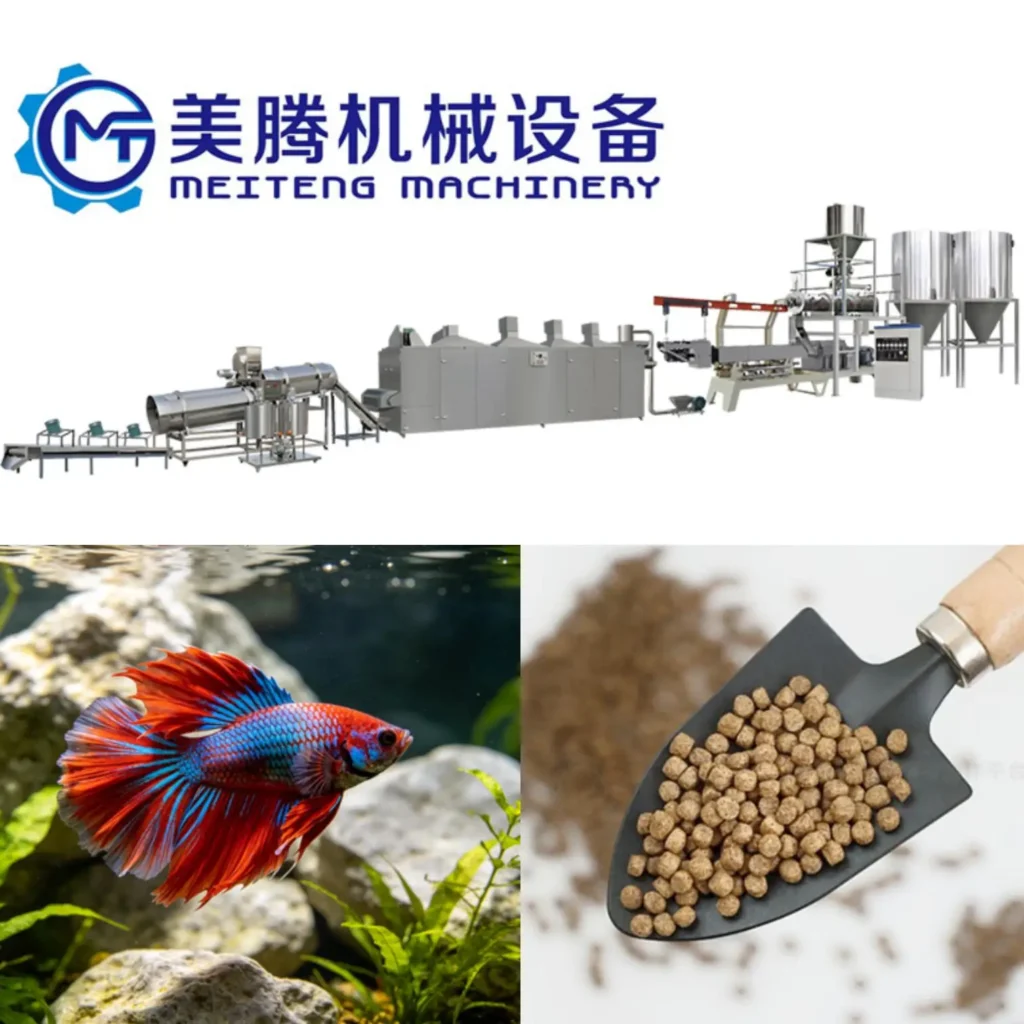
Matched Extrusion Geometry — screw profiles and die apertures are specified against the buyer’s raw material blend and target pellet buoyancy rather than pulled from a generic catalogue.
Technical Specifications
| Parameter | Value |
|---|---|
| Product Type | Twin-Screw Fish Feed Extrusion Production Line |
| Extruder Type | Twin-screw extruder |
| Output Capacity | 1.0–1.2 t/h (basis not stated in source — confirm pellet diameter, formulation, and moisture content) |
| Construction Material | 304 stainless steel (food-contact zones) |
| Control System | PLC or MCC control (configurable) |
| Voltage & Frequency | Configurable to destination country standards |
| Screw Configuration | Matched to raw material and target pellet density |
| Die Configuration | Interchangeable dies for varying pellet diameters |
| Barrel Zones | Multi-zone temperature profiling |
| Moisture & Steam Injection | Steam or water injection available |
| Line Stations | Mixing, extrusion, drying, coating, cooling, packing |
Application Suitability
| Application | Material or Output |
|---|---|
| Floating feed for trout and salmon | High-protein formulations with controlled starch gelatinisation for buoyancy |
| Sinking feed for catfish and bottom-feeding species | Denser formulations with reduced expansion ratio |
| Multi-species aquaculture operations | Single extrusion platform producing both floating and sinking pellets by adjusting screw profile and barrel temperature |
| Transition from single-screw lines | Tighter density tolerance and more consistent pellet geometry across batches |
What "1.0–1.2 Tonnes per Hour" Actually Means on Your Formulation
Nominal capacity figures assume a reference material that almost never matches your actual recipe.
When a twin-screw fish feed extrusion line is quoted at a given throughput, that number is typically derived from a standard corn or soy-based test blend. Switch to a formulation loaded with fish meal, fresh meat slurry, or high-fat content and the real output shifts — sometimes considerably. I have watched lines stall at barely half the quoted rate because the screw configuration was copied from a generic build that never accounted for the buyer’s actual ingredient ratios. The twin-screw fish feed extrusion line specifications only become meaningful once they are validated against the specific raw material profile you intend to run day after day. [NEED_CITE: effect of raw material composition on extruder throughput in aquafeed production]
Screw Geometry as the Primary Density Lever
Pellet buoyancy is not determined by a single variable. It emerges from the interaction between screw flight depth, pitch angle, and the shear history the material experiences as it moves through each barrel zone. For floating feed targeting trout or salmon, the screw profile must generate enough mechanical energy to fully gelatinise the starch fraction while trapping sufficient steam expansion at the die face. Altering one section of the screw assembly — even a single kneading block — changes the residence time distribution and, consequently, the expansion ratio. Getting the twin-screw fish feed extrusion line specifications right at the configuration stage prevents weeks of on-site troubleshooting later.
Barrel Temperature Profiling for Starch Control
Multi-zone barrel heating allows operators to stage the thermal input across the extruder length. Early zones bring the blend to gelatinisation onset without premature expansion, while later zones manage melt temperature and viscosity before the material reaches the die. This staged approach is essential when working with formulations that contain both rapidly gelatinising starches and slower-responding protein fractions. Consistent zone control reduces the variation in pellet density from the first minute of a run to the last, which is exactly what aquaculture buyers inspect when they receive a shipment. [NEED_CITE: barrel temperature profiling and starch gelatinisation in twin-screw extrusion]
Reading the Specification Sheet Against Your Production Targets
Three parameters on the spec table deserve the closest attention. The screw configuration record shows whether the kneading blocks and conveying elements were selected for your formulation or simply carried over from a default build. The die configuration determines pellet diameter range and directly influences the pressure drop at the die face — a key factor in expansion and final density. The construction material, 304 stainless steel in all food-contact zones, matters especially in high-moisture aquafeed environments where corrosion from salt-laden formulations degrades lesser alloys over time. Together, these parameters define whether the twin-screw fish feed extrusion line will hold its output quality across different species-specific recipes.
The Cost of Ignoring Configuration Details
A line that was never trial-run on your actual raw material arrives at your facility as an untested hypothesis. Operators spend days adjusting feed rates, barrel temperatures, and moisture injection to find a stable window — if one exists with the installed screw profile. During that period, off-spec pellets accumulate, dryer throughput drops because wet product loads exceed design capacity, and the coating drum cannot keep pace. The hidden cost is not just the wasted material; it is the delayed market entry while the process is stabilised from scratch. [NEED_CITE: commissioning delays caused by untested extruder configurations in feed production]
Why Sourcing the Extrusion Platform Here Matters
Screw configuration and die design are specified to your raw material and target pellet buoyancy before production begins, not adjusted after installation. An in-house testing workshop runs your actual formulation through the extruder before shipment, generating a trial run report that documents pellet density, expansion ratio, and process parameters. Complete line stations — from mixing through drying, coating, cooling, and packing — are supplied under one responsibility, which means throughput is balanced across every station rather than bottlenecked at the dryer or flavouring drum. Electrical schematics and voltage are confirmed to your destination country standards before the control cabinet is wired. CE and ISO documentation supports customs clearance and regulatory compliance in your market.
Documentation & Verification
- Screw and die configuration record matched to your raw material formulation
- Trial run report on customer raw material confirming pellet density and buoyancy
- Electrical schematic with voltage and frequency matched to destination country
- Line layout and capacity calculation for your target species and pellet sizes
- CE declaration of conformity and ISO certificate for regulatory compliance
- Operation and maintenance manual with wear parts list
Installation, Commissioning & Support
- Foundation and utility planning based on the extruder’s configurable voltage and multi-zone barrel heating requirements
- On-site assembly of line stations with throughput verification across extruder, dryer, and coating drum
- First-run commissioning with screw profile and barrel temperature fine-tuning on your formulation
- Operator training covering die changes for different pellet diameters and species-specific recipes
- Wear parts list identifying screws, dies, and barrel liners with recommended replacement intervals
- Ongoing technical support for formulation changes as new species or market requirements emerge
Preparing Your Inquiry
To move from a general specification to a line configuration that matches your operation, share the raw material formulation you intend to run — including protein sources, starch percentage, and fat content. Indicate the target pellet diameters and whether you need floating, sinking, or both output types. Confirm your facility’s voltage and frequency standards so the control system and heating elements are specified correctly from the outset.
Frequently Asked Questions
Q: How is pellet buoyancy controlled through screw configuration and barrel temperature?
A: Floating pellets require sufficient starch gelatinisation and steam entrapment at the die face, achieved by tuning kneading block placement and barrel zone temperatures to generate the right expansion ratio. Sinking pellets need a denser structure with less expansion, obtained by adjusting screw pitch and reducing thermal input in later barrel zones. The die aperture also influences pressure drop and final density.
Q: What moisture and starch levels are needed for target expansion?
A: Starch content typically needs to exceed a threshold that varies by source — corn, wheat, and tapioca behave differently under shear and heat. Moisture is introduced through steam or water injection and must be balanced so that gelatinisation is complete without making the melt too fluid to hold expansion. A trial run on your exact blend establishes the workable moisture window before the line ships.
Q: How is throughput verified against the actual formulation?
A: The extruder is run on the buyer’s raw material in the testing workshop before dispatch. Output is measured over a sustained period, and the result is documented in a trial run report. This confirms whether the quoted capacity holds on the specific formulation rather than only on a standard reference blend.
Q: What die options are available for different pellet sizes?
A: Interchangeable die plates are provided with aperture sizes matched to the target pellet diameter range for each fish species. The die geometry also affects the pressure profile at the extrusion face, which influences expansion and surface finish. Multiple die plates allow a single line to produce different pellet sizes across production runs.
Q: How is the extruder matched with downstream dryer and coating capacity?
A: Each line station is sized so that the dryer can handle the moisture load leaving the extruder and the coating drum can keep pace with output volume. Throughput balancing is calculated during the layout phase to prevent bottlenecks, ensuring the full line runs at a consistent rate rather than cycling on and off.