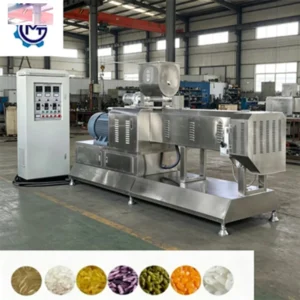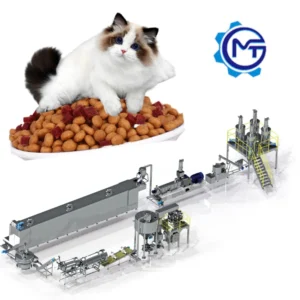
Custom screw configuration — Every barrel section and die plate is specified against the buyer’s actual formulation and target pellet density, verified in our testing workshop before the line ships.
Technical Specifications
| Parameter | Value |
|---|---|
| Product Type | Fish Feed Processing Line |
| Extruder Type | Twin-screw extruder |
| Output Capacity | 4–5 t/h (basis not stated in source — confirm raw material formulation, moisture content, pellet size) |
| Construction Material | 304 stainless steel (contact parts) |
| Control System | PLC and MCC control |
| Line Stations | Batching, mixing, extrusion, drying, coating/flavouring, cooling, packing |
| Screw Configuration | Matched to raw material and target pellet specification |
| Die Design | Configured for target pellet size and density |
| Voltage & Frequency | To be confirmed per buyer’s market |
| Certification | CE, ISO |
Application Suitability
| Application | Material or Output |
|---|---|
| Floating pellets for trout and salmon | High-protein fish meal and starch blends, low-density expansion |
| Sinking pellets for catfish and shrimp | Denser grain and protein mixes, controlled gelatinisation |
| Multi-species feed mills | Changeover between pellet diameters and density targets via die and screw adjustment |
| Aquaculture operations requiring water stability | Formulations demanding precise moisture and shear control during extrusion |
Why Generic Screw Builds Sink Floating Pellets
Floating feed that sinks is almost always a screw configuration problem, not a raw material problem.
When I first started fitting out aquatic feed lines, I watched a Middle Eastern customer lose half their stated output because the extruder was built with a generic screw profile copied from a snack food machine. The high-protein formulation they ran simply would not expand correctly under those conditions. The pellets came out dense, sank immediately in the pond, and the farmer rejected the batch. That experience changed how I approach every twin screw fish feed extrusion technology project — I now insist on running the buyer’s actual raw material through a trial before anything leaves the factory. [NEED_CITE:]
How Barrel Temperature and Shear Shape Pellet Buoyancy
The twin screw fish feed extrusion technology process depends on precise barrel temperature profiling across multiple heating and cooling zones. Each zone controls how quickly starch granules absorb moisture and rupture, which directly determines the expansion ratio of the pellet as it exits the die. For floating pellets targeting trout or salmon, the gelatinisation must be aggressive enough to trap steam pockets inside the pellet matrix, creating the low bulk density that keeps the pellet on the water surface.
Screw element sequencing — forward-flight conveying segments alternating with kneading blocks — dictates the residence time and shear intensity the material experiences. A formulation heavy in fish meal requires gentler shear than a starch-dominant mix, because excessive mechanical energy breaks protein bonds and collapses the expansion structure before the pellet even leaves the die.
Die Geometry and the Floatability Margin
The die plate is where pellet diameter, length, and density converge into a single physical outcome. Orifice diameter and land length together control back-pressure inside the extrusion chamber, which in turn governs how much steam remains trapped at the moment of atmospheric release. A shorter land length reduces resistance, allowing more explosive expansion — suitable for large floating pellets. A longer land length compresses the melt more tightly, producing denser sinking pellets for bottom-feeding species like catfish.
Matching die design to the buyer’s target species is not optional — it is the difference between a product the market accepts and one that gets returned. [NEED_CITE:]
Reading the Specs That Actually Matter
The distinction between single-screw and twin-screw extrusion becomes critical at the 4–5 t/h scale. Twin-screw designs offer self-wiping action between the intermeshing screws, which prevents high-protein or high-fat formulations from sticking and degrading inside the barrel — a common failure mode in single-screw machines running aquatic feed. The screw configuration record should document every element position, because changing even two kneading blocks alters the entire shear profile.
PLC and MCC control ensures that barrel temperatures, screw speed, and feeder rates remain consistent across production shifts, removing operator guesswork from batch-to-batch repeatability. The 304 stainless steel contact surfaces resist the corrosive effect of fish meal and marine-grade additives over long production runs. Voltage and frequency must be confirmed against the buyer’s site conditions before electrical panels are wired — a mismatch here delays commissioning by weeks.
What Happens When Extruder and Dryer Capacity Mismatch
One of the most common line failures I have seen in aquaculture feed installations is an extruder producing pellets faster than the downstream dryer can handle. The pellets pile up with residual moisture still trapped inside, leading to mould growth within hours of packing. This bottleneck does not show up in the extruder’s spec sheet — it only surfaces when throughput is matched across every station from batching through cooling. [NEED_CITE:]
Why Procurement Should Start With a Trial Run
Our in-house testing workshop runs the buyer’s actual raw material through the configured screw and die setup before the line ships, producing a trial run report that documents moisture content, expansion ratio, pellet density, and water stability. Screw configuration and die design are locked to the buyer’s specific formulation, not copied from a generic build intended for a different product category. Every station on the line — batching, mixing, extrusion, drying, coating, cooling, packing — is sized so that throughput matches rather than bottlenecks at any single point.
Line layout and capacity calculations are provided as part of the proposal, showing utility requirements, floor space, and phased installation sequencing. Electrical schematics confirm voltage, frequency, and control language against the buyer’s site conditions before panel fabrication begins. Documentation packages travel with the shipment and include everything needed for customs clearance and local compliance. [NEED_CITE:]
Documentation & Verification
- Trial run report on your raw material formulation before dispatch
- Screw and die configuration record matched to your pellet target
- Line layout with throughput calculation across all stations
- Electrical schematic with voltage and frequency confirmed for your site
- CE declaration of conformity and ISO certificate included
- Wear parts list with replacement intervals for screws and dies
Installation, Commissioning & Support
- Foundation plan provided based on line footprint and twin-screw extruder weight distribution
- Dedicated power circuit specified per confirmed voltage and frequency requirements
- Extruder barrel and screw assembly aligned on-site during commissioning phase
- PLC parameter sets loaded and tuned to your raw material trial results
- Operator training covers screw changeover and die replacement procedures
- Wear parts inventory recommended based on your annual production volume
What We Need to Configure Your Line
To size the extrusion, drying, and coating stations correctly, we need your target pellet diameters, the raw material formulation including protein and starch percentages, and the moisture content at which you plan to feed the extruder. Share your site voltage, frequency, and preferred control language so the electrical panels are built right the first time. If you are replacing an existing single-screw line, tell us the current bottleneck so the twin-screw upgrade addresses the actual constraint.
Frequently Asked Questions
Q: How is the output capacity of this line verified before shipment?
A: We run your actual raw material through the configured twin-screw extruder in our testing workshop and document pellet density, expansion ratio, moisture content, and water stability in a trial run report. Capacity figures are then confirmed against your specific formulation and pellet size rather than quoted from a generic benchmark.
Q: How do you determine screw configuration for my formulation?
A: We analyse your raw material composition — protein level, starch type, fat content, and fibre percentage — then sequence screw elements and kneading blocks to achieve the shear and residence time your formulation requires. The configuration is recorded and shipped with the machine so your team can replicate or adjust it.
Q: What barrel temperature profile is needed for starch gelatinisation in fish feed?
A: The profile depends on your starch source and moisture level, but typically ranges from moderate feed-zone temperatures to higher melt-zone settings. We establish the exact gradient during the trial run and program it into the PLC so operators can recall it for each production batch.
Q: Can this line produce both floating and sinking pellets?
A: Yes. Switching between floating and sinking formats requires changes to die land length, screw element sequencing, and barrel temperature settings. All three adjustments are documented in the configuration record so your team can change over without trial and error.
Q: What does the pre-shipment trial report include?
A: The report covers pellet diameter, bulk density, water stability duration, expansion ratio, and moisture content measured across multiple sample intervals. It also records the exact screw configuration, die specification, and PLC parameter set used, giving you a production baseline from day one.