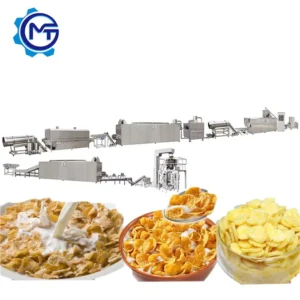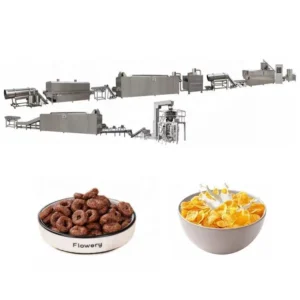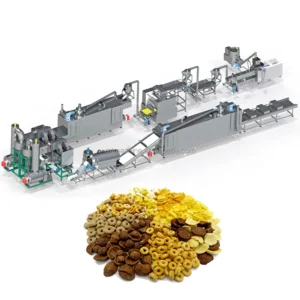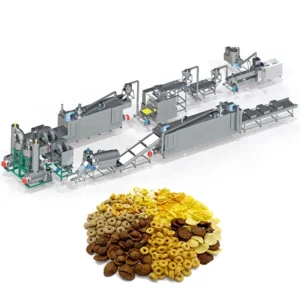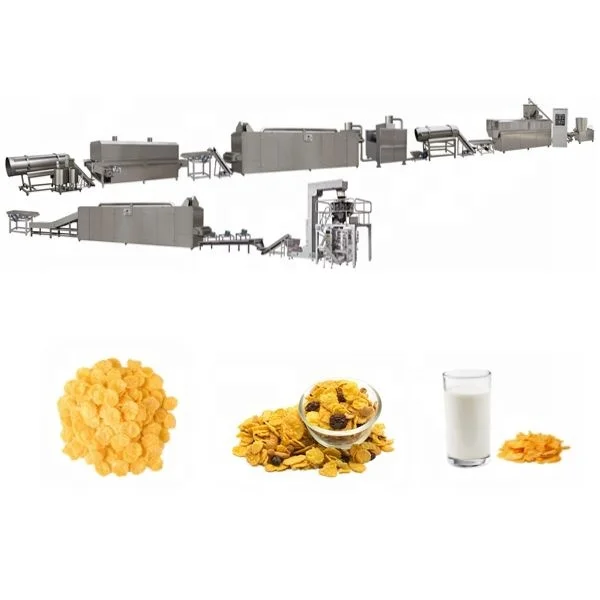
Co-rotating twin-screw extrusion — screw configuration and barrel zones matched to your degerminated corn particle size, verified in our testing workshop before any MT65, MT70, or MT85 line ships.
Technical Specifications
| Parameter | Value |
|---|---|
| Product Type | Twin Screw Corn Flakes Extrusion Production Line |
| Model Options | MT65 / MT70 / MT85 |
| Screw Type | Co-rotating twin screw, sectional modules |
| Screw Material | 38CrMoAL alloy, nitriding process |
| MT65 Installed Power | 70 kW |
| MT65 Real Power | 40 kW |
| MT65 Output | 100–150 kg/h (basis not stated in source — confirm raw material formulation and moisture content) |
| MT65 Dimension | 20000 × 1200 × 2200 mm |
| MT70 Installed Power | 100 kW |
| MT70 Real Power | 70 kW |
| MT70 Output | 200–240 kg/h (basis not stated in source — confirm raw material formulation and moisture content) |
| MT70 Dimension | 25000 × 1500 × 2200 mm |
| MT85 Installed Power | 200 kW |
| MT85 Real Power | 150 kW |
| MT85 Output | 300–400 kg/h (basis not stated in source — confirm raw material formulation and moisture content) |
| MT85 Dimension | 30000 × 3500 × 4300 mm |
| Motor | SIEMENS (China) |
| Inverter | Delta |
| Feeding System | Food-grade stainless steel twin screw feeder, speed-adjusted converter |
| Gearbox | Automatic lubrication function |
| Cutting System | Rotary cutting by V-belt drive, knife fixed in die head seat |
| Dryer Type | Multilayer mesh dryer (electric or steam options) |
| Dryer Temperature Range | 0–200 °C |
| Dryer Options | 3-layer 5 m, 5-layer 5 m, 5-layer 7 m, 5-layer 8 m, 7-layer 8 m, 5-layer 11 m (steam) |
| Corn Flakes Press Machine Power | 16.12 kW |
| Corn Flakes Press Machine Roller | 510 × 310 × 1050 mm |
| Corn Flakes Press Machine Size | 1550 × 1300 × 2000 mm |
| High-Temperature Oven Size | 4.5 × 1.4 × 1.8 m |
| High-Temperature Oven Power | 3.75 kW |
| High-Temperature Oven Heating | Gas, both-side baking system |
| Sugar Spraying System Power | 28.75 kW |
| Sugar Spraying System Dimension | 4000 × 1900 × 1880 mm |
| Sugar Spraying System Roller | Ø600 × 2700 mm |
| Mixer Output | 10–30 kg/load |
| Mixer Power | 4 kW |
| Mixer Tank Size | Ø600 × 500 mm |
| Mixer Dimension | 1000 × 800 × 1200 mm |
| Screw Conveyor Power | 0.75 kW |
| Screw Conveyor Dimension | 2700 × 500 × 2400 mm |
| Line Stations | Mixer, screw conveyor, twin-screw extruder, corn flakes press machine, hoister, multilayer dryer, high-temperature oven, sugar spraying system, sifter, cooling conveyor, packing machine |
| Raw Materials | Corn powder, cereal powder, soybean powder, rice, wheat, oat, rye, and other grains |
| Assembly State | Complete production line |
| Standards | CE, ISO |
| Warranty | 1 year |
Application Suitability
| Application | Material or Output |
|---|---|
| Breakfast cereal corn flakes | Maize grits, degerminated corn |
| Multi-grain flakes | Rice, wheat, oat, rye blends |
| Sugar-coated corn flakes | Maize base with sugar spraying |
| Salt-flavored flakes | Maize or cereal powder with seasoning |
| Extruded grain snacks | Soybean powder, mixed cereal formulations |
Why Corn Flake Density Fails Before the Line Even Ships
Pellet density is locked in by screw configuration and barrel zone temperatures — if those are set on standard maize grits while your raw material is a different particle size, the flakes will never hit market spec.
I have watched trial runs on breakfast cereal lines produce flat, lifeless pellets simply because the screw pitch and kneading block arrangement were copied from a generic build. The buyer’s degerminated corn had a finer grind than the reference material, which meant the residence time inside the barrel was too short for proper starch gelatinisation. By the time those pellets reached the corn flakes extrusion machine specifications sheet, nothing matched. The press rolled them into thin, brittle discs that sank in milk [NEED_CITE: starch gelatinisation temperature thresholds for maize and multi-grain blends].
When corn flakes extrusion machine specifications are quoted without tying the screw profile to the buyer’s actual feedstock, the entire downstream sequence — pressing, drying, baking — operates on the wrong pellet geometry. That is how a line rated at a given capacity ends up running far below it during real production.
How Co-Rotating Screws Shape the Pellet
The co-rotating twin-screw design in the MT65, MT70, and MT85 uses sectional modules that can be rearranged along the shaft to create distinct barrel zones for forward transport, mixing, de-gassing, cooking, and forming. Each zone applies a different level of shear and temperature to the material. For corn flakes, the goal is controlled gelatinisation: enough thermal and mechanical energy to swell the starch granules without over-expanding the pellet before it reaches the die. The corn flakes extrusion machine specifications for screw L:D ratio and module sequence directly determine whether that balance is achieved.
Barrel Zone Temperatures and Moisture Control
Temperature profiling across the barrel sections works in concert with moisture content and optional steam injection. Higher moisture lowers the gelatinisation onset temperature, which changes how aggressively the kneading blocks need to shear the dough. On multi-grain formulations containing oat or rye, the lipid and fibre content shifts the thermal behaviour further. The 38CrMoAL nitrided screws handle these variations without accelerated wear, and their self-cleaning geometry reduces material carryover when switching between maize and mixed-grain batches [NEED_CITE: twin-screw extrusion barrel temperature profiling for cereal processing].
Reading the Press, Dryer, and Oven Parameters
The corn flakes press machine uses a 510 × 310 mm roller set with adjustable gap to flatten extruded pellets into uniform flakes. Press power at 16.12 kW is adequate for continuous throughput at all three extruder scales. Downstream, the multilayer mesh dryer operates across 0–200 °C and is available in configurations from 3-layer 5 m up to 5-layer 11 m steam-heated units — the correct choice depends on extruder output and the moisture level leaving the press. The gas-fired high-temperature oven at 3.75 kW uses a both-side baking system to develop crispness uniformly, which is essential for the flake texture that breakfast cereal markets expect.
What Happens When Dryer Capacity Does Not Match Extruder Output
An undersized dryer creates a bottleneck that forces the extruder to idle or run below its configured throughput. On cereal flake lines, the moisture content leaving the press is high enough that insufficient drying time produces flakes with uneven internal moisture. Those flakes then crack during oven baking or go soft within days of packing. I have seen lines where the extruder and press were correctly specified, but the dryer was selected one tier too small — the result was a production rate far below what the buyer had planned for [NEED_CITE: moisture equilibrium requirements for breakfast cereal shelf stability].
Why This Line Is Built Around Your Feedstock
Screw configuration and die design are specified to the buyer’s raw material blend and target flake density, not pulled from a generic catalogue. Every MT65, MT70, or MT85 setup runs a trial on the customer’s actual grain formulation in the testing workshop before the configuration is locked. Throughput is matched across every station — mixer output, extruder capacity, press speed, dryer length, and oven dwell time — so no single station bottlenecks the rest. The co-rotating twin-screw platform covers applications from pure maize corn flakes through multi-grain and soy-blended formulations without requiring a different machine class. Electrical schematics and voltage are confirmed against the destination market before production begins, avoiding commissioning delays on site.
Documentation & Verification
- Screw and die configuration record matched to your grain blend and target pellet density
- Trial run report on your actual raw material conducted in the testing workshop before dispatch
- Line layout and capacity calculation confirming throughput balance across all stations
- Electrical schematic with voltage and frequency confirmed for your destination market
- CE declaration of conformity and ISO certificate included with shipment
- Operation and maintenance manual with wear parts list for screws, dies, and cutting knives
Installation, Commissioning & Support
- Foundation and floor space planning based on MT65, MT70, or MT85 line dimensions and station count
- Dedicated power circuit sizing for extruder installed power up to 200 kW plus dryer and oven loads
- Assembled line stations shipped in sections with on-site reassembly and alignment of press rollers
- First-run parameter setting for barrel zone temperatures, screw speed, and dryer dwell time
- Operator training on screw module changeover and die cleaning procedures for batch switches
- Wear parts supply schedule for 38CrMoAL screws, die plates, and rotary cutting knives
Preparing Your Line Inquiry
To configure the right twin-screw setup, share your raw material type, particle size, and moisture content along with the target flake thickness and crispness level. Include your planned daily output so the extruder model, dryer length, and oven capacity can be balanced as one system. Specify the local voltage, frequency, and preferred control language for the electrical cabinet.
Frequently Asked Questions
Q: How is screw configuration and die design specified for my raw material?
A: We start with your grain formulation, particle size distribution, and target flake density. The screw module sequence — transport, kneading, de-gassing, and metering sections — is arranged to match the gelatinisation behaviour of your specific blend. Die aperture is then selected to produce pellets that press into the correct flake thickness. This configuration is validated in a trial run on your actual material before shipment.
Q: What is the barrel zone temperature profile across the MT65, MT70, and MT85?
A: Each model uses multiple independently controlled barrel zones with heating and cooling capability. The exact temperature profile depends on your raw material and moisture content. During the trial run, we document the profile that produces correct pellet density and include it in the configuration record shipped with the line.
Q: How does moisture content affect gelatinisation and final flake texture?
A: Moisture lowers the onset temperature for starch gelatinisation and changes how the kneading blocks shear the dough. Too little moisture leaves ungelatinised cores that produce hard, gritty flakes. Too much moisture causes over-expansion at the die, resulting in fragile pellets that shatter during pressing. We confirm the correct moisture range during the pre-shipment trial run.
Q: Can a trial run on my raw material be done before shipment?
A: Yes. Every line runs a trial on the buyer’s actual grain formulation in our testing workshop. The trial run report covers pellet geometry, density, moisture content after extrusion, and pressing results. Any screw or die adjustments needed are made and documented before the machine is packed for dispatch.
Q: How are dryer and oven parameters matched to extruder throughput?
A: Dryer length and layer count are selected based on the moisture load leaving the press and the extruder output rate. The gas oven dwell time is set so that both-side baking achieves uniform crispness without over-drying. Capacity calculations across all stations are documented in the line layout to confirm no bottleneck exists.