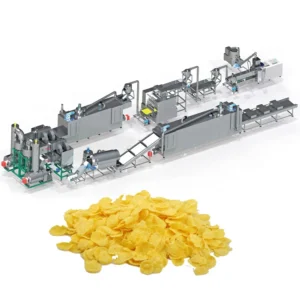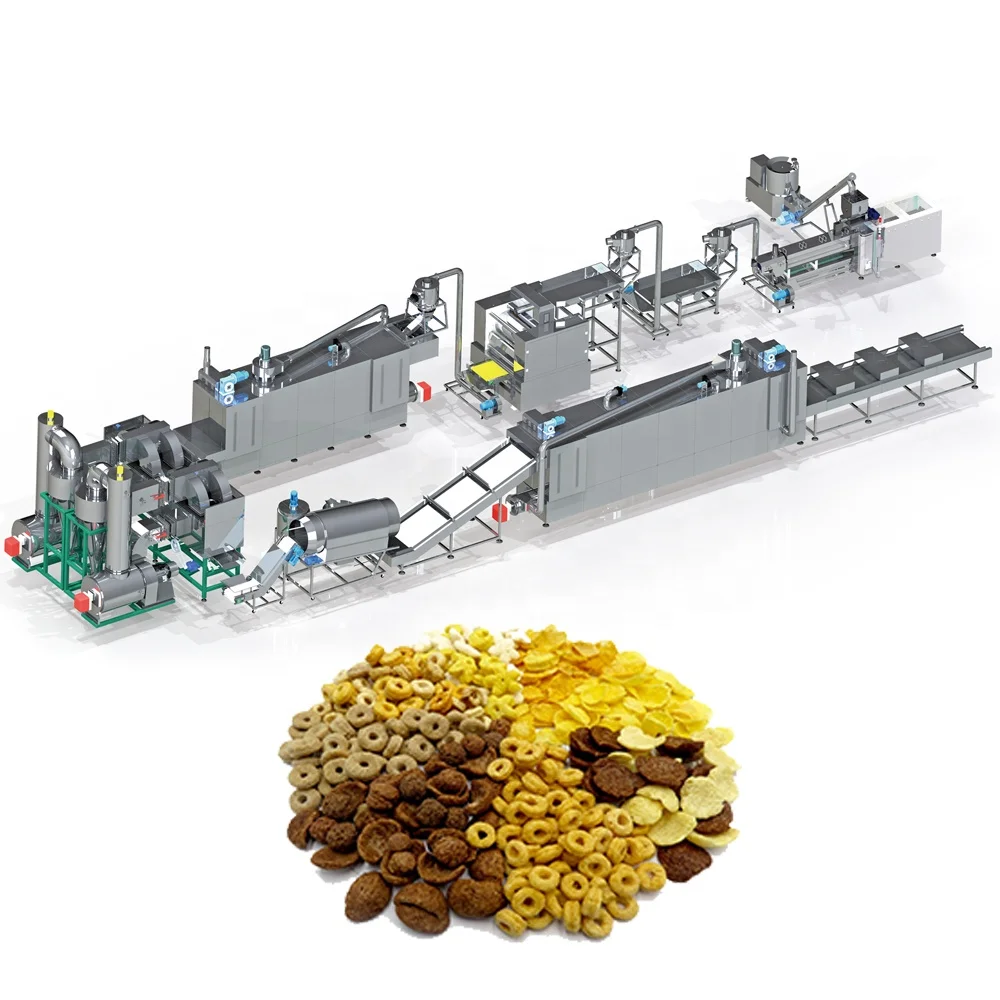
Precision screw configuration matched to raw material behaviour — on this line, the twin-screw extrusion parameters are specified against the buyer’s actual corn flour moisture and particle size before production begins.
Technical Specifications
| Parameter | Value |
|---|---|
| Model | MT75 |
| Product Type | Corn Flakes Processing Line |
| Extruder Type | Twin Screw |
| Installed Power | 210 kW |
| Power Consumption | 150 kW |
| Output Capacity | 300–500 kg/hr (basis not stated in source — confirm raw material and moisture content) |
| Overall Dimensions (L×W×H) | 45 × 1.5 × 3.5 m |
| Control System | PLC (flaking machinery); MCC line control |
| Screw Feature | Automatic lubricating and cooling function |
| Flaking Machinery Drive | Double motors for separate roller driving; hydraulic system for double rollers |
| Flaking Temperature Control | Infrared sensor |
| Dryer Heating Source | Gas / Electric |
| Roasting Oven | Hot air roasting with conciliation burner, two separate circulating fans, cyclone dust removal |
| Coating System | Double tumble for sugar melting, elevator, coating drum, spraying nozzle |
| Assembly State | Complete turnkey line |
| Certification | CE, ISO |
Application Suitability
| Application | Material or Output |
|---|---|
| Natural corn flakes production | Corn grits and corn flour |
| Sugar-coated corn flakes | Corn base with sugar glaze coating |
| Variant-shaped breakfast cereals | Corn, rice, wheat, oat, barley powder |
| Multi-grain cereal shapes (ball, tube, ring, star, wheel, flower, heart) | Mixed grain formulations |
Why Corn Flakes Density Fails Before the Product Reaches the Bowl
Starch gelatinisation inside the barrel determines whether your flakes survive packing or crumble into dust.
A screw and die setup copied from a generic build ignores what happens when corn flour with higher moisture enters the extruder. The shear drops, expansion stalls at the die face, and the pellets arrive at the flaking rolls too dense to blister properly in the roasting oven. I have seen lines where the output looked acceptable during a short test run but produced rock-hard flakes once continuous production stabilised and barrel heat soaked through [NEED_CITE: starch gelatinisation temperature thresholds for corn-based extrusion]. The twin screw corn flakes processing approach on the MT75 addresses this by matching screw element sequencing to the specific gelatinisation window of the buyer’s corn variety.
Barrel Temperature Profile and Starch Gelatinisation Control
Corn starch gelatinises within a narrow temperature band, and the barrel zones on the MT75 are heated independently so the profile can be adjusted section by section. The corn flakes extrusion technology here relies on holding moisture and heat long enough for complete gelatinisation without pushing the dough past the point where it loses elasticity at the die face. When the profile is right, the extrudate exits with uniform cell structure, which is the foundation for consistent flake thickness downstream.
Die Geometry and Its Effect on Flake Expansion
The die opening shape and land length directly govern how much the extrudate expands as pressure releases. A die designed for a different product family will produce pellets that either over-expand and shatter during flaking, or under-expand and resist flattening into proper flakes. On this line, die design is specified against the target corn flakes corn flakes extrusion technology parameters, including the buyer’s corn flour particle size distribution and moisture content entering the conditioner. The in-house testing workshop runs the actual raw material before the line ships [NEED_CITE: die land length influence on extrudate density in twin-screw systems].
What the Specifications Mean for Continuous Production
The 210 kW installed power supports the torque demand of pushing corn dough through a twin-screw configuration at sustained throughput, while the 150 kW consumption figure reflects what the line draws under typical operating load. Automatic screw lubricating and cooling prevents barrel temperature drift during long shifts — a factor that matters when corn starch is sensitive to even minor thermal variation. The flaking station uses double motors with separate roller driving and hydraulic pressure, so roll gap stays constant as the rollers wear. Infrared temperature control on the flaking rolls prevents the dough sheet from sticking or tearing. The roasting oven runs two circulating fans with a cyclone dust removal device, which keeps fine corn particles from scorching and contaminating the batch. Downstream, the double tumble coating system handles sugar melting and spraying for glazed variants, while the PLC and MCC control architecture keeps every station synchronised so the extruder output never outpaces the dryer or roaster.
The Cost of Ignoring Screw Configuration for Your Corn Variety
When the screw elements are arranged for a generic recipe, the corn dough either receives insufficient shear and exits under-gelatinised, or excessive shear burns the starch and produces dark specks in the final flake. Both outcomes lead to product that fails texture tests and cannot be sold under a breakfast cereal label. Flakes that are too dense sink in milk and draw consumer complaints, while fragile flakes break during transport [NEED_CITE: cereal flake density and bowl-life crispness standards]. Re-configuring the screw after installation means production downtime, wasted raw material, and delayed market entry.
Why Procurement Here Reduces Commissioning Risk
The screw configuration and die design are specified to the buyer’s raw material before the line is built, not selected from a catalogue. Throughput is balanced across every station — extruder, flaker, dryer, roaster — so no single unit becomes the bottleneck once the line runs continuously. An in-house testing workshop conducts trial runs on the buyer’s actual corn flour before shipment, generating a report that confirms expansion, flake density, and roasting behaviour. Voltage, frequency, and PLC/HMI language are confirmed against the destination site during the specification phase, preventing commissioning delays. The line layout is designed to the buyer’s factory dimensions, so utility connections and material flow paths are resolved before equipment arrives.
Documentation & Verification
- Screw and die configuration record matched to your corn flour particle size and moisture content
- Trial run report on your raw material from the in-house testing workshop before dispatch
- Line layout and capacity calculation showing throughput balance across all stations
- Electrical schematic with voltage, frequency, and PLC language confirmed for your site
- CE declaration of conformity and ISO certificate for export compliance
Installation, Commissioning & Support
- Foundation must support the 45 m line length with level tolerance for flaking roll alignment
- Dedicated 210 kW power circuit with voltage and frequency matching confirmed before production
- Line arrives in modular sections; flaking and roasting stations require on-site assembly and calibration
- First production run includes barrel temperature profiling and screw speed adjustment to your corn flour
- Operator training covers PLC interface navigation, flaking roll gap adjustment, and roasting oven fan balance
- Wear parts list includes screw elements, die plates, and flaking roller surfaces with replacement intervals
Before You Request a Quote
Send your corn flour specification sheet including moisture content and particle size distribution, along with the target flake dimensions and whether you need natural or sugar-coated output. Confirm your factory floor length and ceiling height, the available voltage and frequency at your site, and the preferred PLC/HMI operating language. If you have existing upstream milling or downstream packing equipment, share the interface requirements so the line layout accounts for them.
Frequently Asked Questions
Q: How is screw configuration selected for corn versus oat or multi-grain cereal recipes?
A: Each grain has a different starch gelatinisation temperature and fibre content that affects how the dough behaves under shear. The screw element sequence — conveying, kneading, and reverse elements — is arranged to match the specific grain blend. For corn, the configuration prioritises complete gelatinisation within the barrel residence time, while oat-heavy recipes require different moisture handling and kneading intensity to prevent gumminess at the die face.
Q: What barrel temperature range drives proper starch gelatinisation for corn flakes?
A: Corn starch typically gelatinises between 62°C and 72°C, but the barrel zones must deliver enough thermal energy to account for moisture evaporation and shear-generated heat. The independent zone heating on the MT75 allows each section to be tuned so gelatinisation completes before the die, without overheating the outer layer of the extrudate. The exact profile is established during the trial run on your specific corn flour.
Q: How do flaking roll pressure and temperature affect final flake thickness and crispness?
A: Roll gap determines flake thickness, while roll surface temperature controls whether the dough sheet releases cleanly or tears. The hydraulic drive on this line maintains constant pressure even as the rollers wear, and the infrared sensor monitors surface temperature continuously. Flakes that are too thick remain chewy after roasting, while overly thin flakes shatter during packing and transport.
Q: What does the trial run on customer raw material cover before shipment?
A: The testing workshop runs your actual corn flour through the extruder at production screw speed and barrel temperatures, then passes the pellets through the flaking rolls and a sample roasting cycle. The report documents expansion ratio, flake density, surface blistering after roasting, and bowl-life texture. Any screw or die adjustments needed are made before the line is packed.
Q: How is dryer and roasting oven capacity matched to extruder output?
A: The line layout calculation balances the extruder output against the dryer belt residence time and the roasting oven volume so no station accumulates backlog. If the extruder produces at the upper range, the dryer and roaster must have sufficient capacity to handle that throughput without reducing dwell time below what is needed for proper moisture removal and surface blistering.