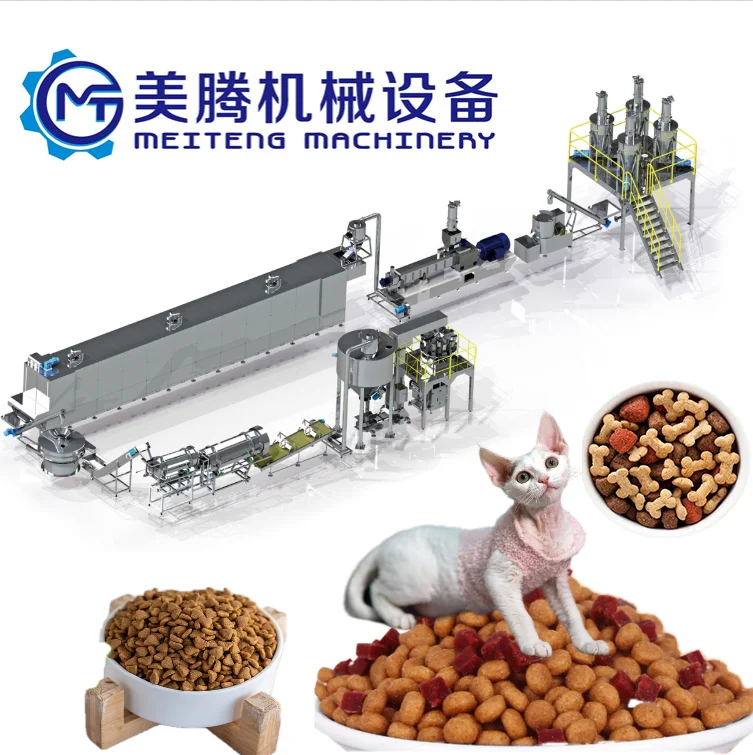
Screw Configuration Matched to Your Formula — Every MT70 build starts with a trial run on your actual raw material, adjusting screw element arrangement and die geometry until expansion, density and texture hold within your target kibble specification.
Technical Specifications
| Parameter | Value |
|---|---|
| Model | MT70 |
| Product Type | Twin Screw Pet Food Extrusion Line |
| Output Capacity | 100–200 kg/h (basis not stated in source — confirm raw material formulation, moisture content and kibble size) |
| Screw Type | Twin Screw |
| Voltage & Frequency | 380V 50Hz Three Phase (configurable to facility supply) |
| Control System | PLC / MCC (available with either option) |
| Line Stations | Mixing → Extrusion → Drying → Packaging |
| Assembly State | Complete production line |
| Certification | CE, FDA |
Application Suitability
| Application | Material or Output |
|---|---|
| Dry kibble production for dog and cat | Corn, rice, wheat, meat meal, fish meal blends |
| Semi-moist pet food formulations | High-moisture dough with glycerin and meat slurry |
| Pet treat extrusion | Starch-protein mixes with fiber inclusions |
| Alternative recipe trials | Cassava, sorghum, potato starch and legume-based formulas |
Why Nominal Capacity Figures Fail on Your Raw Material
The extruder must be configured to your specific formulation, not to a generic test grain.
A twin screw pet food extrusion line technology quoted at a headline throughput number often falls short once the buyer’s actual recipe enters the barrel. Different starch sources gelatinise at different temperatures and moisture thresholds. A screw profile tuned for pure corn may underperform on a cassava-dominant blend, producing kibble that collapses or fails to reach the target expansion ratio. I have watched lines sit idle for days while engineers swapped screw elements and adjusted barrel zone temperatures to recover output [NEED_CITE: starch gelatinisation temperature ranges across common pet food grains]. The MT70 avoids this by running your material in our testing workshop before the line ships.
Barrel Temperature Profiling for Controlled Gelatinisation
The MT70 barrel is divided into multiple independently heated and cooled zones, allowing the process engineer to set a precise temperature gradient from feed inlet to die face. Starch gelatinisation in pet food formulations typically requires a specific thermal window that shifts depending on the grain source and moisture level. Too low a temperature leaves raw starch in the kibble core; too high scorches the product and accelerates screw wear. The twin screw pet food extrusion line technology on the MT70 lets you dial in each zone to match the gelatinisation curve your formulation demands.
Screw Element Arrangement and Shear Management
Twin screw extrusion relies on the interplay between conveying elements, kneading blocks and reverse-screw sections to control residence time and shear intensity. A high-shear kneading block placed too early can fracture protein structures before they have fully hydrated, reducing the textural bite that premium kibble requires. The MT70 screw configuration is built element by element after reviewing your raw material particle size, fat content and target kibble density [NEED_CITE: twin screw element configuration principles for food extrusion]. This means a formulation heavy in meat meal receives a different screw build than one based primarily on cereal grains.
Reading the Specs That Actually Matter
The L:D ratio of the barrel determines how long material stays inside the extrusion zone — a longer ratio gives more residence time for thorough starch cooking and protein texturisation, which is essential when working with high-fiber or legume-based recipes. The 380V 50Hz three-phase supply is standard, but voltage must be confirmed against your facility before production begins; running a 50Hz motor on 60Hz power alters screw RPM and shifts the entire shear profile. The PLC or MCC control choice affects how recipes are stored and recalled: PLC allows parameter logging and batch-to-batch repeatability, while MCC offers simpler relay-based operation. Die selection directly governs kibble shape and the expansion ratio after the product exits the barrel — a die with smaller orifices increases back-pressure and typically yields denser kibble.
The Cost of Skipping a Pre-Shipment Trial
When an extrusion line arrives at the factory without having processed the buyer’s actual raw material, the commissioning period stretches from days into weeks. Screw elements must be reordered, barrel temperatures re-mapped and die plates re-cut — all while production schedules slip. In one West African installation I supported, the local kibble recipe used a cassava-to-corn ratio unlike anything in our standard test library, and the initial generic screw build produced flat, under-expanded pellets. Four days of on-site adjustment followed [NEED_CITE: typical commissioning delays from mismatched extrusion configurations]. A pre-shipment trial on your exact formulation eliminates that risk.
Why Source This Line From Meiteng
The MT70 is built as a matched system from batching through packaging, so throughput at each station is balanced rather than bottlenecked by an undersized dryer or conveyor. Screw and die configurations are documented specifically for your formulation, not copied from a generic template. An in-house testing workshop allows us to run your raw material and record expansion ratio, kibble density and output rate before the line is crated. The PLC and MCC control options are wired and labelled in the language your operators read. Wear parts — screws, dies, barrel liners — are catalogued and stocked so the first replacement set is ready when you need it.
Documentation & Verification
- Line layout drawing showing station spacing and utility connection points for the MT70
- Screw and die configuration record matched to your specific kibble formulation
- Trial run report on your raw material documenting expansion ratio and output rate
- Electrical schematic confirming voltage, frequency and control language for your facility
- CE declaration of conformity covering the full MT70 line assembly
Installation, Commissioning & Support
- Foundation plan with load points and leveling requirements for the MT70 frame
- Dedicated circuit specification matching the 380V three-phase motor and heating zones
- Barrel and screw assembly sequence for on-site reassembly after transit
- First-run parameter log covering barrel temperatures, screw speed and feed rate
- Operator training on PLC recipe storage and die changeover procedure
- Wear parts list with screw element and die plate reorder codes
What We Need From You to Move Forward
Share your target kibble size, shape and density range along with the primary starch and protein sources in your formulation. Confirm your facility voltage and frequency so the MT70 motor and heating elements are wound correctly. Let us know your available floor space and ceiling height so the line layout fits your building without rework. If you can send a sample batch of your raw material, we will run a trial and return the test data with our proposal.
Frequently Asked Questions
Q: How is screw configuration selected for my raw material and target kibble density?
A: We review your formulation’s starch type, protein level, fat content and particle size, then assemble the screw shaft with specific conveying and kneading elements. A trial run on your actual material confirms the configuration, and we document the final element layout so you can replicate it on every production run.
Q: What barrel temperature profile is needed for proper starch gelatinisation in pet food?
A: The profile depends on your grain source. Corn-based recipes typically need a different thermal gradient than cassava or rice blends. The MT70 barrel zones are independently controlled, and we establish the correct gradient during the pre-shipment trial on your raw material.
Q: How do I verify that the stated output capacity applies to my specific formulation?
A: The 100–200 kg/h range is a starting reference; actual throughput depends on your recipe’s moisture content, kibble size and density target. We confirm real output during the trial run on your material and record it in the test report before shipment.
Q: Can I run a trial on my own raw material before the line ships?
A: Yes. Send us a representative sample of your formulation and we process it through the MT70 in our testing workshop. You receive a report covering expansion ratio, kibble density, output rate and the specific screw and die configuration used.
Q: How does die design affect expansion ratio and final product density?
A: Die orifice diameter, land length and pattern determine back-pressure inside the barrel and how much the product expands as it exits. We select the die plate based on your target kibble shape and density, verified during the pre-shipment trial.