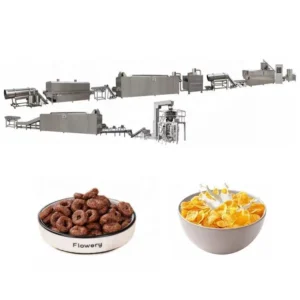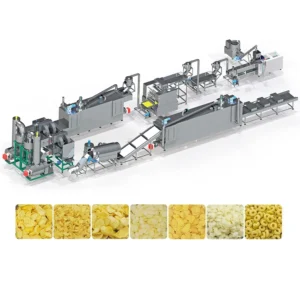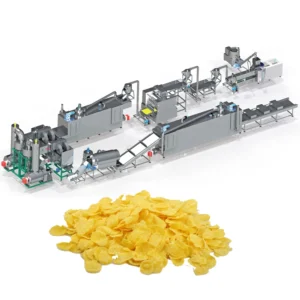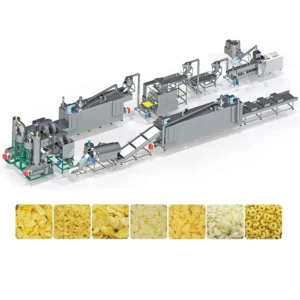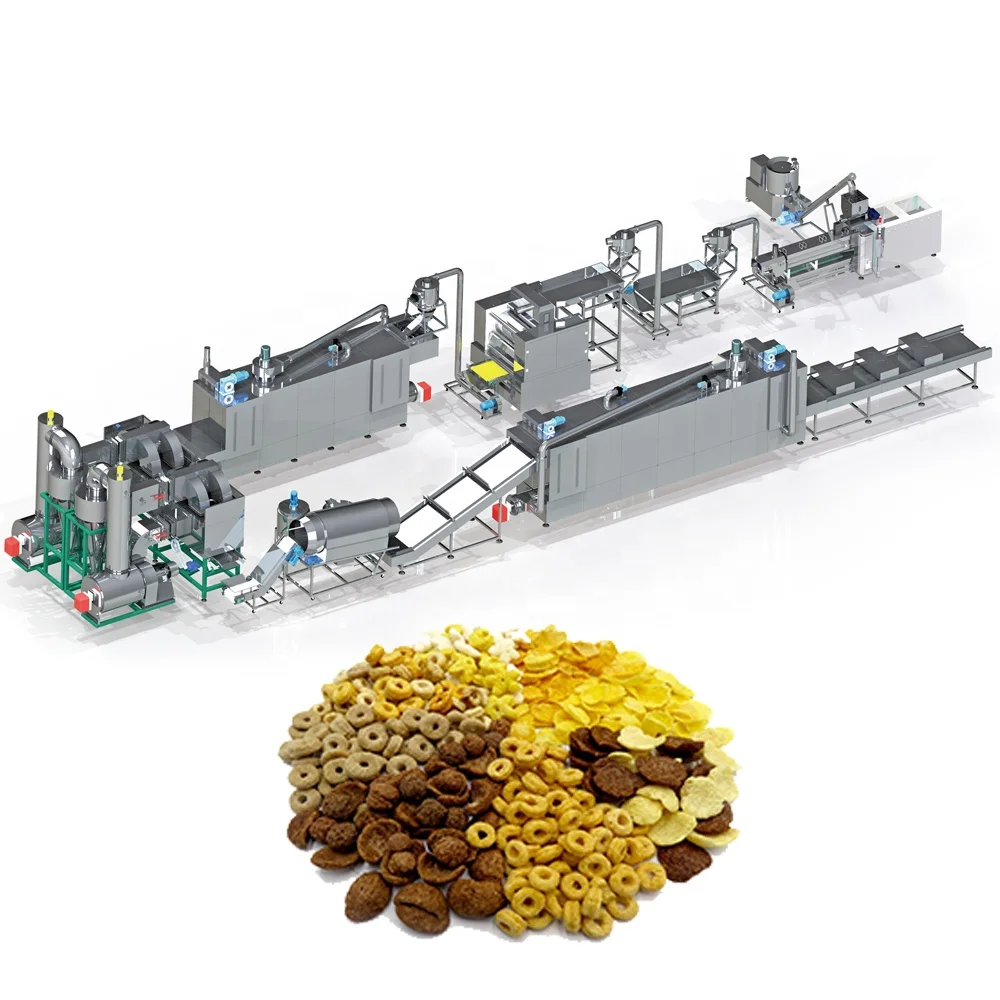
Thermodynamic control inside the barrel — Every zone of the twin-screw extruder is mapped so that starch gelatinisation and moisture reduction happen exactly where the flake profile requires them.
Technical Specifications
| Parameter | Value |
|---|---|
| Product Type | Breakfast Cereal Corn Flakes Processing Line |
| Extruder Model | MT-65 Double Screw Extruder |
| Screw Configuration | Co-rotating twin screw, sectional modules |
| Mixer Tank Capacity | φ600 × 500 mm |
| Mixer Motor Power | 4 kW |
| Screw Conveyor Motor Power | 0.75 kW |
| Corn Flakes Press Machine Power | 16.12 kW |
| Press Machine Roller Size | 510 × 310 × 1050 mm |
| High-temperature Oven Dimensions | 4.5 × 1.4 × 1.8 m |
| High-temperature Oven Heating Source | Gas-fired, both-side baking system |
| Sugar Spraying System Total Power | 28.75 kW |
| Sugar Spraying Roller Size | Ø600 × 2700 mm |
| Contact Material | Stainless steel (food-contact parts) |
| Certification | CE |
Application Suitability
| Application | Material or Output |
|---|---|
| Traditional corn flakes production | Maize flour, corn grits, sugar or salt flavour profiles |
| Fortified breakfast cereals | Multi-grain flour blends with added vitamins and minerals |
| Multi-shape puffed cereal snacks | Rice, oat, and wheat powders using interchangeable moulds |
| Leisure snack flakes | Honey-coated or sugar-coated grain extrudates consumed dry |
What "Rated Capacity" Leaves Out About Corn Flakes Extrusion
A number on a brochure means nothing if the screw configuration and barrel profile were never tested against your actual grain blend.
I have stood in humid production halls where the extruder was pushing out pellets that looked right but lacked the internal starch gelatinisation needed for a proper flake. The flakes tore during pressing or turned to mush in milk. This happens when a machine is selected on nominal throughput rather than on how the twin-screw geometry handles a specific corn flour’s moisture and fat content. The corn flakes extrusion technology breakfast cereal market demands is unforgiving: a fraction of a degree in barrel temperature or a slight change in screw element spacing shifts the texture entirely [NEED_CITE: starch gelatinisation temperature thresholds in cereal processing].
Managing Shear, Moisture, and Residence Time
The MT-65 co-rotating twin-screw setup uses sectional modules so that forward transport, mixing, de-gassing, and cooking zones can be adjusted independently. This matters because corn grits and multi-grain blends behave differently under shear. A longer residence time in the conditioning zone might gelatinise oat starch completely while leaving maize starch undercooked, leading to uneven expansion at the die. The corn flakes extrusion technology breakfast cereal producers rely on must be tuned to the exact grain ratio, which is why modular screw elements exist in the first place.
The Die Face and Pellet Geometry
When the cooked mass exits the die, the shape and size of each pellet dictates how evenly it will flatten under the press rollers. A die with too many apertures might exceed the press machine’s capacity, causing pellets to pile up and cool before they are flattened. That cooling alters the moisture gradient inside the pellet, so the resulting flake cracks rather than flattening into a uniform sheet. Getting the die design right is a balancing act between the extruder’s output and the downstream flaking press throughput.
Breaking Down the Line’s Core Parameters
The 4 kW mixer handles batches within its φ600 × 500 mm tank, ensuring dry flour and water are blended before entering the screw conveyor. Consistent pre-mixing prevents dry pockets that cause erratic extrusion behaviour. Downstream, the flaking press draws 16.12 kW to drive its 510 × 310 × 1050 mm rollers, which feature an adjustable gap to set flake thickness precisely. After pressing, the gas-fired high-temperature oven uses its both-side baking system across its 4.5-meter length to draw moisture out evenly, which is critical for achieving the snap and crispness that breakfast cereal consumers expect [NEED_CITE: moisture reduction rates in continuous cereal drying]. The sugar spraying system, with its 28.75 kW total draw and Ø600 × 2700 mm temperature-keeping roller, maintains syrup viscosity so the coating adheres uniformly without clumping.
The Cost of Skipping Configuration Alignment
Buyers sometimes assume that an extrusion line configured for one grain will handle another with a simple recipe change. In reality, switching from a low-fat maize flour to a high-fibre oat blend alters the friction and heat generation inside the barrel. If the screw modules are not reconfigured and the barrel temperature profile is not adjusted, the pellets exit with inconsistent density. The press then produces flakes of varying thickness, and the oven dries some to a brittle snap while leaving others chewy [NEED_CITE: impact of fibre content on twin-screw extrusion behaviour]. Sorting out these defects after installation is far more disruptive than running a proper material trial beforehand.
Why This Extrusion Partner Works
Every line is built from the batching station through to the cooling conveyor under a single supplier, meaning throughput is matched at every point rather than patched together from independent vendors. The screw configuration and die design are specified against your actual grain blend, not copied from a generic template. Before shipment, raw material trial runs are conducted in the in-house testing workshop to verify that starch gelatinisation, expansion, and flake density meet your target specification. The entire system uses food-grade stainless steel on all contact surfaces and carries CE certification for machinery safety compliance. Electrical schematics are confirmed for your facility’s voltage and frequency before production begins, preventing commissioning delays [NEED_CITE: industrial voltage and frequency standards across export markets].
Documentation & Verification
- Line layout and throughput calculation showing station-by-station capacity matching
- Screw and die configuration record mapped to your grain blend and target flake density
- Trial run report on your raw material executed before shipment
- Electrical schematic with voltage, frequency, and control language confirmed for your market
- Operation and maintenance manual with wear parts list specific to your line configuration
Installation, Commissioning & Support
- Foundation and floor space planning based on the 4.5 m oven and full line footprint
- Dedicated electrical circuits sized for the 28.75 kW sugar spraying system and 16.12 kW flaking press
- Barrel and screw module assembly aligned and verified during on-site commissioning
- Initial temperature profile and roller gap calibration using your raw material
- Operator training covering screw element changes and die maintenance procedures
- Wear parts list provided for screws, dies, and press roller surfaces
Starting Your Corn Flakes Line Inquiry
To specify this line correctly, we need your primary grain types, their typical moisture content, and whether you intend to run fortified blends with added vitamins or minerals. Share your target flake thickness, whether the end product will be sugar-coated or sold plain, and the local voltage and frequency at your facility. If you have existing upstream milling or downstream packing equipment, provide those specifications so the line interfaces are confirmed before fabrication.
Frequently Asked Questions
Q: How is the screw configuration chosen for different grain blends?
A: Each grain has a unique starch gelatinisation temperature and fibre-to-starch ratio. We select and arrange the co-rotating twin-screw modules so that mixing, cooking, and forming zones match your specific flour blend. The configuration is recorded and provided as part of your documentation package, allowing future replication or adjustment when you introduce new cereal recipes.
Q: What barrel temperature profile works best for proper starch gelatinisation?
A: The ideal profile depends on your grain blend’s moisture content and composition. Maize typically requires a different thermal curve than oat-heavy mixes. During the pre-shipment trial run in the testing workshop, we establish the barrel zone temperatures that produce complete gelatinisation without overcooking, and those settings transfer directly to your installed line.
Q: How is throughput balanced between the extruder, press, and dryer?
A: The extruder’s die aperture count and the screw speed determine pellet output rate. We then match the flaking press roller speed and the gas-fired oven conveyor pace so that pellets are flattened before they cool, and dried at a rate that prevents bottlenecking. The line layout document shows these calculations for your specific configuration.
Q: Can the line run a trial on my raw material before shipment?
A: Yes. We conduct a trial run using your actual grain flour in the in-house testing workshop. This verifies that the screw configuration, die design, and barrel temperature profile produce the flake density, texture, and expansion your market requires, and the results are documented in a trial report before the equipment leaves the factory.
Q: How is flake thickness controlled during continuous production?
A: The flaking press features adjustable roller distance, allowing precise thickness control for the 510 × 310 × 1050 mm rollers. An integrated cooling system on the press stabilises the roller surface temperature, preventing thermal expansion from altering the gap during long production runs and ensuring consistent flake geometry from the first batch to the last.