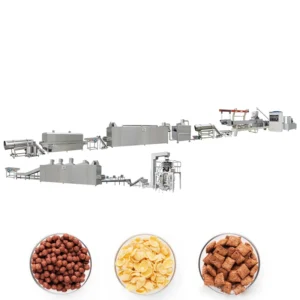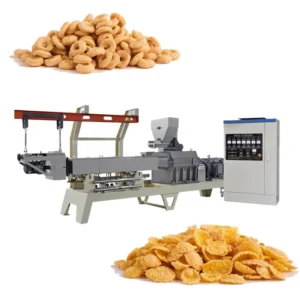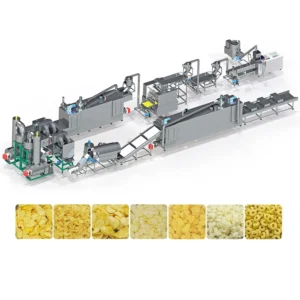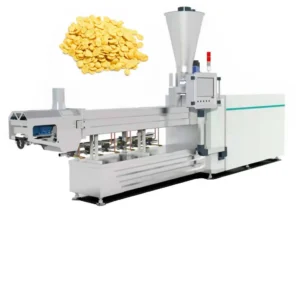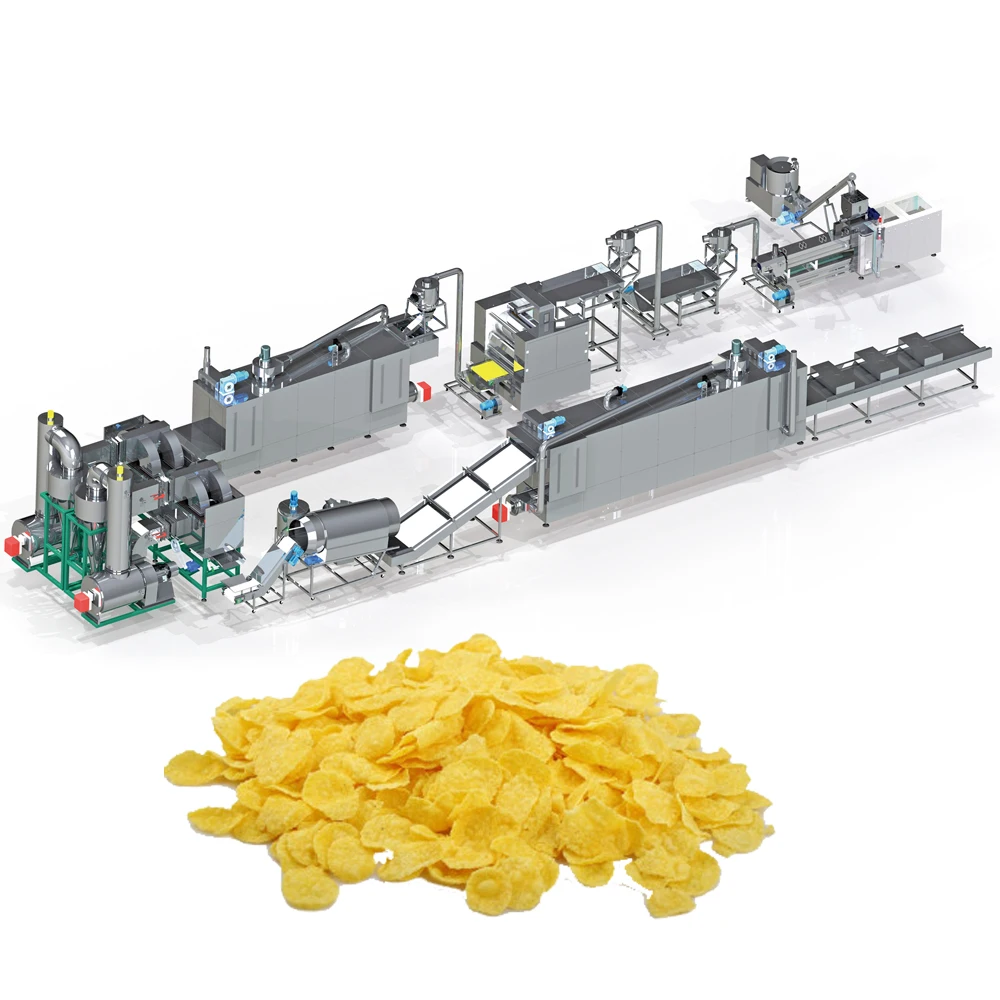
Process-Engineered Extrusion — Every MT75 corn flakes extrusion production line turnkey build begins with screw configuration and die design matched to the buyer’s actual cereal formulation, verified through in-house trial runs before shipment.
Technical Specifications
| Parameter | Value |
|---|---|
| Product Type | Corn Flakes Production Line |
| Model | MT75 |
| Available Models in Series | MT70 / MT85 / MT75 |
| Installed Power | 210 kW |
| Power Consumption | 150 kW |
| Output Capacity | 300–500 kg/h (basis not stated in source — confirm raw material, moisture content, and target flake specification) |
| Overall Dimensions | 45 × 1.5 × 3.5 m |
| Extruder Screw Type | Twin Screw |
| Control System | PLC control system (flaking machinery); MCC available |
| Basic Raw Materials | Powder of corn, rice, wheat, oat, barley |
| Flaking Machinery Drive | Double motors for separate roller driving; hydraulic system for double rollers |
| Flaking Temperature Control | Infrared sensor for even temperature pipe control |
| Roasting Oven Configuration | Hot air roasting with high-temperature spraying tubes, two separate circulating fans, cyclone dust removal device, reconciliation burner |
| Dryer Heating Source | Gas or Electric |
| Coating System | Double tumble for sugar melting, elevator, coating drum, spraying nozzle |
| Extruder Features | Automatic lubricating and cooling function; screw made by special wear-resistant technology |
| Assembly State | Complete turnkey production line |
| Line Layout | Customized according to factory size |
| Certifications | CE; ISO |
Application Suitability
| Application | Material or Output |
|---|---|
| Natural corn flakes production | Corn powder formulations for breakfast cereal markets |
| Sugar-coated corn flakes production | Corn, rice, or wheat powder with sugar spraying and coating stages |
| Mixed cereal breakfast flakes | Blends of oat, barley, wheat, and rice powder |
| Shaped breakfast cereals | Ball, tube, stick, ring, fruit loop, star, wheel, flower, and heart shapes via extruder die adjustment |
What "300 kg/h on Paper" Actually Means for Your Cereal Blend
Capacity is only meaningful when tied to your raw material, moisture level, and target flake density.
I once spent two weeks re-tuning a corn flakes line in Germany because the buyer’s own grain blend behaved completely differently from our standard test corn flour. Flake thickness went uneven, roasting colour turned dark, and the whole parameter set had to be rebuilt from scratch. That experience is why every corn flakes extrusion production line turnkey project now goes through mandatory trial runs on the buyer’s actual material before we ship [NEED_CITE: starch gelatinisation behaviour across cereal grain types]. A rated capacity figure without specifying the raw material and moisture baseline tells you very little about what will happen on your factory floor.
Screw Configuration and Barrel Profile for Cereal Starch Gelatinisation
The twin-screw extruder in this line is not built to a generic template. Screw element arrangement, barrel temperature zones, and die geometry are specified against the buyer’s cereal formulation — whether that is pure corn powder or a multi-grain blend containing oat and barley. Each cereal starch has a different gelatinisation window, and the barrel temperature profile must hold the material within that window long enough for full cooking without over-shearing the dough. This is where a corn flakes extrusion production line turnkey setup either succeeds or fails at the very first station.
Die Design and Its Effect on Flake Expansion and Surface Texture
Die aperture shape and land length directly govern how the extrudate expands as it exits the barrel. For corn flakes, the goal is a controlled, moderate expansion that produces a dense enough pellet to survive flaking without shattering, yet porous enough to develop the characteristic surface blistering during roasting. When the die is mismatched to the raw material — say, using a die designed for pure corn on a high-oat blend — the pellets emerge either too dense to toast properly or too fragile to pass through the roller gap intact [NEED_CITE: die land length influence on extrudate expansion in cereal processing]. Getting this right during the design phase prevents weeks of post-installation troubleshooting.
Reading the Specs: What the Numbers Mean for Your Production
The 210 kW installed power on the MT75 reflects the combined demand of the twin-screw extruder, flaking rollers, and roasting oven circulating fans — a figure that matters when you are planning your facility’s electrical infrastructure and dedicated circuit capacity. The hydraulic double-roller flaking system with independent dual-motor drive allows each roller to be adjusted separately, which is critical for maintaining uniform flake thickness across the full roller width when processing different grain densities. The infrared sensor temperature control on the flaking machinery keeps the roller surface within a tight band, preventing the sticking and tearing that occurs when temperature drifts. For the roasting stage, the reconciliation burner and dual circulating fans work together to maintain even heat distribution, while the cyclone dust removal device captures fine particulate before it can recirculate and cause scorching. Gas or electric dryer heating source options mean the line can be configured for whichever energy supply is economical and available at the buyer’s facility.
The Hidden Cost of Generic Extruder Builds
When a supplier copies a screw and die configuration from a standard catalogue rather than engineering it to your specific cereal blend, the problems surface gradually. Flakes may look acceptable at low throughput but crumble at target speed. Roasting colour drifts from batch to batch because the pellet density is inconsistent. The coating drum then applies sugar unevenly because the flake surface texture varies. These are not issues you fix with a parameter tweak — they require new screw elements, a new die, and sometimes a redesigned barrel sleeve [NEED_CITE: impact of screw wear on extrusion consistency in food processing]. Downtime, wasted raw material, and missed shipment deadlines add up quickly.
Why Source This Line Here
Every station from mixing through packing is supplied and throughput-matched under one build responsibility, so the dryer capacity is never a bottleneck to the extruder, and the coating drum is sized to handle the roaster’s full output. Screw configuration and die design are specified to the buyer’s raw material and target flake product, not pulled from a generic library. The in-house testing workshop runs your actual cereal formulation before shipment, generating a trial run report that confirms capacity, flake density, and roasting behaviour. Twin-screw expertise spans corn, rice, wheat, oat, and barley applications, meaning the engineering team has encountered the gelatinisation quirks of your grain blend before. Pre-sales consultation through on-site installation, commissioning, and ongoing maintenance keeps one team accountable from first inquiry to steady-state production [NEED_CITE: turnkey line accountability and single-supplier advantage].
Documentation & Verification
- Line layout and capacity calculation matched to your factory footprint and target output
- Screw and die configuration record tied to your cereal raw material specification
- Trial run report on your actual grain blend confirming flake density and expansion
- Electrical schematic with voltage, frequency, and control language confirmed before production
- CE declaration of conformity and ISO certificate for import and compliance clearance
- Wear parts list with part numbers for screws, dies, and roller sleeves
Installation, Commissioning & Support
- Line layout customised to your factory dimensions within the 45 × 1.5 × 3.5 m footprint envelope
- Dedicated electrical circuit planned around the 210 kW installed power requirement
- Complete turnkey delivery with every station assembled and tested before dispatch
- On-site parameter tuning for barrel temperature profile and roller gap on your grain blend
- Operator training covering PLC interface, hydraulic roller adjustment, and roasting oven control
- Wear parts inventory including twin-screw elements and die plates stocked for first replacement cycle
- Scheduled maintenance guidance for automatic lubricating system and infrared sensor calibration
What We Need to Configure Your Line
To move from inquiry to line configuration, share your cereal raw material specification including grain type and moisture content, your target flake density and finished product format, and your required hourly throughput on that specific formulation. We also need your facility’s available floor space and ceiling height, local voltage and frequency standard, and preferred control language. If you are running sugar-coated product, confirm your coating formulation and target sugar pickup level so the coating drum and spraying system can be sized correctly.
Frequently Asked Questions
Q: How is screw configuration and die design matched to my specific cereal raw material and target flake density?
A: Our engineering team reviews your grain formulation, starch composition, and target flake specifications to select screw element geometry, barrel zone count, and die aperture dimensions. The configuration is then validated during a trial run on your actual raw material in our testing workshop, with adjustments made before the screw and die configuration record is finalised for production.
Q: How is output capacity verified on my actual raw material rather than on a nominal rating?
A: We run your grain blend through the complete extrusion, flaking, and roasting sequence in our in-house testing workshop. The trial run report documents actual throughput, flake thickness uniformity, and roasting colour at steady state, giving you a verified capacity figure tied to your specific material and moisture level rather than a generic catalogue number.
Q: What barrel temperature profile and moisture parameters are set for starch gelatinisation on corn versus mixed cereal blends?
A: Each cereal starch gelatinises at a different temperature and moisture threshold. Pure corn requires a different barrel zone profile compared to a blend containing oat or barley. During the trial run, we map the moisture addition rate and barrel temperature gradient that achieves complete gelatinisation without over-shearing, then lock those parameters into the PLC recipe for your production runs.
Q: Can I run a trial on my raw material in your testing workshop before the line ships?
A: Yes. Every line undergoes a mandatory trial run using the buyer’s actual cereal formulation in our in-house machine testing workshop. You receive a full trial run report covering throughput, flake density, expansion behaviour, and roasting results. The line does not ship until those results meet the agreed product specification.
Q: What process documentation is provided with delivery?
A: Delivery includes a line layout and capacity calculation, screw and die configuration record for your material, trial run report, electrical schematic with confirmed voltage and control language, CE declaration of conformity, ISO certificate, operation and maintenance manual, and a wear parts list with replacement part numbers for ongoing procurement.