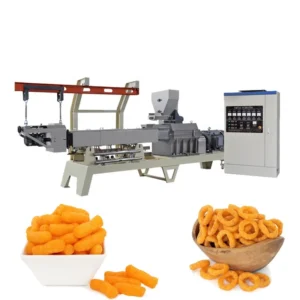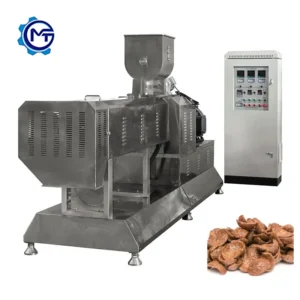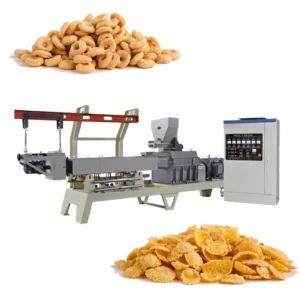
Screw Configuration Integrity — Every MT75 corn flakes production line extrusion technology build ships with a documented screw profile matched to the buyer’s grain blend and target flake density, verified in our testing workshop before dispatch.
Technical Specifications
| Parameter | Value |
|---|---|
| Model | MT75 |
| Product Type | Corn Flakes Production Line |
| Screw Type | Twin Screw |
| Installed Power | 210 kW |
| Power Consumption | 150 kW |
| Output Capacity | 300–500 kg/h (basis not stated in source — confirm raw material, moisture content, product density) |
| Flaking Machinery Capacity | 200–300 kg/h (basis not stated in source — confirm raw material and flake thickness) |
| Overall Dimensions | 45 × 1.5 × 3.5 m |
| Control System | PLC and MCC |
| Flaking Machinery Drive | Double motors for separate roller driving, hydraulic system |
| Flaking Machinery Temperature Control | Infrared sensor |
| Dryer Heating Source | Gas or Electric |
| Hot Air Roasting Oven | Vibrating pan, conciliation burner, dual circulating fans, cyclone dust removal |
| Coating System | Double tumble for sugar melting, elevator, coating drum, spraying nozzle |
| Extruder Features | Automatic lubricating, cooling function |
| Standards | CE, ISO |
Application Suitability
| Application | Material or Output |
|---|---|
| Natural corn flakes production | Corn grits and corn flour blends |
| Sugar-coated breakfast cereal | Corn flakes with sugar syrup glazing |
| Multi-grain flake production | Rice, wheat, oat, and barley powder blends |
| Shaped cereal snacks | Ball, tube, ring, star, fruit loop, and wheel formats via die changes |
| Fortified breakfast cereals | Grain blends with added vitamin and mineral premix |
What "300–500 kg/h" Actually Means for Corn Flakes
Capacity only holds when the grain moisture, screw profile, and barrel temperature curve match your specific formulation.
I have watched lines rated at impressive numbers fall short the moment a buyer switched corn suppliers. The new corn grits arrived at a different moisture level, gelatinisation shifted, and the flakes came out dense and gummy instead of crisp. The extruder was the same — only the raw material had changed. That is the gap between a nameplate rating and a working corn flakes production line extrusion technology setup [NEED_CITE: starch gelatinisation thresholds vary across corn varieties and moisture levels].
When we quote a throughput figure, we tie it to a specific grain blend, moisture percentage, and target flake density. If any of those variables move, the number moves with them. This is why we insist on running your actual raw material in our testing workshop before the extruder leaves the factory.
Barrel Temperature Profile and Starch Gelatinisation
Corn starch gelatinises within a narrow temperature window, and the barrel zones must hold that window precisely as the material moves from feed to die. The MT75 twin-screw extruder uses independent heating zones with automatic cooling to prevent overshoot. When the barrel profile is set correctly, the starch granules swell uniformly, producing a pellet that flakes evenly under the rollers and toasts to a consistent colour in the roasting oven.
Shear, Moisture, and the Density Question
The screw configuration determines how much mechanical shear the grain blend experiences before it exits the die. Higher shear with lower moisture produces a more expanded pellet that yields a lighter, crisper flake after roasting. Lower shear with higher moisture gives a denser pellet suited to thick-cut styles. The corn flakes production line extrusion technology approach on the MT75 lets us rebuild the screw stack — adjusting element pitch, kneading block count, and reverse-flight positions — to dial in the exact density your market expects [NEED_CITE: twin-screw element arrangement effects on pellet density in cereal extrusion].
How the Downstream Stations Close the Loop
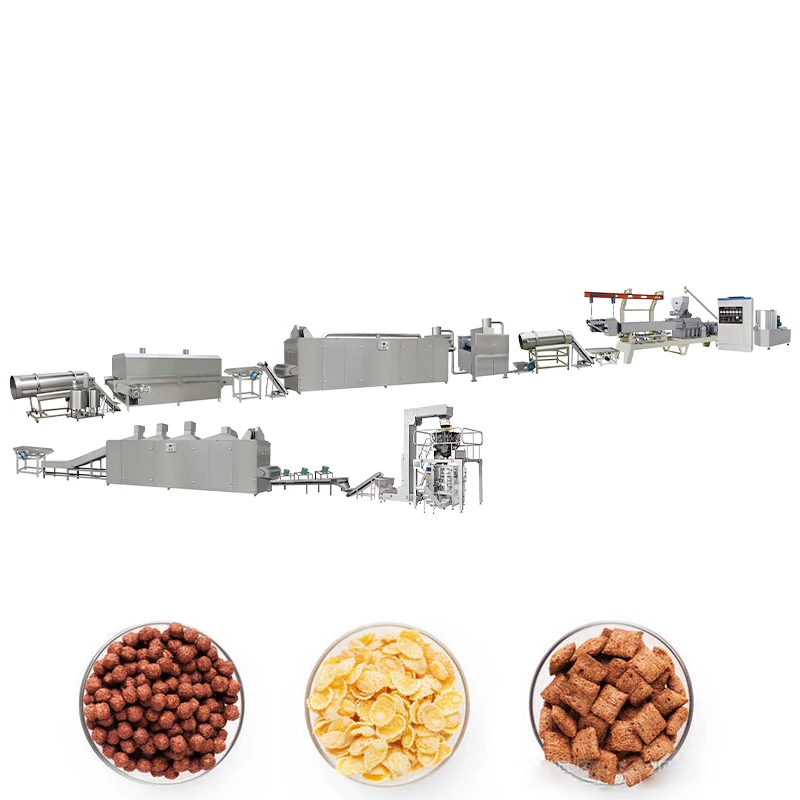
A flake’s final texture is decided as much by the roasting oven as by the extruder. The MT75 line uses a vibrating pan hot-air roasting oven with a conciliation burner and two separate circulating fans to move heated air evenly across the bed. The cyclone dust removal device pulls fines out of the airstream so they do not scorch and contaminate the batch. Upstream, the flaking machinery runs hydraulic double rollers with separate motor drives and infrared-sensor temperature control, keeping flake thickness uniform across the full roller width. When these stations are throughput-matched to the extruder, no single station bottlenecks the line or forces the extruder to idle.
Reading the Specs That Matter
The 210 kW installed power on the MT75 reflects the combined load of the extruder’s main drive, feeder, and cutter — not the entire line. Actual running consumption sits around 150 kW under typical load, which is the figure to use when sizing your transformer and dedicated circuit. The PLC and MCC control system manages barrel zone temperatures, screw speed, and feeder rate from a single panel, reducing the operator variables that cause batch-to-batch drift. The line footprint of 45 × 1.5 × 3.5 m accounts for the straight-through arrangement from mixing to packing; sugar-coating adds a tumble station, elevator, and secondary dryer that extend the layout.
The Hidden Cost of a Generic Screw Build
Order a line built on a default screw configuration and you may spend weeks after installation chasing the right texture. Flakes come off the roaster too hard, too soft, or with a raw centre because the gelatinisation was incomplete. Operators adjust barrel temperatures to compensate, burning energy and accelerating screw wear. The die may produce pellets that crack under the flaking rollers instead of compressing cleanly. Every one of these symptoms traces back to a screw stack that was never matched to the buyer’s grain blend [NEED_CITE: consequences of unconfigured screw profiles in food extrusion].
Why the Technical Details Hold Up Here
We specify the screw configuration and die design to the buyer’s raw material and target product before production starts — not after the machine is bolted to the floor. The in-house testing workshop runs your actual grain blend through the MT75, so gelatinisation, pellet density, and flake behaviour are confirmed before shipment. Line throughput is matched across every station — mixing, extruding, flaking, drying, roasting, coating, and packing — under one supplier, eliminating the mismatched-bottleneck problem that arises when stations come from separate vendors. The PLC and MCC control documentation includes voltage, frequency, and control language confirmed for your facility before the electrical panels are wired. Every build ships with a screw and die configuration record tied to your specific formulation, so reordering wear parts or scaling to a second line starts from a known baseline.
Documentation & Verification
- Line layout and capacity calculation based on your grain blend and target flake density
- Screw and die configuration record documenting element arrangement for your formulation
- Trial run report on your raw material from our in-house testing workshop before dispatch
- Electrical schematic with voltage and frequency confirmation for your facility
- CE declaration of conformity and ISO certificate included with every shipment
Installation, Commissioning & Support
- Foundation plan provided for the 45 m line length, including flaking machinery anchor points
- Dedicated 210 kW circuit specified; transformer sizing guidance included for 150 kW running load
- Extruder arrives with barrel pre-assembled; roller and roaster sections ship in modules for site bolting
- Barrel temperature profile and screw speed parameters loaded into the PLC at commissioning
- Operator training covers screw element inspection intervals and hydraulic roller gap adjustment
- Wear parts list with screw elements, die plates, and roller bearings identified for first reorder
Before You Send an Inquiry
We need your grain blend composition — corn variety, grit size, and moisture range — along with your target flake thickness and whether you want natural or sugar-coated output. Share your workshop floor dimensions and ceiling height so we can map the full station sequence including the sugar-coating loop. Confirm your local voltage and frequency, plus the control language your operators prefer, so the PLC panel is configured before the line enters production.
Frequently Asked Questions
Q: How is output capacity verified on the buyer’s actual grain blend and moisture content?
A: We run your raw material through the MT75 in our in-house testing workshop before shipment. The trial covers the target moisture level, screw speed, and barrel profile, and we document actual throughput and pellet density. The report ships with the line so you have a verified baseline for production ramp-up.
Q: How are screw configuration and die design matched to corn versus multi-grain formulations?
A: Each grain blend behaves differently during gelatinisation — corn, rice, wheat, and oat all have distinct starch profiles. We select kneading block count, element pitch, and die aperture based on your specific blend ratio, then validate the combination during the workshop trial to confirm pellet structure and flake behaviour.
Q: What barrel temperature profile produces the target flake density and crispness?
A: The profile is zone-by-zone, set to bring the starch through gelatinisation at the rate your formulation requires. Higher moisture blends need a gentler ramp to avoid surface hardening; lower moisture blends need more aggressive shear. We record the confirmed curve in your configuration file and load it into the PLC.
Q: How is throughput balanced across extrusion, flaking, drying, and roasting stations?
A: Each station is sized so its maximum handling rate exceeds the extruder’s verified output on your material. The flaking machinery runs at a matched rate with hydraulic roller gap control, and the roasting oven residence time is set to the flake thickness so no station forces the others to slow down.
Q: Is a trial run on customer raw material performed before shipment, and what does the report cover?
A: Yes. The trial uses your grain blend at your specified moisture level. The report documents screw speed, barrel temperatures, pellet dimensions, flake thickness after the rollers, and colour after roasting. It gives your production team a starting parameter set on day one of installation.