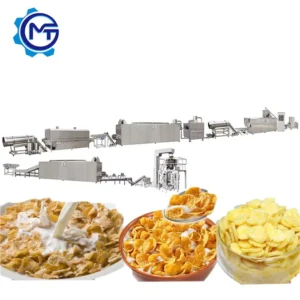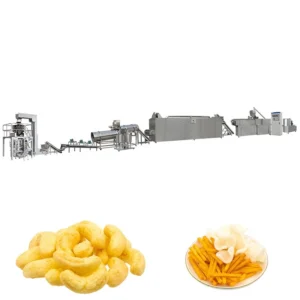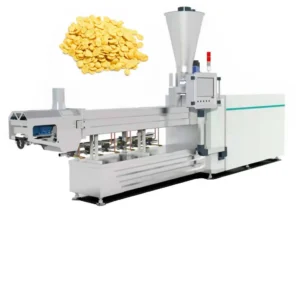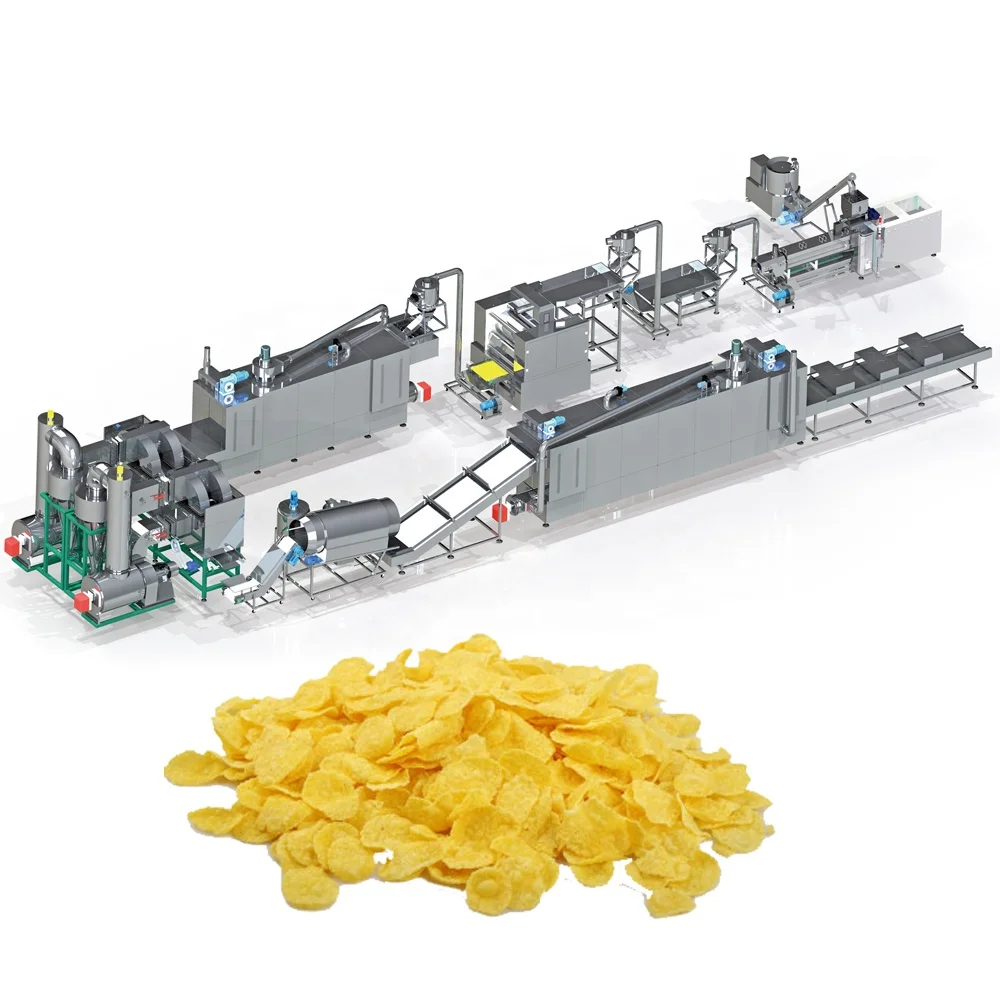
Screw Configuration Matched to Material — Every corn flakes extrusion technology production line we ship carries a configuration record based on the buyer’s actual corn variety and moisture profile, not a generic template.
Technical Specifications
| Parameter | Value |
|---|---|
| Model | MT70 / MT85 / MT75 |
| Product Type | Corn Flakes Breakfast Cereal Production Line |
| Screw Type | Twin-screw |
| Installed Power | MT70: 160 kW; MT85: 190 kW; MT75: 210 kW |
| Power Consumption | MT70: 120 kW; MT85: 140 kW; MT75: 150 kW |
| Output Capacity | MT70: 150–200 kg/h; MT85: 300–400 kg/h; MT75: 300–500 kg/h (basis to be confirmed with raw material and moisture) |
| Overall Dimensions | MT70: 41 × 1.5 × 2.2 m; MT85: 43 × 1.5 × 3.2 m; MT75: 45 × 1.5 × 3.5 m |
| Control System | PLC control; MCC available per project scope |
| Dryer Heating Source | Gas or Electric |
| Flaking Machine Capacity | 200–300 kg/h (basis to be confirmed with raw material and flake thickness) |
| Flaking Machine Features | Hydraulic double rollers; separate roller motors; infrared temperature sensing |
| Roasting Oven | Hot air circulation; conciliation burner; dual circulating fans; cyclone dust removal |
| Coating System | Double tumble sugar melting; elevator; coating drum; spray nozzle |
| Certification | CE, ISO |
Application Suitability
| Application | Material or Output |
|---|---|
| Natural corn flakes | Degerminated corn grits, milled to target particle size |
| Sugar-coated corn flakes | Corn grits base with sugar, malt, salt coating solution |
| Multigrain breakfast flakes | Blends of corn, wheat, rice, or oat grits adjusted for gelatinisation |
| Fortified cereal flakes | Corn grits blended with vitamin and mineral premix before extrusion |
Why Starch Gelatinisation Decides Your Flake Quality Before the Flaker Even Starts
If the barrel temperature profile and screw configuration miss the gelatinisation window, no amount of roasting will fix the final bowl-life.
A corn flakes extrusion technology production line lives or dies by what happens inside the barrel. When starch granules absorb moisture and shear at the right temperature, they swell and form a continuous matrix that holds the flake together during pressing and roasting. Miss that window and the flake either crumbles in the bowl or turns hard enough to break a tooth. I have seen lines where the operator kept raising moisture to compensate for poor screw geometry, only to end up with sticky dough that clogged the flaking rolls [NEED_CITE: starch gelatinisation temperature ranges for corn and wheat]. The problem was never the moisture — it was the shear profile.
Barrel Zones and the Gelatinisation Curve
Corn starch gelatinises between roughly 62 °C and 72 °C, but inside a twin-screw extruder the effective window shifts depending on moisture content, shear rate, and residence time. The barrel on the MT70, MT85, and MT75 is divided into independently heated and cooled zones. This lets the process engineer build a temperature ramp — lower in the feeding section to prevent premature swelling, rising through the compression and metering sections where the bulk of gelatinisation occurs, then dropping near the die to stabilise the dough before cutting. Getting this curve right is the core task when setting up a corn flakes extrusion technology production line for a new corn variety.
Shear, Moisture, and What the Screw Elements Actually Do
The screw elements — conveying, kneading, and reverse sections — determine how much mechanical energy goes into the dough. Kneading blocks generate shear that breaks cell walls and forces water into the starch granules. Too many kneading blocks and the dough overheats; too few and gelatinisation stays incomplete, leaving a gritty, undercooked core that the roaster cannot cure. Moisture injection or steam conditioning before the extruder sets the baseline, typically between 20% and 28% depending on the grits source [NEED_CITE: moisture conditioning parameters in cereal extrusion]. The screw configuration record documents which elements sit at which positions for each product target.
Reading the Specs Against Your Raw Material
Installed power across the three models ranges from 160 kW on the MT70 to 210 kW on the MT75, which translates to different torque ceilings and therefore different maximum dough viscosities the extruder can handle. Higher-protein or higher-fiber corn blends demand more torque because the dough resists shear more aggressively. The PLC control system monitors motor load in real time and adjusts screw speed to hold the target specific mechanical energy — a parameter that directly links power draw to gelatinisation completeness. When you compare models, match the power headroom to your worst-case raw material scenario, not your easiest recipe.
The Cost of a Copied Screw Layout
Buyers sometimes arrive with a screw configuration copied from a different supplier or a different product entirely. Running a corn flake recipe through a screw layout designed for a puffed snack means the residence time distribution is wrong — some material overcooks while other material passes through under-processed. The result shows up downstream: uneven flake thickness after the hydraulic double-roller flaker, inconsistent blistering in the roasting oven, and a final product that varies bag to bag [NEED_CITE: impact of screw configuration on cereal flake density uniformity]. Reconfiguring the screw after installation costs production days and raw material waste that a pre-shipment trial run would have avoided entirely.
Why This Line Is Built Around Your Material, Not a Catalog Number
Every corn flakes extrusion technology production line we configure starts with the buyer sending raw material to our testing workshop. We run the actual corn grits — or corn-wheat blend, or fortified mix — through the extruder, measure the expansion, press the cooked dough through the flaker, and roast sample flakes to check blister formation and bowl-life. The screw configuration, die geometry, and barrel profile that produce the right result are recorded and locked into the build specification. Line throughput is calculated station by station so the flaker capacity matches extruder output and the roasting oven dwell time matches the conveyor speed. Electrical schematics are drawn to the voltage and frequency of the installation site before production starts.
Documentation & Verification
- Screw and die configuration record tied to your corn variety and target flake density
- Trial run report on your raw material showing expansion, flake thickness, and blister results
- Line capacity calculation matching extruder, flaker, dryer, and roaster throughput
- Electrical schematic with voltage, frequency, and control language confirmed for your site
- CE declaration of conformity and ISO certificate included in shipment documentation
Installation, Commissioning & Support
- Foundation layout drawn to the 41–45 m line footprint and station-specific load points
- Dedicated circuit sized to the 120–150 kW operating draw of your selected model
- Extruder, flaker, and roaster shipped in modular sections for site assembly sequence
- PLC parameter set loaded with your trial-run screw speed and barrel zone temperatures
- Operator training covers screw element changes, flaker gap adjustment, and roaster airflow tuning
- Wear parts list identifies screw sections, die plates, and flaker roller surfaces with replacement intervals
What We Need From You to Start Configuration
Before we can map a corn flakes extrusion technology production line to your facility, we need your corn grits specification — variety, particle size distribution, protein and fiber content, and incoming moisture. Tell us the target flake thickness, whether you plan natural and sugar-coated variants, and the daily output you are designing for. Include your site voltage and frequency so the electrical design matches the local grid, and confirm the PLC display language your operators need.
Frequently Asked Questions
Q: How is screw configuration and die design matched to different corn varieties?
A: We run your specific corn grits in our testing workshop, measure expansion and dough rheology, then adjust kneading block placement and die orifice size to hit the target gelatinisation and flake density. The final configuration is documented in a record that travels with your line.
Q: What barrel temperature profile is used for corn flakes gelatinisation?
A: A typical ramp starts below gelatinisation temperature in the feed zone, rises through the compression and metering zones where starch swelling peaks, and drops near the die to stabilise dough temperature before cutting. Exact setpoints depend on your corn moisture and variety.
Q: How is flake density controlled through extrusion, flaking, and roasting?
A: Extrusion sets the cooked dough structure and moisture level. The hydraulic flaker presses it to target thickness with infrared-monitored roller temperature. The roasting oven then drives surface blistering and final moisture reduction to lock in crispness and bowl-life.
Q: Can the line produce both natural and sugar-coated corn flakes?
A: Yes. The coating station with double tumble sugar melting and spray nozzle is a modular add-on. Switching between natural and coated variants requires only activating or bypassing the coating drum without reconfiguring the extruder or flaker.
Q: What moisture range is needed at extrusion for corn flakes?
A: Conditioning moisture typically falls in a mid-range band depending on the corn variety and protein content. We confirm the exact injection rate during the trial run and record it in the process specification so your operators have a validated starting point at commissioning.