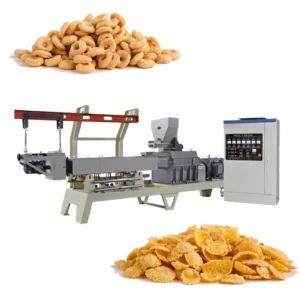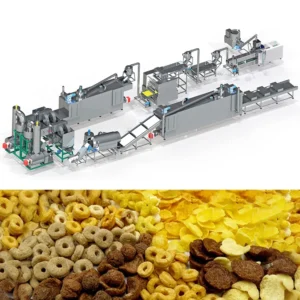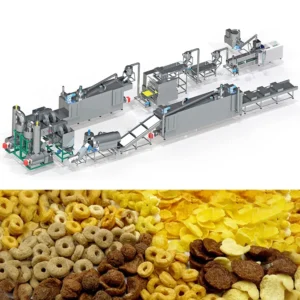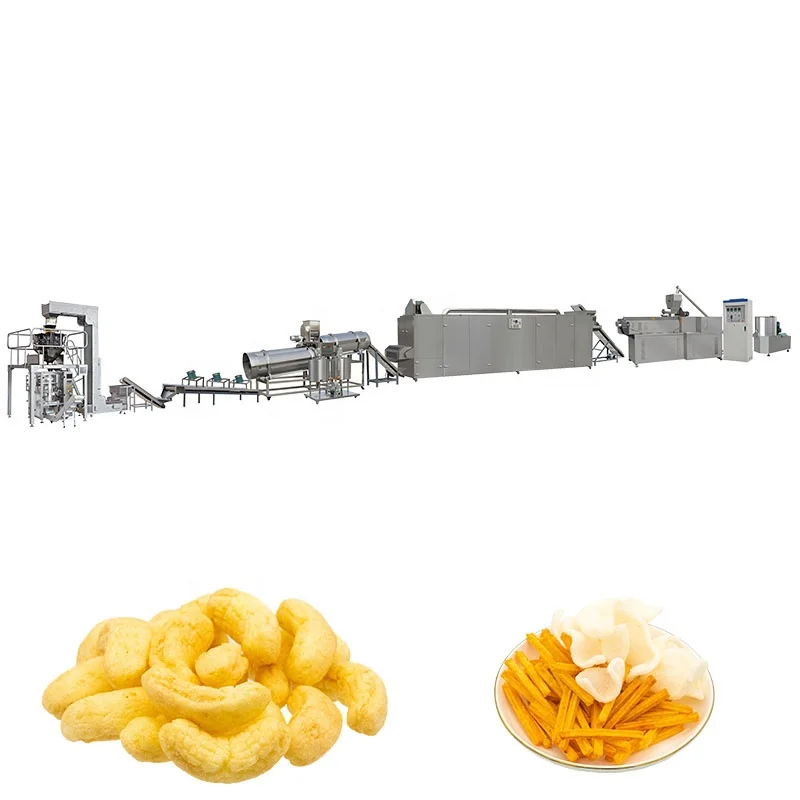
Screw and die matched to formulation — Every MT-75 barrel profile and die opening is configured against the buyer’s actual grain blend, not copied from a catalog default.
Technical Specifications
| Parameter | Value |
|---|---|
| Model | MT-75 Twin Screw Extruder |
| Product Type | Corn Flakes Production Line (Twin Screw Extrusion System) |
| Screw Type | Twin Screw |
| Output Capacity | 200–300 kg/hr (basis not stated in source — confirm raw material type, moisture content and specific formulation) |
| Rated Power | 3 kW (rated or peak not specified — verify against full line power requirement) |
| Voltage & Frequency | 220V / 380V (frequency to be confirmed per destination market) |
| Control System | PLC control system (flaking machinery); line-level control available with PLC or MCC options |
| Line Stations | Mixing → Extruding → Flaking → Drying → Hot Air Roasting → Cooling → Packing |
| Optional Coating Circuit | Sugar Spraying → Sugar Coating → Secondary Drying → Cooling → Packing |
| Flaking System | Hydraulic double-roller, dual independent motors, infrared sensor temperature control |
| Dryer Heating Source | Gas or Electric |
| Hot Air Roasting Oven | Vibrating pan, high-temperature spraying tubes, conciliation burner, dual circulating fans, cyclone dust removal |
| Coating System | Double tumble melter, elevator, coating drum, spraying nozzle array |
| Certification | CE (since 2014), ISO certified |
| Warranty | 1 Year (core component: gearbox) |
| Machinery Test Report | Provided |
| Video Outgoing-Inspection | Provided |
Application Suitability
| Application | Material or Output |
|---|---|
| Traditional corn flakes | Degerminated corn grits, whole corn meal |
| Multi-grain breakfast flakes | Wheat, rice, oat, barley blends |
| Sugar-coated cereal flakes | Base flake with sucrose or glucose syrup coating |
| Fortified breakfast cereals | Grain base with added vitamin and mineral premix |
| Puffed snack variants | Adjusted die and screw configuration for expanded shapes |
What Generic Screw Configurations Cost Corn Flake Producers
A screw layout designed for one grain blend will fail on another.
I spent years on assembly floors watching twin-screw extruders ship out with die sets that were simply carried over from the last order. When a Southeast Asian buyer ran local corn meal with lower starch content through a generic build, the flakes came out dense, blistering was uneven, and the roasting oven could not compensate. The entire downstream rhythm collapsed — the flaking rollers pressed inconsistent sheets, moisture varied across the belt dryer, and bowl-life crispness never met the buyer’s market expectation. That mismatch between screw geometry and raw material is where most corn flakes extrusion line specifications fall apart before production even begins [NEED_CITE: twin screw extrusion parameter matching for cereal grains].
How Barrel Zones and Shear Define Flake Density
The MT-75 twin screw extruder divides its barrel into discrete temperature zones, each governing a stage of starch gelatinisation. Moisture content entering the feed zone and shear intensity through the compression zone together determine how completely the starch matrix develops. For corn grits, the residence time and shear must produce a dough that will flatten into a coherent sheet at the flaking rollers — too little gelatinisation and the sheet crumbles, too much and it becomes sticky and difficult to dry. Selecting the right corn flakes extrusion line specifications screw configuration means adjusting pitch, flight depth and kneading block arrangement to the exact grain blend the buyer intends to run.
Flaking Precision and Roasting Uniformity Under One Line
The hydraulic double-roller flaking station uses separate motors for each roller, allowing independent speed control and gap adjustment. An infrared sensor monitors roller surface temperature continuously, which matters because even a few degrees of drift changes how the extrudate compresses into sheet form. Downstream, the hot air roasting oven relies on a conciliation burner combustion chamber with two circulating fans and a cyclone dust removal device. The vibrating pan keeps flakes moving through the high-temperature zone so that surface blistering develops evenly across the full batch rather than only at the center of the belt [NEED_CITE: cereal flake roasting oven air circulation design].
Reading the Numbers That Actually Matter
The twin screw design gives the MT-75 a wider processing window than single-screw extruders of comparable frame size, because counter-rotating elements create a positive conveying action that handles varying moisture levels without surging. The hydraulic flaking station with dual independent motors directly addresses flake thickness consistency — a parameter that single-motor flakers struggle to hold when production speed changes. Voltage configurability between 220V and 380V must be locked in before manufacturing, because rewiring a PLC cabinet and motor drives after arrival delays commissioning by weeks. The PLC control system governing the flaking machinery can integrate with line-level MCC or PLC architectures depending on the buyer’s existing factory automation standard.
When a Copied Configuration Fails on Your Grain
Buyers who skip the material-specific configuration step discover problems only after the line is bolted to their floor. Extrudate that does not gelatinise uniformly produces flakes with internal voids that shatter during roasting rather than developing the expected surface blister. If the die opening was sized for a different grain, the sheet entering the flaking rollers will be the wrong thickness, forcing operators to over-compress and create flakes that are too dense for the target market. The roasting oven then runs longer cycles trying to drive out residual moisture, which in turn bottlenecks the cooling conveyor and packing station [NEED_CITE: corn flake blister formation and moisture control].
Why This Line Is Built Around Your Material
Screw configuration and die design are specified against the buyer’s grain formulation, not pulled from a generic template library. An in-house testing workshop runs the buyer’s actual raw material before the extruder ships, generating a trial run report that documents barrel temperatures, screw speed, moisture targets and flake thickness. The complete line — from batching through extrusion, flaking, drying, roasting and packing — is engineered under one supplier so that throughput at every station is matched rather than assembled from independent vendors. Food-grade contact materials are used at every product-contact surface throughout the extrusion, flaking and roasting sections. Pre-sales consultation, on-site installation, commissioning and ongoing maintenance support are delivered by the same engineering team that configured the screw profile.
Documentation & Verification
- Screw and die configuration record matched to your grain blend and target flake density
- Trial run report on your raw material documenting barrel zones and moisture parameters
- Electrical schematic with confirmed voltage, frequency and PLC language for your market
- Line layout drawing showing throughput balance across extruder, flaker, dryer and roaster
- CE declaration of conformity and ISO certificate for customs and regulatory clearance
- Operation and maintenance manual with wear parts list and replacement intervals
Installation, Commissioning & Support
- Foundation plan accounts for the MT-75 extruder footprint and hydraulic flaking station load points
- Dedicated power circuit sized to confirmed voltage and total line amperage draw
- Modular line stations shipped in sequence for phased assembly on your factory floor
- First-run parameter tuning covers barrel temperatures, screw speed and roller gap settings
- Operator training addresses PLC interface navigation and daily start-up and shutdown sequences
- Wear parts list covers screws, dies and flaking roller surfaces with recommended stock levels
What to Include in Your Inquiry
Share the specific grain type or blend you plan to extrude, along with typical moisture content and any vitamin or mineral premix additions. Confirm your target daily output so the line capacity can be calculated across every station rather than only the extruder. Provide your local voltage, frequency and preferred PLC control language to avoid delays during commissioning.
Frequently Asked Questions
Q: How is screw configuration selected for different grain blends?
A: Each grain — corn, wheat, oat or multi-grain — has distinct starch behaviour under heat and shear. The screw pitch, kneading block arrangement and die opening are specified after reviewing your formulation. A trial run on your raw material in the testing workshop validates barrel temperatures and moisture targets before the machine ships.
Q: How is output capacity verified on my actual raw material?
A: Nominal capacity figures assume a reference formulation. Your grain blend and moisture content are processed during an in-house trial run, and the measured throughput is documented in a report that accompanies shipment. This ensures the extruder, flaking station and roasting oven are all balanced to your real output.
Q: What voltage and control language options are confirmed before production?
A: Voltage and frequency are confirmed during the specification stage to match your destination market. The PLC control system language is set before factory testing. Electrical schematics reflecting these choices are included in the documentation package so your local electricians can proceed without guesswork.
Q: How is flake thickness and blister uniformity controlled?
A: The hydraulic flaking station uses dual independent motors and an infrared sensor to hold roller gap and surface temperature within tight limits. Downstream, the roasting oven’s dual circulating fans and vibrating pan ensure every flake receives even heat exposure, producing consistent surface blistering across the full batch.
Q: Can a trial run be performed before shipment?
A: Yes. The in-house testing workshop processes your raw material through the configured extruder and flaking station. The trial report records screw speed, barrel zone temperatures, moisture readings and flake thickness measurements, giving you a verified starting point the moment the line is installed.