Screw Geometry Matched to Grain — We configure screw elements and die profiles specifically for your corn, rice, or oat formulation rather than shipping a generic build, verified through in-house trial runs before dispatch.
Technical Specifications
| Parameter | Value |
|---|---|
| Product Type | Corn Flakes Breakfast Cereal Production Line |
| Models Available | MT70, MT85, MT75 |
| Extruder Type | Twin Screw |
| MT70 Installed Power | 160 kW |
| MT70 Power Consumption | 120 kW |
| MT70 Output Capacity | 150–200 kg/hr (basis not stated in source — confirm raw material / moisture content) |
| MT70 Overall Dimensions | 41 × 1.5 × 2.2 m |
| MT85 Installed Power | 190 kW |
| MT85 Power Consumption | 140 kW |
| MT85 Output Capacity | 300–400 kg/hr (basis not stated in source — confirm raw material / moisture content) |
| MT85 Overall Dimensions | 43 × 1.5 × 3.2 m |
| MT75 Installed Power | 210 kW |
| MT75 Power Consumption | 150 kW |
| MT75 Output Capacity | 300–500 kg/hr (basis not stated in source — confirm raw material / moisture content) |
| MT75 Overall Dimensions | 45 × 1.5 × 3.5 m |
| Control System | PLC with MCC across line |
| Flaking Drive | Double motors with hydraulic system for separate roller driving |
| Flaking Temperature Control | Infrared sensor for even temperature pipe control |
| Dryer Heating Source | Gas or Electric (configurable) |
| Roasting Oven | Hot air with vibrating pan, dual circulating fans, cyclone dust removal |
| Coating System | Double tumble sugar melting, elevator, coating drum, spraying nozzle |
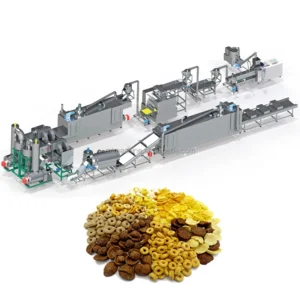
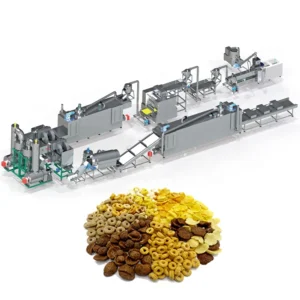
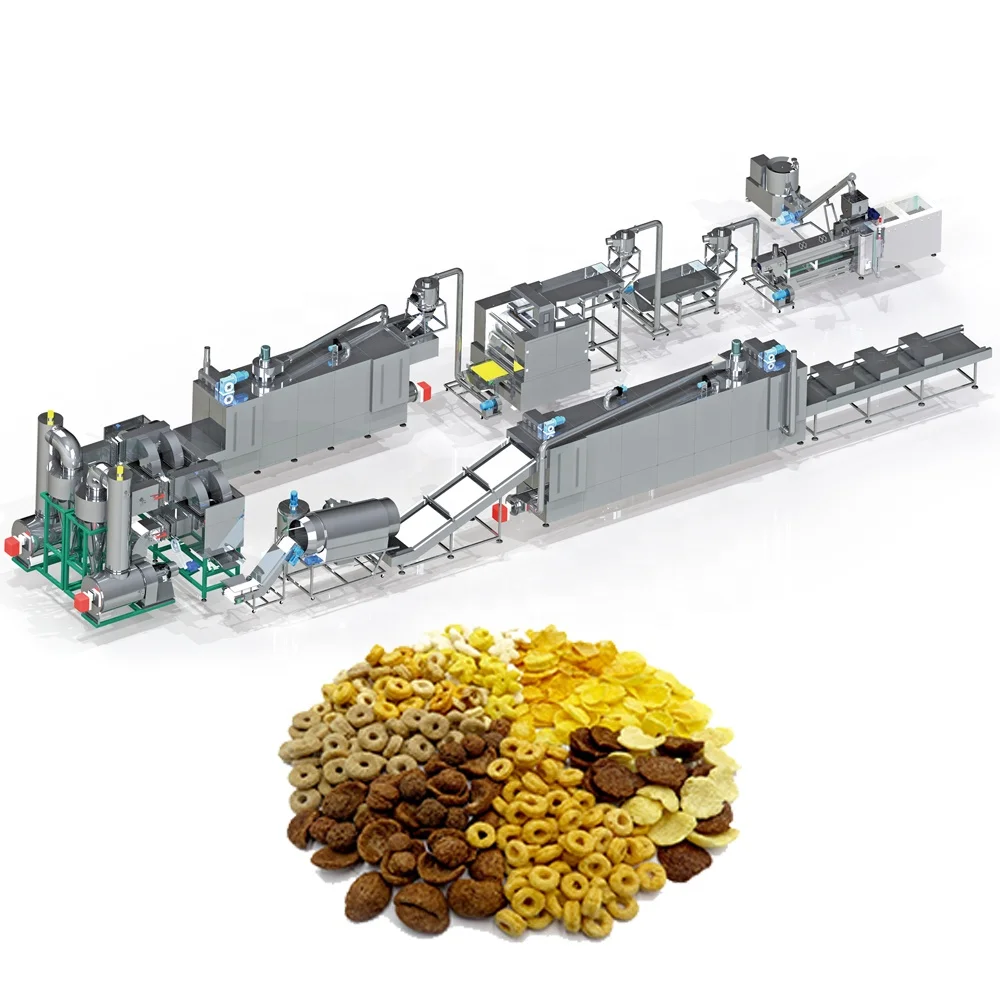
| Line Stations (Natural) | Mixing → Extruding → Flaking → Drying → Hot Air Roasting → Cooling → Packing |
| Line Stations (Sugar-Coated) | Mixing → Extruding → Flaking → Drying → Roasting → Sugar Spraying → Coating → Drying → Cooling → Packing |
| Certifications | CE, ISO |
Application Suitability
| Application | Material or Output |
|---|---|
| Natural corn flakes production | Corn grits and corn flour blends |
| Sugar-coated breakfast cereal | Corn, rice, or multi-grain base with sugar glaze |
| Multi-grain cereal flakes | Wheat, oat, and barley powder formulations |
| Shaped cereal pieces | Ball, tube, ring, fruit loop, star, wheel, flower, heart via die change |
| Fortified breakfast cereal | Grain base with added vitamin and mineral premix |
What "Rated Capacity" Leaves Out About Corn Flake Extrusion
A capacity figure means nothing unless it is tied to your exact grain formulation, moisture level, and target flake density.
I have watched lines run perfectly on one corn grits specification and then choke when the buyer switched to a coarser grind from a local mill. The starch gelatinisation window shifted, the dough lost its elasticity at the die face, and what came off the flaking rollers looked more like broken tile than breakfast cereal. A corn flakes extrusion production line rated for a certain throughput on standard corn flour may deliver considerably less when processing whole-grain oat or barley blends with different fibre and fat content. [NEED_CITE: starch gelatinisation temperature ranges across grain types]
How Screw Configuration Controls Flake Density and Bowl Life
The twin-screw configuration on the MT70, MT85, and MT75 is not a fixed build. Screw elements are selected and sequenced to generate the right balance of shear, residence time, and pressure for your specific grain blend. High-shear kneading blocks drive gelatinisation in high-starch corn formulations, while gentler conveying elements prevent over-working dough that contains bran-rich whole wheat or oat. The die design then governs the expansion ratio as the extrudate exits the barrel — a factor that directly determines whether the final flake holds crispness in milk or turns to mush within seconds.
Barrel Temperature Profiling Across the Cooking Zones
Each barrel section on the corn flakes extrusion production line operates under independent temperature control, creating a gradient that moves the dough from initial hydration through full gelatinisation and into the pressure zone ahead of the die. Moisture injection points are positioned to match the absorption characteristics of the raw material. Running corn grits at one moisture level and then switching to a rice-heavy blend without adjusting the profile produces inconsistent cooking — some particles exit under-processed while others degrade into fines that cannot survive the flaking stage. [NEED_CITE: barrel temperature profiling best practices in food extrusion]
Reading the Spec Sheet for What It Actually Means
The installed power figures across the three models — 160 kW on the MT70, 190 kW on the MT85, 210 kW on the MT75 — reflect the thermal and mechanical energy available to cook and convey the dough through the barrel. Higher installed power supports greater throughput and the additional shear needed for denser whole-grain formulations. The hydraulic flaking rollers, driven by separate double motors, allow independent pressure adjustment on each roller to control flake thickness uniformly. Infrared temperature monitoring on the flaking unit ensures the extrudate arrives at the rollers within the correct plasticity range. The hot air roasting oven uses dual circulating fans and a cyclone dust removal device to achieve even surface blistering without scorching, which is critical for developing the final crispness and colour the market expects.
The Cost of Ignoring Extrusion Parameters Before Shipment
Buyers who skip material-specific screw configuration and accept a generic build often discover the problem only after installation. Flakes come out too dense and sink in the bowl, or too fragile and shatter during conveying and packing. Adjusting on-site means trial-and-error with screw element swaps, die changes, and barrel temperature rewrites — burning raw material, delaying commercial production, and frustrating operators who have no baseline to work from. [NEED_CITE: common causes of extrusion line startup delays]
Why Sourcing the Full Line From One Extrusion Supplier Matters
Screw geometry and die design are specified against your grain formulation, not copied from a standard template. The in-house testing workshop runs your actual raw material before shipment, generating a documented trial report that confirms expansion behaviour and flake texture. Throughput is balanced across every station — extruder output is matched to flaking roller capacity, dryer residence time, and roasting oven throughput so no single point bottlenecks the corn flakes extrusion production line. Barrel temperature profiles and moisture settings are recorded per formulation, giving your operators a verified starting point at commissioning. PLC and MCC control systems are configured to your local voltage, frequency, and preferred operating language before the line leaves the factory.
Documentation & Verification
- Screw and die configuration record matched to your grain formulation
- Trial run report on your raw material confirming expansion and flake texture
- Line layout and capacity calculation showing throughput balance across stations
- Electrical schematic with voltage and frequency confirmation for your market
- Factory test record documenting run parameters before dispatch
- CE declaration of conformity and ISO certificate
Installation, Commissioning & Support
- Foundation plan accounts for line lengths up to 45 m depending on model selected
- Dedicated power circuit sized to installed power ranging from 160 kW to 210 kW
- Modular station layout allows phased installation within your factory footprint
- Commissioning includes barrel profile calibration on your grain formulation
- Operator training covers screw element swaps and die changes for product variety
- Wear parts list covers screws, dies, and roller surfaces with replacement intervals
What We Need to Size Your Line Correctly
To configure the right corn flakes extrusion production line, share your primary grain materials and their particle size distribution, target flake density and bowl-life requirement, daily production volume, factory floor dimensions, and local voltage and frequency. If you are planning sugar-coated or multi-grain variants, let us know those formulations as well so the coating and drying stages are sized accordingly.
Frequently Asked Questions
Q: How is screw configuration selected for different grain raw materials and target flake densities?
A: Screw elements are chosen based on your grain type, starch content, and fibre level. High-starch corn requires more kneading blocks for full gelatinisation, while whole-grain blends need gentler conveying to prevent dough degradation. Die aperture and land length are then matched to achieve the expansion ratio that produces your target flake density and bowl life.
Q: What barrel temperature profile and moisture range produce consistent starch gelatinisation?
A: The profile is set zone by zone along the barrel, moving from hydration through cooking to the pressure zone before the die. Moisture injection points are positioned to match your grain’s absorption rate. The exact temperatures and moisture levels are established during the trial run on your raw material and documented for your operators.
Q: How is output capacity verified against the buyer’s actual raw material and formulation?
A: We conduct a trial run using your grain formulation in our testing workshop before shipment. The run measures actual throughput, expansion behaviour, and flake texture under production conditions. Results are documented in a trial report that accompanies the line, replacing guesswork with verified data.
Q: What is the role of die design in controlling expansion ratio and final flake thickness?
A: Die aperture size and land length determine how much the extrudate expands as it exits the barrel. Greater expansion produces a lighter, more fragile piece, while restricted expansion yields a denser flake. The die is selected alongside screw configuration to hit the exact thickness and density your market requires after flaking and roasting.
Q: Can a trial run on customer raw material be conducted before shipment?
A: Yes. Our in-house testing workshop runs your actual raw material through the configured extruder and flaking setup. The trial verifies extrusion behaviour, expansion ratio, and flake texture before the line is approved for dispatch, so product development starts from a proven baseline rather than from scratch on your factory floor.